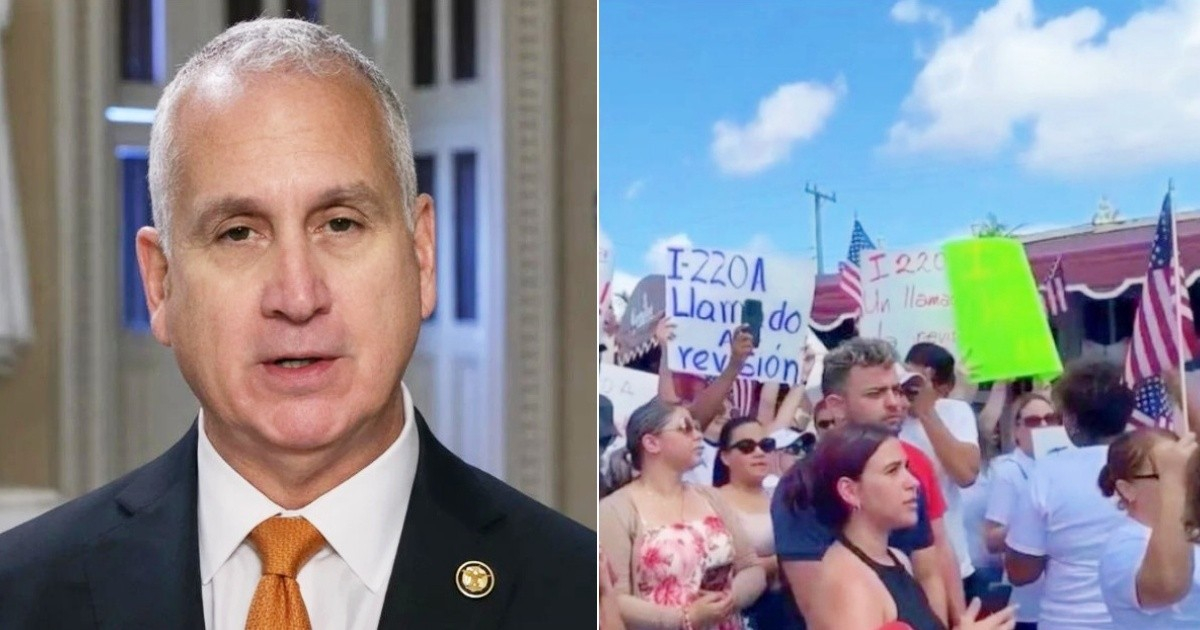
Republican Congressman Mario Díaz-Balart has reiterated his dedication to finding a legal resolution for Cubans with the I-220A form and has called for the reinstatement of Temporary Protected Status (TPS) for Venezuelans, Haitians, and other nationalities.
Representing Florida's 26th District, Díaz-Balart was candid about the plight of nearly half a million Cubans who hold this document without a defined immigration status during an interview on Telemundo 51's "Encuentro Virtual," hosted by journalist Gloria Ordaz.
"We continue our efforts to ensure that Venezuelans, Cubans, and Nicaraguans in this legal limbo can remain here," he stated.
His stance against deportations was equally clear: "I oppose and advocate against deporting Cubans back to Cuba, or returning them to their country."
This position extends to other nationalities as well.
"I have consistently supported TPS. I continue to advocate for TPS for Venezuelans, Haitians, and others. I do not believe it is reasonable to deport people to Cuba, Venezuela, Haiti, or Nicaragua. Given the situations in those countries, individuals should not be returned there," he argued.
The I-220A is a release order under supervision issued by ICE, allowing individuals to stay out of custody while their immigration case is pending, but it does not equate to parole, which would activate the Cuban Adjustment Act of 1966.
This distinction is at the heart of the lawsuit Bello-Rubio vs. the Department of Homeland Security, filed by 992 Cubans, whose hearing was postponed to September 2 before Judge Jacqueline Becerra in Miami.
Díaz-Balart acknowledged that the only path forward involves direct dialogue with the White House.
"We continue fighting and working towards that, and the only way is by collaborating with the president, not by shouting or making a scene, but by working with this administration," he concluded.
On the political future of the island, the congressman expressed a strong conviction that the Trump administration will not allow the regime to remain in power by the end of the presidential term.
"As long as his hands are not tied, I am convinced he will not leave the White House with the regime in Havana still in control," he declared, citing Trump's own words that, once the situation with Iran is resolved, Cuba will be the next focus.
Regarding the possibility of a Castro family member leading a transition process, Díaz-Balart recalled the three conditions set by U.S. law for lifting sanctions:
- Release of all political prisoners.
- Legalization of free press and political parties.
- Holding free and multi-party elections.
"Is this regime capable of doing that? I don't think they are, but if there are free elections under those conditions, it means they're no longer there," he pointed out.
He also dismissed the idea that Cuba's future leadership should be sought among the regime's ranks:
"Cuban political prisons are full of heroes ready to be Cuba's next leaders. What is needed is for the Cuban people to have elections. I am convinced that this will finally happen soon."
Turning to Venezuela, Díaz-Balart openly endorsed María Corina Machado as the country's future elected president.
"I am convinced that when free elections take place in Venezuela, I know who will be the next elected president. I believe it will be María Corina Machado," he affirmed, describing her as one of the most impressive leaders he has ever met.
"For Venezuela, for the hemisphere, and for the relationship with the United States, there's no one better than María Corina Machado. But for that, there must be elections, and we are moving towards that process," he assured.
The congressman credited Trump for making this prospect possible: "The only reason there is a possibility of free elections and this transition is precisely because of what President Trump has done."
Key Points on U.S. Immigration Policies and Cuban Politics
What is the I-220A form?
The I-220A is a release order under supervision issued by ICE, allowing individuals to stay out of custody while their immigration case is pending. It does not provide the same status as parole under the Cuban Adjustment Act.
What are the conditions for lifting U.S. sanctions on Cuba?
The U.S. requires the release of all political prisoners, the legalization of free press and political parties, and the holding of free and multi-party elections to lift sanctions on Cuba.