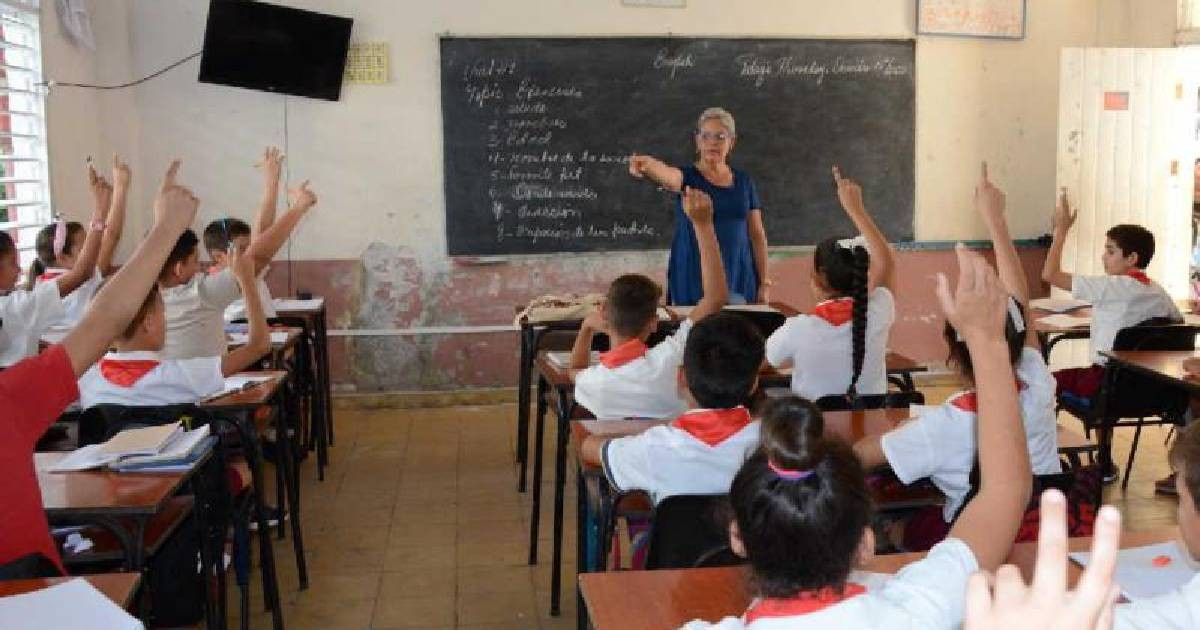
As the 2026-2027 school year is set to begin on September 1st, an increasing number of Cuban mothers have taken to social media to declare they won't send their children to school unless the government ensures basic necessities like electricity, potable water, lunch, and adequate rest facilities.
Roxana San Gil expressed her frustration in the Facebook group "Strong Cuban Mothers 2," stating, "I'm eager to see the new 'SCHOOL YEAR' starting without electricity, food, water, or even the means to provide snacks, lunch, or anything for these kids. As of today, I am firmly standing my ground. If there's no quality education for my children, THEY WON'T GO TO SCHOOL (...), I can't afford to buy them anything, not even their school supplies. THEY WON'T GO, PERIOD."
Her post resonated with other mothers who echoed similar sentiments. One mother commented, "I'd rather pay for a private tutor to come to my house than send them to a school where they lack proper sleep, are hungry, without water, with filthy bathrooms full of bacteria." Another mother from Pinar del Río added, "Mine won't go either, and if we all take a stand, something has to change."
Voices of Dissent Among Cuban Mothers
The grievances are directed at the regime's failure to address these issues: "How can a child learn at school if they haven't had enough sleep?" questioned another mother.
One voice was particularly resolute: "If we all take a stand, something will happen; only mothers have the power to bring about change."
However, the debate isn't one-sided. A woman from Havana pointed out the internal disparities of the movement: "This is something that can only be done by a mother who doesn't rely on her salary, because those who have to work can't afford such a luxury."
Meanwhile, a mother from Matanzas argued that many working mothers have no choice but to send their children to school. "They're desperate to drop their kids off at school because they're overwhelmed," she wrote.
Despite the dire conditions, another perspective suggests that school is still preferable to leaving children at home or on the streets without electricity.
"Are they better off wandering the streets from dawn, or at home, facing the same issues as at school—no sleep, poorly fed, no electricity, no TV, confined, hungry every five minutes, anxious, and surrounded by problems? Or at school? They're safe, with their friends, away from so many troubles. At least they're learning something, however imperfectly," she questioned.
One final opinion held that keeping children at home would ultimately harm them. "They stay home, miss content, and then fail the year; it’s the child who suffers. With what little there is, we have to send them, there’s no other choice."
Challenges in Cuba's Education System
The debate underscores the desperation of families facing power outages lasting over 20 hours, deteriorating schools, and a food crisis documented by the World Food Program (WFP), which revealed that 48.5% of Cuban children aged six to 11 receive no food or snacks at school.
The education system is also grappling with a shortage of at least 24,000 teachers, equivalent to 12.5% of the required positions, with provinces like Camagüey and Matanzas having more than 2,000 vacancies each.
The contrast with the official narrative is stark. Education Minister Naima Ariatne Trujillo Barreto recently claimed that "September will once again be a celebration," a statement that sparked outrage among Cubans facing a vastly different reality.
This upcoming school year follows the premature closure of the 2025-2026 cycle, which was suspended between June 15 and June 30 due to the energy crisis and a complete lack of fuel, as acknowledged by Minister Trujillo herself.
Common Concerns About Cuban Schools
Why are Cuban mothers refusing to send their children to school?
Cuban mothers are refusing to send their children to school due to the lack of basic necessities such as electricity, potable water, food, and proper rest facilities, which they believe are essential for a conducive learning environment.
What are the current challenges facing Cuba's education system?
The education system in Cuba faces significant challenges, including a shortage of at least 24,000 teachers, deteriorating school infrastructure, and a food crisis that leaves many children without meals at school.
How have power outages affected Cuban schools?
Power outages, some lasting over 20 hours, severely impact Cuban schools by disrupting daily operations, making it difficult for children to learn and for schools to function effectively.