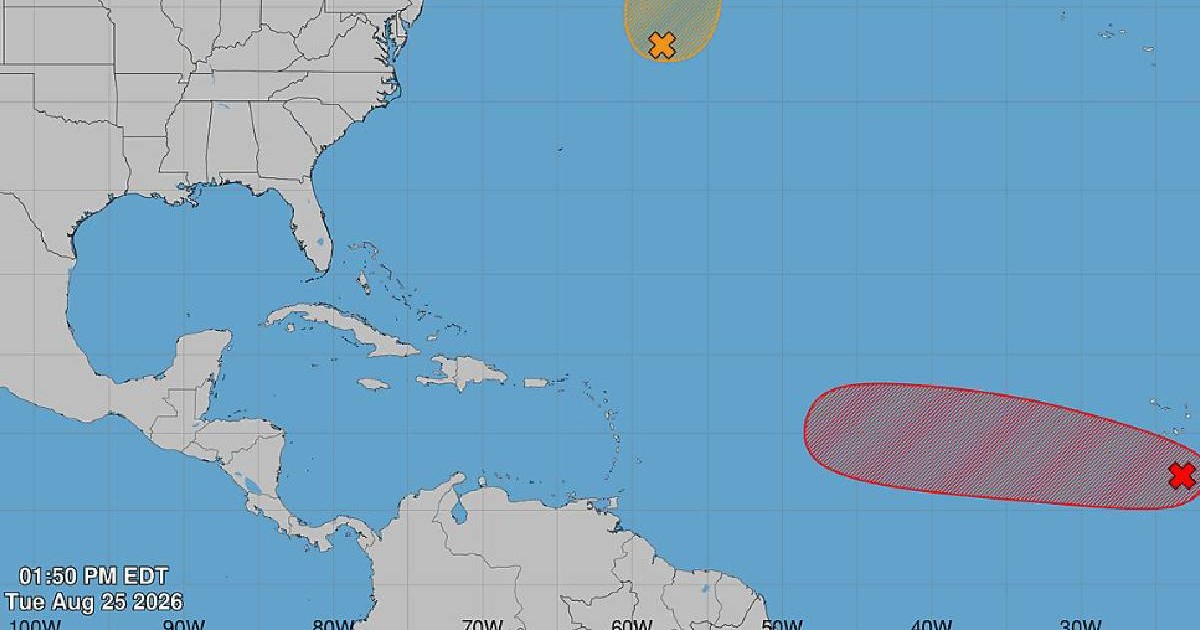
The National Hurricane Center (NHC) in the United States increased the likelihood on Tuesday for a low-pressure system in the eastern tropical Atlantic to evolve into a tropical cyclone, estimating a 70% chance within the next two days.
Should this system attain the status of a named tropical storm, it would be called Dolly, marking the fourth name on the official Atlantic list for 2026.
Designated as AL96, the system is positioned several hundred miles south-southeast of the Cabo Verde Islands, with a central pressure of 1,008 mb and maximum winds near 25 knots.
Current Movement and Weather Conditions
The NHC's weather bulletin indicates that the system is moving west and west-northwest across the open tropical Atlantic, producing scattered showers and thunderstorms with waves reaching up to seven feet nearby.
The center rated the probability of development as "high" over both the next 48 hours and seven days, maintaining a 70% chance, and noted that "environmental conditions appear favorable for gradual development."
Monitoring Additional Systems
Nevertheless, the agency cautioned that those conditions "could become less conducive towards the weekend."
The NHC is also keeping an eye on another system, AL95, a subtropical low-pressure area located hundreds of miles northeast of Bermuda, moving north-northeast. This system has broad and disorganized circulation, with only a 40% chance of development, deemed "medium" by the NHC.
The agency suggested it might briefly become a tropical depression or storm before encountering increasingly hostile conditions by early Wednesday, likely diminishing its chances for development. AL95 poses no threat to Cuba or the Caribbean.
Historical Context and Current Season
As of this Tuesday, the 2026 Atlantic season has seen only three named storms: Arthur in June, and Bertha and Cristóbal, both in mid-August. Cristóbal was the latest, with the Cuban Institute of Meteorology (INSMET) issuing Tropical Cyclone Advisory No. 1 on August 13, although the system dissipated within 48 hours without endangering the island.
No official trajectory from the NHC currently targets Cuba, the Caribbean, or Florida for AL96. The system remains in the open eastern Atlantic, but the agency warned it "has the potential to develop into a tropical cyclone and bring increasing winds and seas to portions of the southeastern tropical Atlantic by Saturday and Sunday."
The name Dolly carries significant historical importance for Cuba. Hurricane Dolly in 2008 reached Category 2 before making landfall near South Padre Island, Texas, causing heavy rains in western Cuba, including Isla de la Juventud, Pinar del Río, and Havana.
A Noteworthy Coincidence
An intriguing news coincidence adds a unique dimension: this same Tuesday, legendary country singer Dolly Parton passed away in Nashville at the age of 80, coinciding with the NHC's increased probability of the system that could bear her name. For more on Dolly Parton's passing, see our coverage.
Cuba is currently in the most dangerous phase of the hurricane season, which statistically peaks in activity during the second half of August and throughout September.
Frequently Asked Questions about Tropical Cyclone Development
What are the chances of AL96 becoming a tropical cyclone?
The National Hurricane Center has given AL96 a 70% chance of developing into a tropical cyclone within the next 48 hours.
Is AL95 a threat to Cuba or the Caribbean?
No, AL95 is not a threat to Cuba or the Caribbean. It is located northeast of Bermuda and is expected to encounter conditions unfavorable for development.
What impact could a storm named Dolly have on Cuba?
If a storm named Dolly were to form and follow a path toward Cuba, it could bring increased winds and rainfall. However, no specific forecast currently predicts this trajectory.