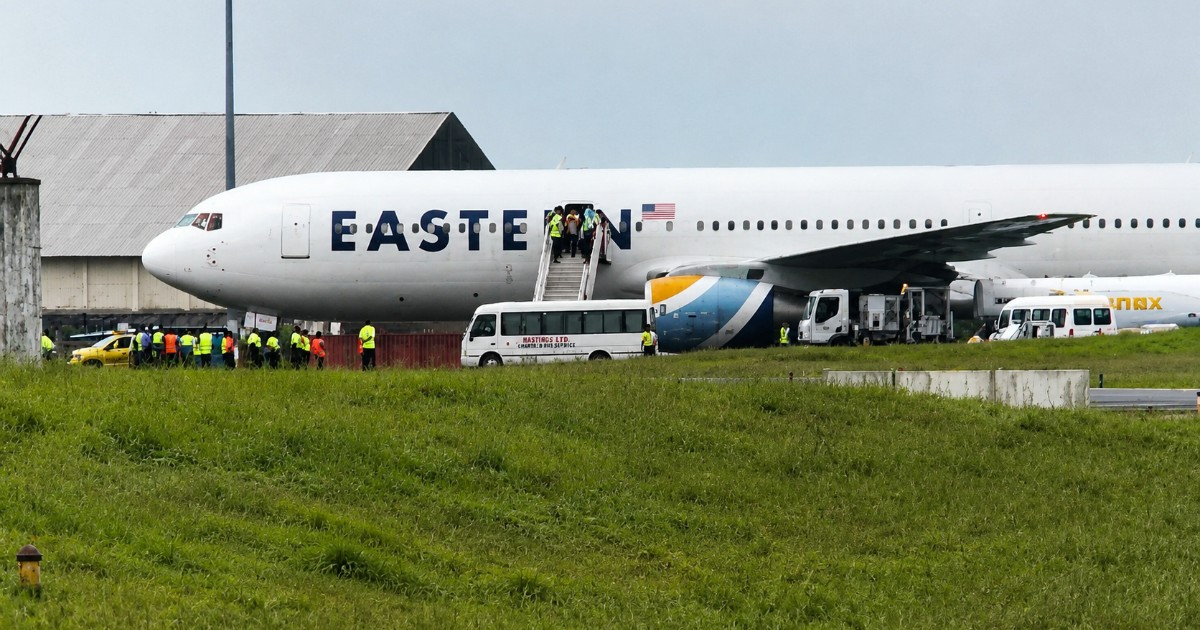
A quartet of Cuban men, accompanied by a Brazilian man and a Cameroonian woman, refused to disembark in Liberia on Thursday, August 20, during the inaugural deportation flight dispatched by the United States under its bilateral agreement with the African nation.
Instead of being returned to U.S. soil as promised, the deported Cuban immigrants were transported to Malabo, the capital of Equatorial Guinea.
The group expressed that Liberia "was not their country" and feared for their safety there, as recounted by a Honduran deportee who did exit the plane and spoke anonymously to AP News due to fear of reprisals. After their refusal to deplane, the six individuals were separated from the other passengers and reboarded, but not bound for the United States.
Telemundo 51 identified the four Cuban men as Carlos Rodríguez López, Leandro Sánchez, Emilio Destrade Correoso, and Darwin Hernández Calvo. The Brazilian national is Pietro Graza de Lima.
Meredyth Yoon, the litigation director of Asian Americans Advancing Justice-Atlanta, described their arrival in Malabo as "a truly harrowing and chaotic scene." Some of the six migrants arrived in chains and were in a state of severe distress.
One of the Cuban men, in particular, suffers from a severe medical condition, requiring a colostomy bag that needs regular emptying. Yoon emphasized that medical personnel is absent at their detention site.
The six are held in a hotel in Malabo alongside approximately 40 other deported migrants. The hotel, owned by the family of Equatorial Guinea's President Teodoro Obiang Nguema Mbasogo, has been repurposed as a detention center through a $7.5 million agreement with the Trump administration.
Conditions at the hotel have progressively worsened: food is sometimes withheld, and guards have been accused of threatening, beating, and strangling some detainees, according to Yoon.
The Thursday flight originated from Louisiana, made a stop in Dakar, Senegal, and carried about 20 migrants. It was the first executed under the agreement between Washington and Monrovia, allowing up to 1,200 deportees from third countries over the course of 12 months.
This policy of deporting to third countries—places with which migrants have no connections—has become a cornerstone of the Trump administration's immigration crackdown. Immigration attorneys argue that this mechanism is used to indirectly send asylum seekers back to nations they fled, bypassing standard legal protections. The United States has entered agreements with at least 35 countries and deported over 23,000 people to 26 countries under these arrangements.
For Cubans, the situation is further complicated by the structural issue that Havana's regime has consistently refused to accept deportees, prompting Washington to seek alternative destinations.
In February 2026, a federal judge in Massachusetts ruled this practice illegal due to lack of prior notification and the opportunity to challenge the transfer, but the decision was temporarily suspended.
Igrayne Ribot, the wife of Carlos Rodríguez López, a Cuban from Miami Gardens whose case was publicized earlier, encapsulated the bewilderment of many families affected by these deportations. "He called me and said, 'Mom, I'm in Africa.' That's all he said, and I broke down. No one imagines that; it was horrifying," she expressed.
Understanding U.S. Deportation Policies to Third Countries
What prompted the deportation of Cubans to Equatorial Guinea?
The deportation was part of the U.S. agreement with Liberia to send deportees to third countries. However, due to the migrants' refusal to disembark in Liberia, they were sent to Equatorial Guinea instead.
What are the conditions like for deportees in Malabo, Equatorial Guinea?
The conditions have deteriorated, with reports of food being withheld and guards physically abusing detainees. The hotel, used as a detention center, lacks proper medical care.
How has the U.S. policy of deporting to third countries been criticized?
Critics argue that this policy bypasses legal protections for asylum seekers, sending them back to countries they fled without proper legal recourse or notice.