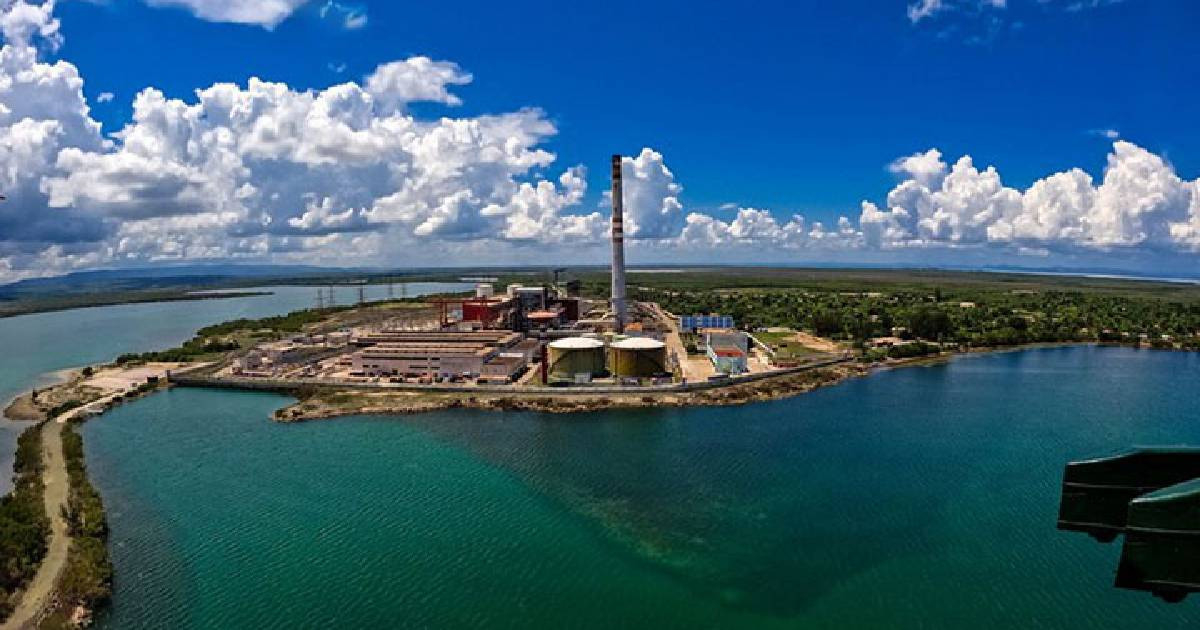
The first unit of the Lidio Ramón Pérez Thermoelectric Plant in Felton, Holguín province, is striving to reconnect with the National Electrical System (SEN) after addressing a crack and rectifying over a hundred issues identified during its restoration efforts.
Workers and experts at the facility have successfully repaired a leak in the fifth tube of the dome's rear wall, one of the most challenging areas within the critical repair path that has kept the unit offline since Tuesday, as reported by the Cuban News Agency on Saturday.
Víctor Hugo González Quiala, the plant's technical director, informed Emilio Rodríguez from Radio Mayarí that the repairs on the dome were expected to wrap up by Friday.
If the unit successfully passes the hydraulic test scheduled for Sunday, it will be ready to synchronize once again with the SEN.
González stated, "The team has focused on addressing more than a hundred anomalies found in the turbogroup."
The repair efforts included restoring high-pressure heaters to boost the machine's efficiency and attending to the deaerator leak, with particular attention to the feed tank, according to reports.
Staff from the plant, the Electric Power Plant Maintenance Company, and ECI-3 participated in the repairs, which involved descaling the boiler and cleaning reheater number one.
A crack discovered near the top of the boiler, close to the dome, had previously increased water consumption and forced a reduction in energy output, prompting authorities to halt the unit for repairs, as detailed in the report.
González emphasized that the repairs were conducted with utmost precision to ensure the unit's availability and reliability when it reenters power generation.
The plant's second unit remains out of service due to a fire that occurred during the startup process after maintenance, which was expected to add approximately 220 megawatts to the SEN in the summer of 2022. The government announced in November 2024 that its rehabilitation would not be completed until late 2027 or early 2028.
The Felton plant, Lidio Ramón Pérez, is regarded as one of Cuba's most efficient power stations.
With both units at Felton out of service, the SEN is operating at its limit. This Sunday, the available generation capacity stood at just 1,032 MW, compared to an anticipated demand of 2,298 MW, according to power outage tracking in Cuba. In Holguín, some circuits experienced interruptions lasting up to 19 hours on Sunday.
Unit 1 at Felton has had numerous instances of disconnection and reconnection throughout the year. In July, its departure from the system triggered another collapse of the SEN, and in May, it left the grid just hours after synchronization.
As of 2026, Cuba has experienced at least seven complete collapses of the SEN, with power outages exceeding 20 hours daily in many areas, sparking protests in neighborhoods across Havana and other cities.
Understanding Cuba's Electrical Challenges
What caused the problems at the Felton Thermoelectric Plant?
The Felton plant's issues stemmed from a crack in the boiler and over a hundred detected anomalies, including leaks and malfunctioning equipment, which required extensive repairs.
How do these problems affect Cuba's National Electrical System (SEN)?
The deterioration of Felton's units has pushed the SEN to its operational limits, leading to frequent power outages and reduced energy supply across the country.
What measures are being taken to prevent future collapses of the SEN?
Efforts include conducting thorough repairs and maintenance, improving equipment efficiency, and planning long-term rehabilitation of damaged units to stabilize and enhance Cuba's electrical infrastructure.