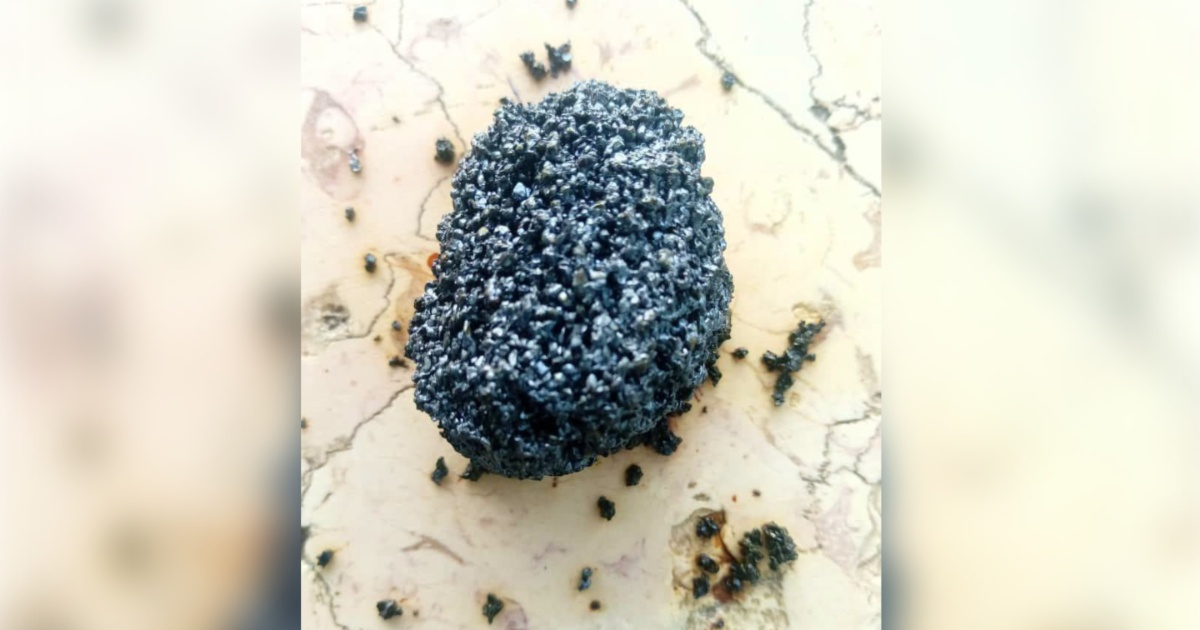
On Saturday around midday, an unidentified object believed to be of extraterrestrial origin descended approximately 50 meters from the Purgatorio River bridge in the Pilón municipality, located in Granma province. Local officials are actively working to safeguard the object and conduct a scientific analysis.
Journalist Marisela Presa reported on her Facebook page that a group of young people discovered the object, still emitting smoke, and handed it over to municipal authorities.
Eyewitnesses noted that the object bounced three times upon landing and exhibited a reddish hue, indicating the high-temperature nature of the impact.
Preliminary measurements suggest the fragment is about the size of an almond, with a dark color and rough texture.
A video shared in the "Revolico Pilón" Facebook group shows two dark objects on dry ground, surrounded by a reddish area, implying significant heat was generated upon impact. The individual filming the scene can be heard saying, "It fell from the sky... it's emitting gas and a terrible odor."
Marta Digno, president of the Pilón Municipal Assembly of People's Power, confirmed the incident and provided two images of the object to Presa. She noted that local MININT officials currently have the object in custody for protection and further examination.
Enrique Diego Arango Arias, head of the National Seismological Service and technical director of CENAIS (National Center for Seismological Research), described the event as a "possible meteorite fall in Pilón" and stressed the importance of preserving the site to allow for thorough study and sample analysis.
As of now, there is no official scientific confirmation that the object is indeed a meteorite; investigations are ongoing.
The verification process in Cuba involves a combination of seismological data from CENAIS, eyewitness accounts, satellite information, and mineralogical and chemical laboratory analyses. A meteorite can only be confirmed when multiple lines of evidence align.
If the discovery is validated, it would mark the sixth scientifically documented meteorite event in Cuba. The five previously recognized events are Las Canas (1844), Bacuranao (1974), Santa Isabel de las Lajas (1994), Viñales (2019), and Ramón de las Yaguas in Santiago de Cuba (2021).
The most recent and notable case was in Viñales, Pinar del Río, where CITMA confirmed the fall of an ordinary L6 chondrite that broke into several pieces, the largest measuring about 11 centimeters. In November 2024, a potential fall in Matanzas was investigated but not confirmed due to the absence of terrestrial fragments.
The scientific community eagerly awaits the results of the analysis on the object recovered in Pilón to determine if Cuba will add another chapter to its meteoric history.
Frequently Asked Questions About Meteorite Events in Cuba
What happens after a potential meteorite is discovered in Cuba?
The object is secured by local authorities, who then conduct a series of analyses, including seismological, mineralogical, and chemical tests, to confirm its extraterrestrial origin.
How many meteorites have been confirmed in Cuba so far?
To date, five meteorites have been scientifically confirmed and documented in Cuba.
What was the most recent confirmed meteorite fall in Cuba?
The most recent confirmed meteorite fall occurred in Viñales, Pinar del Río, in 2019, involving an ordinary L6 chondrite.