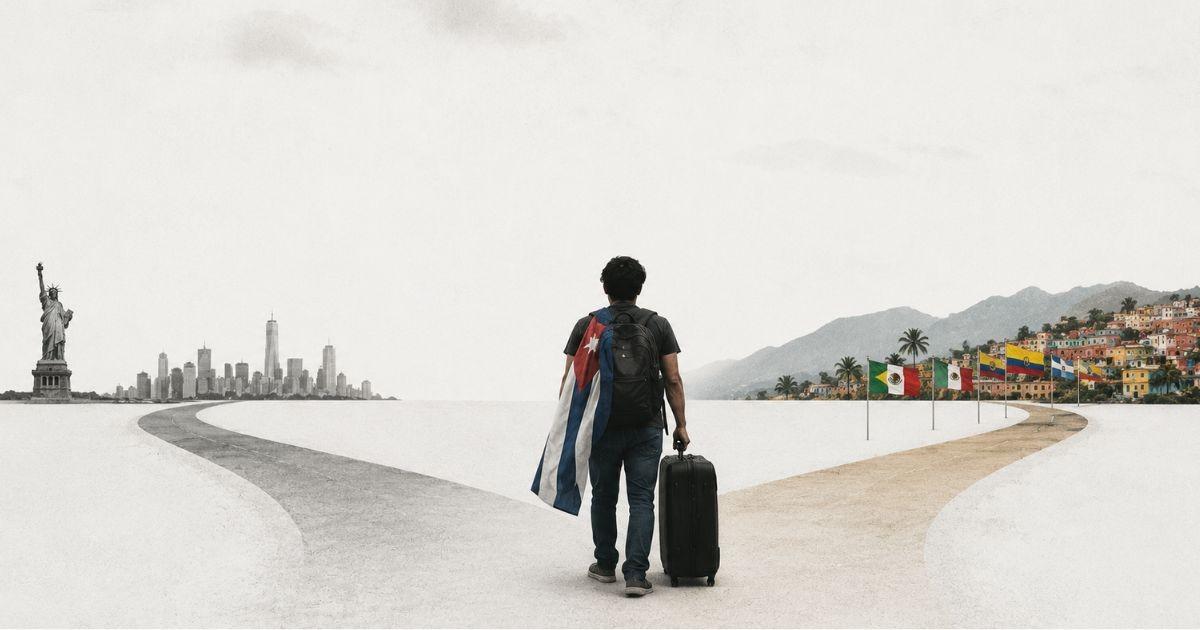
On Thursday, Cuban poet Juan Carlos García Guridi unveiled a poignant poem penned in May 2023, shedding light on a persistent wound: the heartache of remaining in Cuba as the nation empties of its people.
The Emotional Core of "Catarsis"
Entitled "Catarsis", and shared on the author's Facebook page, this composition utilizes the traditional Cuban form of décimas espinelas—ten-line stanzas with eight syllables each, historically a vehicle for political resistance. It encapsulates the collective anguish of those who stay on the island.
Born in Batabanó, Mayabeque, in 1968, García Guridi is a poet and literary researcher who has published over a dozen books on décimas and Cuban popular poetry. His poem begins with an image of sleeplessness and grief: "Last night I lay in bed thinking / of how many people have left / I couldn't sleep / I nearly cried."
The Pain of the Boat People
The sorrow deepens as the poet turns his attention to the balseros (rafters): "It was harder when / I thought of the rafters / and all those who / dying mile by mile / never set foot / on the other shore." This is not an abstract image; according to the International Organization for Migration's Missing Migrants Project, at least 142 Cuban rafters perished trying to cross the sea in 2024.
A Divided Existence
The poet describes himself as someone staying in Cuba with "divided blood," standing before a sea that invites him to cross, "but I don't cross / I'm not sure if it's because I'm a fool / or because fear keeps me." This duality between illusion and fear mirrors the paralysis of thousands of Cubans who witness the exodus but do not take the step. In 2024, 251,221 Cubans emigrated, and the island's population plummeted from 10,055,968 to 9,748,007 within a year.
The Silence of Resistance
"Catarsis" is more than a lament for the departed; it's also a denunciation of the imposed silence. "I have no other allegiance / than my books. The sorrow / is that my head / is a separate cemetery / and a pain shared / among rubble and weeds," writes García Guridi, before reaching the central verse: "Silence is not worthy of a medal: / A poet who remains silent / dies but from silence... / I do not sentence myself to death, / no matter that I do not leave."
The poem quietly questions those who remain unnamed: "[...] silently I ask myself / who—in the midst of all this / that cuts me to the bone— / thinks of the prisoner’s mother / and the mother of the deceased." These figures encapsulate the dual Cuban tragedy: political repression and death at sea.
The Poem's Ongoing Resonance
The text reverberates in 2026 with a strength its author may not have fully anticipated. The U.S. Department of State warned in August that Cuba is undergoing a severe crisis, a direct result of the ruling regime, its failed economic model, and incompetence. The Cuban Human Rights Observatory estimates that 89% of the population lives in extreme poverty, and the informal exchange rate for the dollar has surged to over 670 pesos in recent weeks.
García Guridi has published a series of protest poems in 2026 that have gained significant attention. In July, his décimas poem "PREGUNTO" sparked a wave of reactions among his followers. One reader wrote: "The most brutal torture that can be inflicted on a human being is being applied in our country; we have nothing left." Another commented: "God, how much suffering in those verses! We all ask ourselves so many questions daily. But no one has an answer; only uncertainty is present in our lives."
"Catarsis," written three years before this engagement with readers, concludes with a desire that sounds utopian in the Cuba of 2026: "I want to live, / and sing, and smile, / in a Caribbean corner / from which, in search of a dream, / no one has to leave."
Understanding the Cuban Exodus and Its Impact
Why are so many Cubans leaving the island?
Many Cubans are leaving due to severe economic hardships, political repression, and a lack of opportunities, driven by the country’s failing economic model and governance issues.
What risks do Cuban rafters face?
Cuban rafters face numerous dangers including the threat of drowning, harsh weather conditions, and the peril of being lost at sea without rescue.
How has the population of Cuba changed in recent years?
Cuba's population has significantly declined due to emigration, dropping from over 10 million to under 9.75 million in just one year, reflecting a massive exodus.