"If Trump sends in the Army, everyone will take to the streets." This remark was made by a 33-year-old Cuban to British journalist James Bloodworth while he was touring Havana.
The comment, made partly in jest, was quickly clarified with the assertion that Trump is "crazy." However, Bloodworth understood that the essence was not a literal call for military intervention but rather a reflection on the desperation that leads someone within Cuba to entertain such a scenario.
"The level of frustration is such that some are willing to consider almost anything that brings the prospect of change," Bloodworth noted.
It's been a few months since Bloodworth published his piece titled "In Cuba, Socialism Has Morphed Into A Racket," a vivid account of his time on the island. The chronicle is even more revealing now than it was in May, not because it uncovers poverty, blackouts, or shortages—realities well-known to Cubans—but because it highlights the weariness from endless waiting.
The Language of Frustration
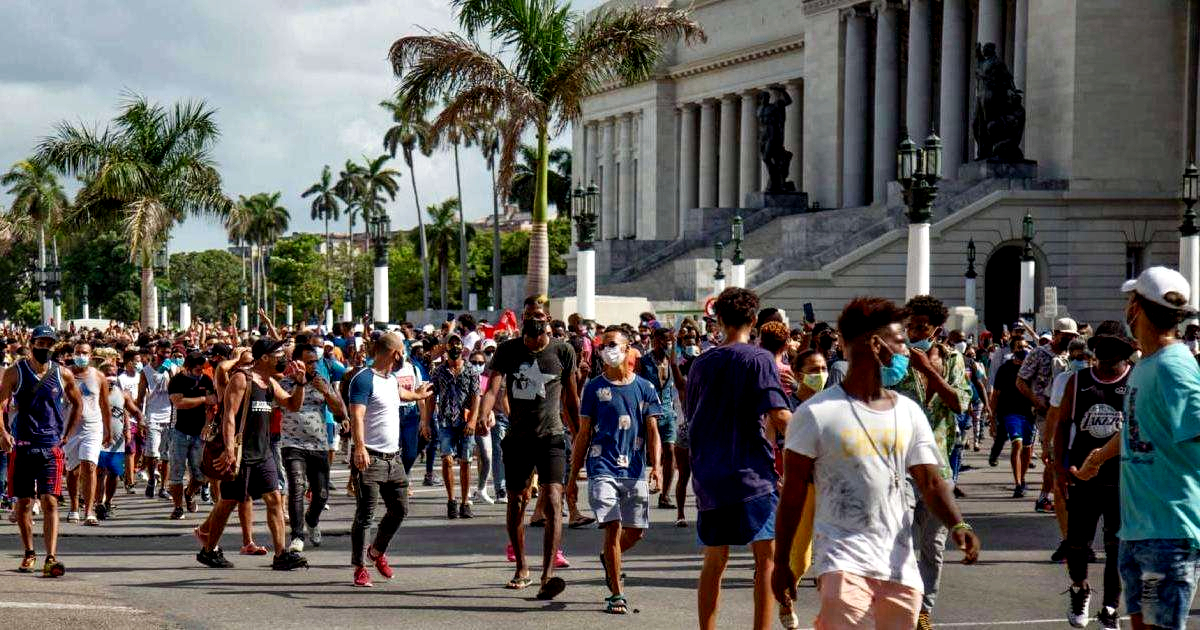
This feeling is increasingly evident in street language and the reactions of Cubans to news about the crisis: “How long will it last?” “We need change now,” “They should leave,” “Stop talking and take action.” These different expressions ultimately converge on a collective impatience.
In June, after more than 36 hours without electricity in a neighborhood between La Lisa and Marianao, a woman expressed her exhaustion on camera, bypassing political abstractions: "We are tired of so much hunger, misery, and darkness." She questioned how long they would continue living this way and demanded that those in power step down.
Protests and Desperation
In July, women blocked the Calzada de Diez de Octubre after enduring prolonged blackouts, spoiled food, and sleepless nights for their children due to the heat. In Guanabacoa, there was a pot-banging protest after five days without electricity.
August has not brought the relief often promised. Early in the month, ten thermoelectric units were simultaneously out of service, leading to extraordinary power deficits, with many Cubans enduring over 20-hour outages. In Camagüey, while some communities reported endless blackouts, provincial authorities celebrated a concert for Fidel Castro's centennial.
The Deepening Divide
Bloodworth's observations in Havana included encountering a nearly empty state bakery with people queuing for bread that might never arrive. Across the street, a black SUV was parked in front of a hotel catering primarily to foreigners, offering imported whiskey and air conditioning.
During his walk, he met Antonio Rodríguez, a 60-year-old university history professor who also worked as a tour guide. Despite holding two jobs, he admitted to eating only once a day.
These are not just snapshots of poverty. For Bloodworth, they reveal a much deeper contradiction.
Contradictions of Power
Cuba still officially presents itself as a besieged socialist society, yet Bloodworth argues that socialism, in any recognizable form, "has already fallen in Havana." He sees a post-ideological system run by a bureaucratic-military elite that continues to use the language of the so-called "revolution" long after its promises have lost meaning.
The red flag, Bloodworth suggests, continues to fly, but power and wealth flow through other channels. Central to this contradiction is GAESA, the business conglomerate linked to the Armed Forces, which controls significant portions of tourism, retail, real estate, and foreign currency operations.
While millions of Cubans anxiously wait for electricity or worry about the rising cost of rice, this military structure manages hotels, stores, businesses, and resources in hard currency.
Bloodworth cites analyses based on leaked financial information indicating that GAESA operates with extraordinary opacity, accumulating resources that fail to fund the crumbling infrastructure and public services around the Cuban people.
Here lies one of the most uncomfortable images in his article: not a country where everyone is equally poor due to the failure of an old socialist utopia, but a society split in two.
Economic Hardships
On one side are those with access to dollars, certain stores, or privileged economic sectors. On the other are those who earn in pesos and struggle daily to buy food.
The gap between these worlds continues to widen. Official year-on-year inflation reached 20.70% in July. Food and non-alcoholic beverages were once again the main drivers of price increases. One Cuban woman recently highlighted some of the lowest prices she found: rice at 330 pesos, sugar at 550, powdered milk at 1,700, a liter of oil at 3,650, and a pack of chicken at 6,800.
These figures take on new meaning when compared to salaries. Another Cuban woman showed earlier in August how 100 dollars, then equivalent to about 65,000 pesos, vanished quickly when attempting to stock a refrigerator. She spent 36,000 pesos on basic supplies that, according to her, wouldn't even sustain her family for the month.
The dollar itself is a measure of how conditions have worsened since Bloodworth's visit. When he published his account on May 13, he noted the U.S. currency had reached 545 CUP in the informal market, referencing information from CiberCuba. This week, the dollar has remained above 660 pesos, with the euro around 750.
A System in Crisis
Focusing solely on inflation, the dollar, or even blackouts would be to miss the deeper story Bloodworth seeks to convey. His argument is that beneath the precariousness lies a power structure with vested interests in maintaining the system. An elite that continues to invoke socialism and the "revolution" in speeches, slogans, and political events while controlling much of the sectors capable of generating foreign currency, shielded from the material conditions endured by most Cubans.
Thus, Bloodworth's deliberately provocative title: for him, Cuban socialism has transformed into a racket, a term implying an organized scheme benefiting those in control.
His depiction leans more towards an oligarchic structure than the egalitarian society still touted by official propaganda: new or half-empty hotels while resources are scarce in hospitals; stores stocked for those with foreign currency while state salaries lose value; a powerful military corporation managing businesses while the state claims it lacks resources to meet basic needs.
And against all this, a population continually asked to endure.
The Growing Discontent
Perhaps that's why another of Bloodworth's observations is so significant. During conversations in Havana, many people began by clarifying that they "weren't political." Yet, once they felt secure, they spoke at length about the country. They started in hushed tones and ended up saying much more than they initially seemed willing to share.
Three months later, some of that fatigue no longer needs to be whispered.
It appears in a woman asking "how long" after 36 hours without power; in neighbors taking to the streets with pots and pans; in those responding with disbelief to yet another recovery plan from the Electric Union; and in the hundreds of comments accompanying each new official promise with variations of the same demand: that something finally happen.
This doesn't mean that all Cubans think alike, nor that the comment about a U.S. intervention can be extrapolated to the entire society. Bloodworth himself encountered differing opinions and people wary of such a prospect, even though, in early May, 60.9% of participants in the #EncuestaCuba supported a direct U.S. military intervention.
The significance lies elsewhere.
When someone can imagine even an extreme scenario as desirable; when others openly question how much longer they must endure hunger and darkness; when official promises elicit more ridicule than hope, the problem for those in power transcends the economic realm.
It becomes a crisis of credibility.
Bloodworth concludes his article with a damning observation: the "Cuban revolution," understood as a project capable of offering society a future, ended long ago. What remains, he argues, is a military elite clinging to its privileges while invoking that tradition.
Their old slogan was "Socialism or death." Bloodworth suggests another to describe the Cuba he found: "privilege or hunger."
And perhaps it is precisely here that the testimony collected in May best connects with the current discontent pervading the island. The question is no longer just how long a Cuban can endure without electricity, how much rice can rise in price, or how high the dollar can climb.
It is how long a system can persist when more and more citizens seem to have stopped expecting anything from it.
Understanding Cuba's Economic and Social Crisis
What is the main cause of the growing frustration in Cuba?
The increasing frustration among Cubans is primarily due to the worsening economic conditions, including inflation, shortages, and blackouts, coupled with a lack of effective government response and the perception of an elite benefiting from the current system.
How does GAESA influence the Cuban economy?
GAESA, a conglomerate linked to the Cuban Armed Forces, controls significant sectors like tourism, retail, and real estate, managing resources in hard currency. It operates with opacity and often does not reinvest in infrastructure or public services, contributing to economic disparities.
What is the significance of the phrase "privilege or hunger" in the Cuban context?
The phrase "privilege or hunger" highlights the stark division in Cuban society between those with access to resources and foreign currency and the majority who struggle daily to meet basic needs under a failing socialist system.