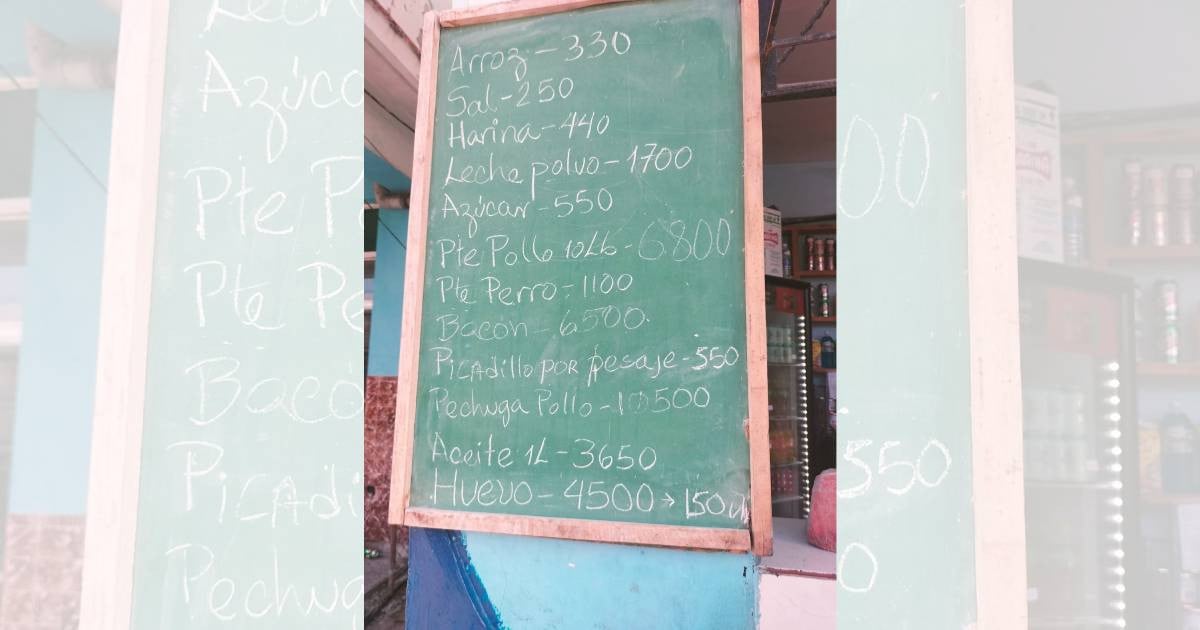
On Friday, a Cuban woman recorded the price board at a store in Havana, describing it as one of the more affordable options she could find. This sparked a wave of reactions on social media, highlighting the relentless food crisis plaguing the island.
Yoryany Veranes shared the image on her Facebook profile with a straightforward warning: "These are from the places where I found the cheapest prices... you don't want to see the most expensive ones!"
The board, scribbled in chalk on wood, likely at a grocery or food store, lists prices in Cuban pesos (CUP) that are out of reach for most Cubans: rice at 330 CUP, salt at 250, flour at 440, powdered milk at 1,700, sugar at 550, a pack of chicken at 6,800, bacon at 6,500, chicken breast at 10,500, a liter of oil at 3,650, and eggs at 150 CUP each.
The Reality of Escalating Prices
Comments from citizens across various provinces quickly confirmed that these prices are not anomalies but rather the baseline. Reports came in from Cotorro of oil priced at 4,500 CUP and chicken at 8,000; from Baracoa, oil at 5,000 and rice at 380; from Rodas in Cienfuegos, oil at 7,000; and from Alta Habana, sugar per package at 1,400 and oil also at 7,000 CUP.
A retiree with forty years of service summed up the plight with a stark figure: she earns 3,150 pesos monthly, while two pounds of sugar cost her 1,100. Another user was more blunt: "Just the oil alone is a month's salary."
Comparisons and Contrasts Across the Island
In Camagüey, someone remarked that the prices on the board "are cheap in comparison" to those in their city. From Bayamo, the warning was more vivid: "Hold onto the brush because I'm taking the ladder." Meanwhile, some expressed bitter irony, asking for the store's address because everything in their neighborhood was pricier.
A private-sector worker who joined the discussion summed it up plainly: "The reality is singular: understand that we live under a dictatorship. I don't see anything expensive; it's merely the fair price for enduring communism."
Economic Context and Its Impact
The macroeconomic backdrop fuels this outrage. According to the National Office of Statistics and Information, Cuba's official year-over-year inflation reached 20.70% in July 2026, with food and non-alcoholic beverages accounting for 63.18% of the total increase in the consumer price index that month.
The minimum wage, set at 3,210 CUP per month since July, equates to less than five dollars on the informal exchange market. Meanwhile, meeting a family's basic needs requires about 96,000 CUP monthly, with over 70,000 solely for food, as estimated by independent economists.
In this scenario, a pineapple tart at a pastry shop in Central Havana costs 9,650 CUP, exceeding the average monthly salary of a Cuban worker.
Additionally, bread prices in Santiago de Cuba have triggered a debate on whether eating has become a luxury for a select few.
Simultaneously, the government has launched a crackdown on the private sector, resulting in the closure of 22 businesses and fines exceeding 1.2 million pesos in just a week in Las Tunas. This move further reduces the limited food sources available without providing any alternatives.
Understanding Cuba's Economic Challenges
What are the current price trends in Cuba for basic commodities?
Prices for basic commodities in Cuba, such as rice, oil, and chicken, are skyrocketing, making them unaffordable for the average Cuban citizen.
How is the Cuban government responding to the economic crisis?
The Cuban government has initiated a crackdown on the private sector, closing businesses and imposing hefty fines, which further limits access to food without offering viable alternatives.
What is the impact of inflation on Cuban households?
Inflation has severely impacted Cuban households, with food and non-alcoholic beverages contributing significantly to the rising consumer price index, making basic sustenance a challenge.