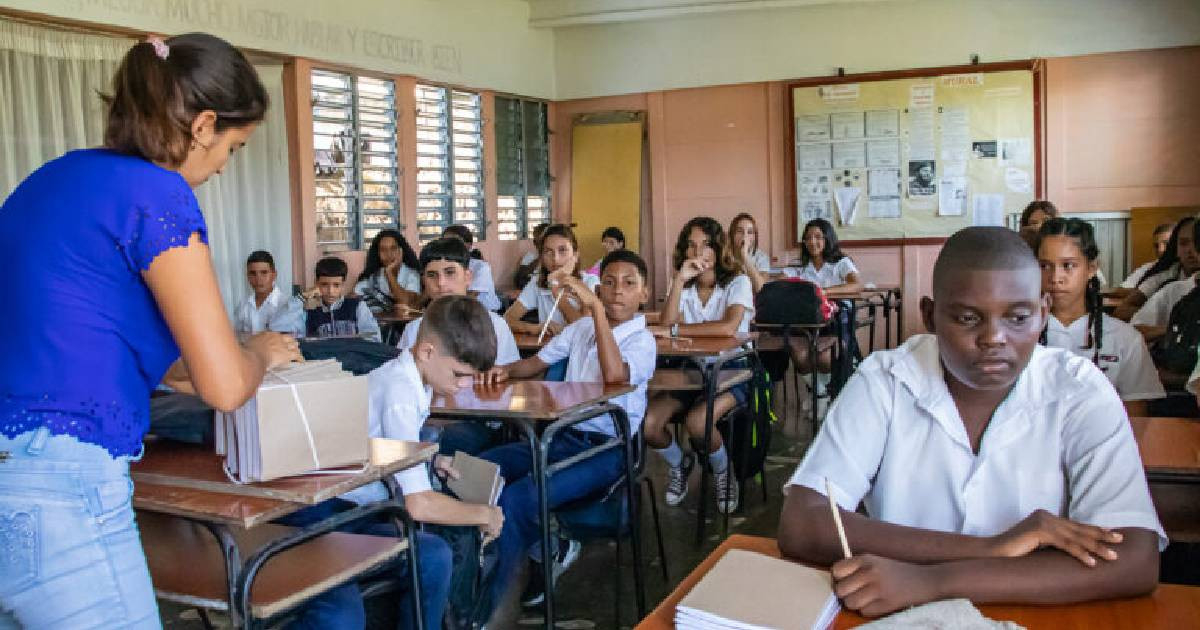
As the 2026-2027 school year is set to start on September 1, Cuban mothers have sparked a heated debate on social media, with many declaring they will not send their children to school unless the government ensures basic necessities like electricity, food, and rest.
On the Facebook group Madres Cubanas Luchadoras 2, numerous comments have surfaced, portraying the desperation of families contending with power outages lasting over 20 hours daily, dilapidated schools, inaccessible uniforms, and a food crisis that makes it impossible to provide even breakfast or snacks for children.
"If my kids can't sleep because of the extreme heat and the swarm of mosquitoes, THEY'RE NOT GOING TO ANY SCHOOL. Enough is enough with abusing our children," one mother expressed, capturing the sentiment of those who refuse to accept what they see as abusive conditions.
Another participant was more direct: "My children are kids; they shouldn't have to sacrifice for anything. No electricity, no school; no snacks, no school; no water, no school; no uniforms, no school."
Struggles of Cuban Families
The situation described by these families is dire. The World Food Program reported that 48.5% of Cuban students aged six to eleven receive no meals or snacks at school.
Providing breakfast and a snack for one child for a month can exceed 10,000 Cuban pesos, an unattainable amount for most families, not including lunch, transportation, shoes, or supplies.
"It's already August 20, and I'm still worried about so many things, like their shoes and school supplies. Honestly, I don't know what else to come up with... I rely on getting called to work in private homes and hostels, but there's no tourism, which is my livelihood," a mother admitted.
Challenges in the Education System
The educational system is plagued with a structural deficit of at least 24,000 teachers, representing 12.5% of the required positions. The previous school year ended early, between June 15 and 30, due to fuel shortages and power outages.
Recently, a teacher from the municipality of Urbano Noris in Holguín province publicly challenged the ruler Miguel Díaz-Canel, highlighting that "we haven't been paid since May," with a backlog of over three months without salary.
Uniform Shortages and Parental Burden
The uniform situation is equally grim. Education Minister Naima Ariatne Trujillo Barreto admitted that only 20% of students nationwide will have new uniforms at the start of the school year, as production barely reached between 2.2 and 2.3 million of the 3.6 million needed.
In Ciego de Ávila, uniforms are being prioritized solely for preschool, fifth, and seventh grades.
Not all voices echo the same concerns. Some mothers insist on sending their children to school regardless of the challenges. "Mine is going, and he'll use the same backpack and sneakers from last year. He studies, I work; he does his duty, and I strive to provide what's essential," one participant shared.
Another added that she prefers her children to be in school "talking with their friends about childhood topics" rather than at home listening to family woes.
However, the most widespread criticism targets the unintended complicity of parents themselves. "For ages, schools in this country have operated thanks to parents who bring everything: paint, brooms, fans, lamps. Now we also have to buy uniforms because the school doesn't provide them," a mother complained, noting that this normalization allows the regime to avoid taking responsibility.
"In this country, the abnormal becomes normal," another user summarized, encapsulating the frustration of thousands of Cuban families facing a new school year that the regime optimistically announces, despite the stark reality.
FAQs about the Cuban Education Crisis
What are the main issues Cuban families face with the new school year?
Families are dealing with extensive power outages, inadequate school facilities, inaccessible uniforms, and a lack of food for children.
Why are some parents refusing to send their children to school?
Parents refuse to send their children to school due to the lack of basic necessities like electricity, food, uniforms, and proper rest conditions.
How is the Cuban government responding to the education crisis?
The government has made limited acknowledgments, such as the Education Minister admitting uniform shortages, but there's widespread criticism for failing to address the root causes.