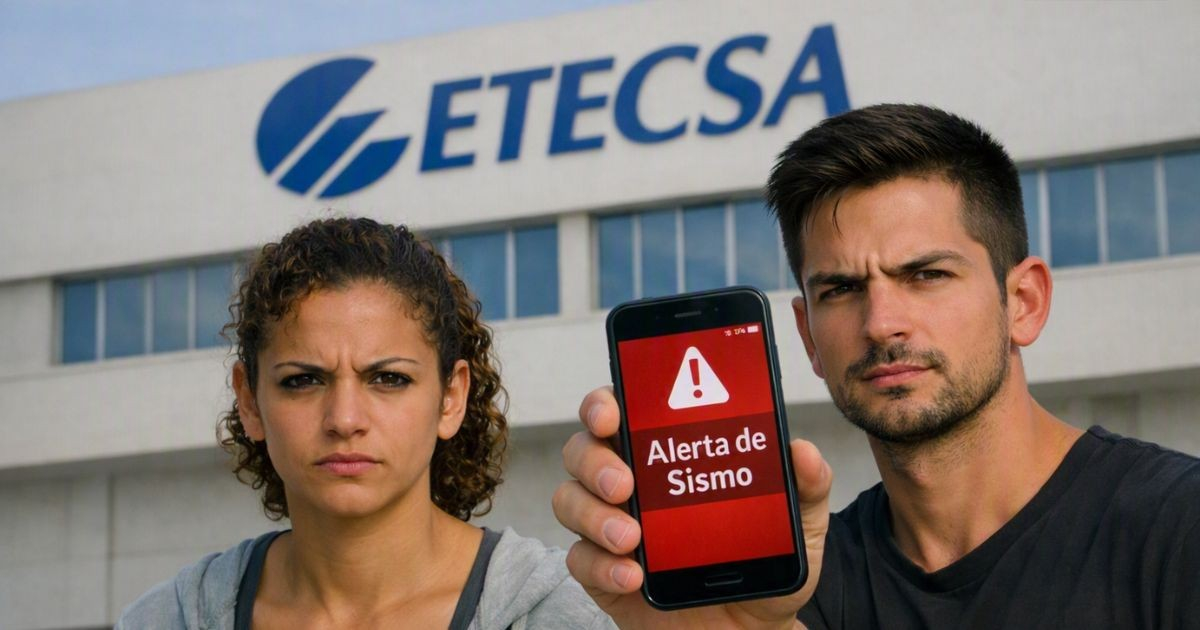
In the wake of a fake earthquake alert that incited panic across Cuba, ETECSA has come forward three days later, admitting that the chaos resulted from an internal error. The telecommunications company revealed that its specialists accidentally triggered the emergency messaging system while conducting network tests.
On the afternoon of August 18, countless Cubans received alarming messages on their phones urging calm and advising them to seek nearby shelter. This message was accompanied by an icon depicting a collapsing building. The Civil Defense quickly clarified that the seismic alert was entirely false and that no activity had been recorded by the national seismological network to warrant such a warning.
Initially, state media and Cuban television pointed fingers at Google as the potential source of the error. However, Google promptly denied any involvement, confirming that its platform had neither detected an earthquake nor issued alerts on the island. It was only after this that ETECSA released a statement admitting, "The messages were sent due to a technical-human error by our specialists conducting network tests."
The public outcry has been particularly intense regarding the impact on vulnerable populations, such as those who are ill or living in high-rise buildings. One woman, who identified herself as having heart disease and hypertension, candidly expressed, "This mistake almost cost me my life."
Physical risks were also a consequence of the panic. "Elderly people were seen descending flights of stairs from a 12-story building in Ciego de Ávila, frightened by the human error," an internet user described. Another summarized the collective damage: "It was an unforgivable mistake, causing panic among a population already under immense stress."
One forum participant questioned the lack of accountability: "What about the sanctions? In my building, 12 floors, we had to help sick and elderly people down from high floors using wheelchairs. And now, what's the excuse? The blockade?"
Critics also targeted the delay in taking responsibility. "Acknowledging the error is crucial for correction. However, it took [several days] to publicly accept responsibility for something so sensitive... And it wasn't just a few users affected; it was thousands across Cuba, perhaps hundreds of thousands," one commenter noted. Another directly accused, "If Google hadn't denied it, you would continue lying and blaming Google."
Calls for tangible consequences were frequent. "They should be held accountable for putting an already battered and stressed population on edge. Sanctions are warranted," one internet user demanded. Others called for compensation and questioned the possibility of suing ETECSA, the country's sole telecommunications provider.
This incident further damages the already shaky reputation of ETECSA, which faced backlash in May 2025 for a controversial price hike that partially dollarized internet access. Adding to the irony, the National Center for Seismological Research reported a real 3.6 magnitude earthquake in Santiago de Cuba on Friday. Users noted that the alert system failed this time: "There was a tremor in Santiago, and the alert didn't work. Yet another thing that doesn't function."
Frequently Asked Questions About ETECSA's Alert System
What caused the false earthquake alert in Cuba?
The false alert was triggered by a technical-human error at ETECSA while specialists were conducting tests on the telecommunications network.
How did the public react to the false alert?
The public response was one of intense criticism, particularly from those affected, including the elderly and sick individuals who were evacuated from high-rise buildings.
Has ETECSA faced similar issues in the past?
Yes, ETECSA has previously faced public disapproval, notably when it implemented a controversial price increase in May 2025 that partially dollarized internet access.