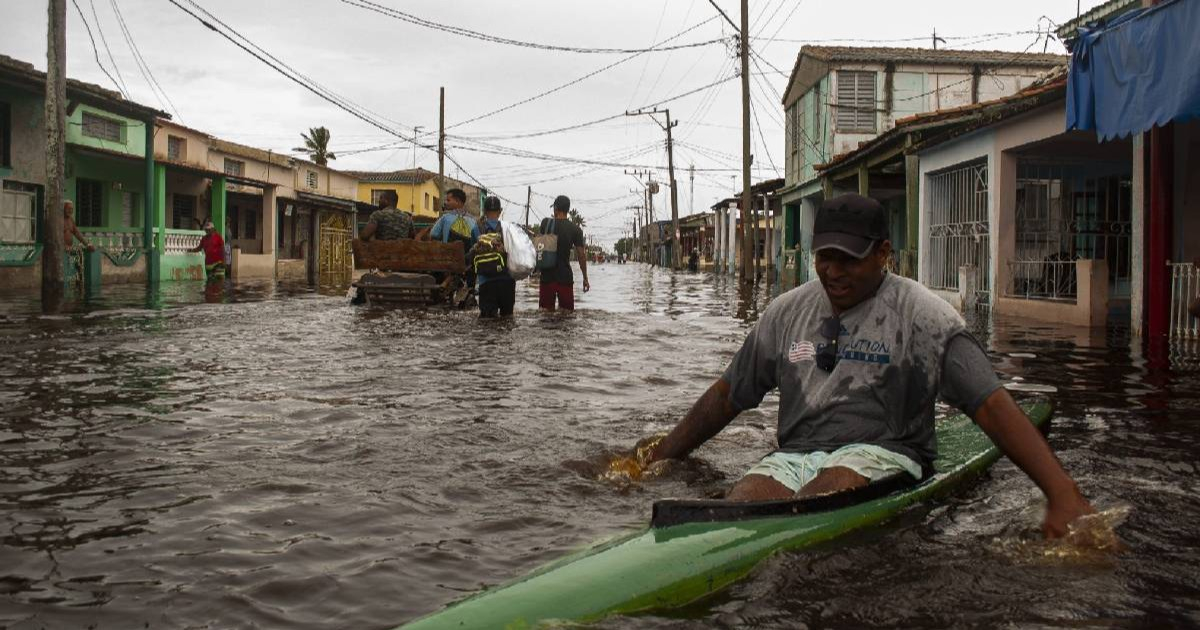
A coastal town in Cuba’s Mayabeque province, established over 300 years ago, is confronting a dire existential threat. The relentless advance of the sea, vanishing mangroves, and increasingly severe cyclones are jeopardizing its very existence.
Surgidero de Batabanó is on the brink of disappearing, as vividly captured in a series of photo reports by Juventud Técnica. These images leave no room for doubt about the unfolding crisis.
The work is authored by young journalist Yans Roberto Pérez Domínguez, forming part of his thesis on the impact of climate change on this community.
Published this Thursday, the photographs depict the devastation wrought by three meteorological events in just 50 days during the 2024 hurricane season: Tropical Storms Helene and Milton, followed by Hurricane Rafael.
The Devastating Impact of Recent Storms
“In a little over 50 days, residents of Surgidero de Batabanó witnessed the merciless invasion of water into their streets, a direct consequence of climate change and the gradual destruction of the coastal mangrove ecosystem,” wrote Pérez Domínguez.
On September 26, 2024, Helene unleashed 85.1 millimeters of rain on the town, overwhelming river systems and leaving over a meter of water in the lowest areas.
Rafael proved even more devastating, with 183.7 millimeters of rainfall in just 24 hours in November of the same year.
Personal Stories of Struggle and Resilience
Among the powerful narratives is that of Yelenis Díaz and Marcos Iván Cintras, a couple from Holguín with two children, one a newborn, living in one of the homes closest to the coast.
When Rafael struck, the front wall of their house tilted, the roof was torn off and flew 90 degrees east, leaving the interior a swampy mess.
Nearly two years later, Marcos has patched up their home with whatever means available. The family remains, clinging to the hope that no future cyclone will flood their doorstep, as chronicled in the fotorreportaje.
Beyond Cyclones: A Persistent Flooding Crisis
The challenges extend well beyond cyclones. Flooding in Surgidero happens frequently; in June 2020, residents reported prolonged inundation caused merely by southern winds, absent any major weather phenomena.
The natural barrier that once shielded the town has been critically damaged: 83% of the mangroves between Surgidero and Playa Mayabeque are fully or partially destroyed, according to the Ministry of Science, Technology, and Environment (CITMA).
CITMA’s Resolution 252/2021 has already classified the stretch between Surgidero de Batabanó and Playa Tasajera as a moderate erosion zone with the risk of total flooding by 2050.
Modeling studies predict that coastal flooding could reach 2,200 meters by that year and 2,300 meters by 2100, should a Category 3 hurricane strike.
National Implications and Restoration Efforts
Nationally, between 15 and 22 Cuban coastal settlements could be completely submerged by 2050, with up to 130 suffering partial damage by 2100, according to CITMA’s "Coastal Danger and Vulnerability" macroproject estimates.
The "Mi Costa" project, funded by the Green Climate Fund and implemented by CITMA’s Environmental Agency with UNDP support from 2022 to 2026, includes Surgidero de Batabanó among its seven priority intervention sites, focusing on mangrove restoration and enhancing coastal resilience.
“The sea continues to encroach, and the loss of the coastal ecosystem is increasingly frequent, posing the threat of disappearance for the human settlement of Surgidero,” warned Pérez Domínguez, encapsulating in one sentence the fate looming over this town with over three centuries of history.
Understanding the Threats to Surgidero de Batabanó
Why is Surgidero de Batabanó at risk of disappearing?
The town is facing severe threats from climate change, including rising sea levels, disappearing mangroves, and increasingly intense cyclones.
What measures are being taken to protect Surgidero de Batabanó?
The "Mi Costa" project aims to enhance coastal resilience and restore mangroves, focusing on Surgidero among its priority sites.
How have recent storms affected the community?
Recent storms, such as Helene and Rafael, have caused severe flooding, damaging homes and infrastructure, and leaving residents in a state of vulnerability.