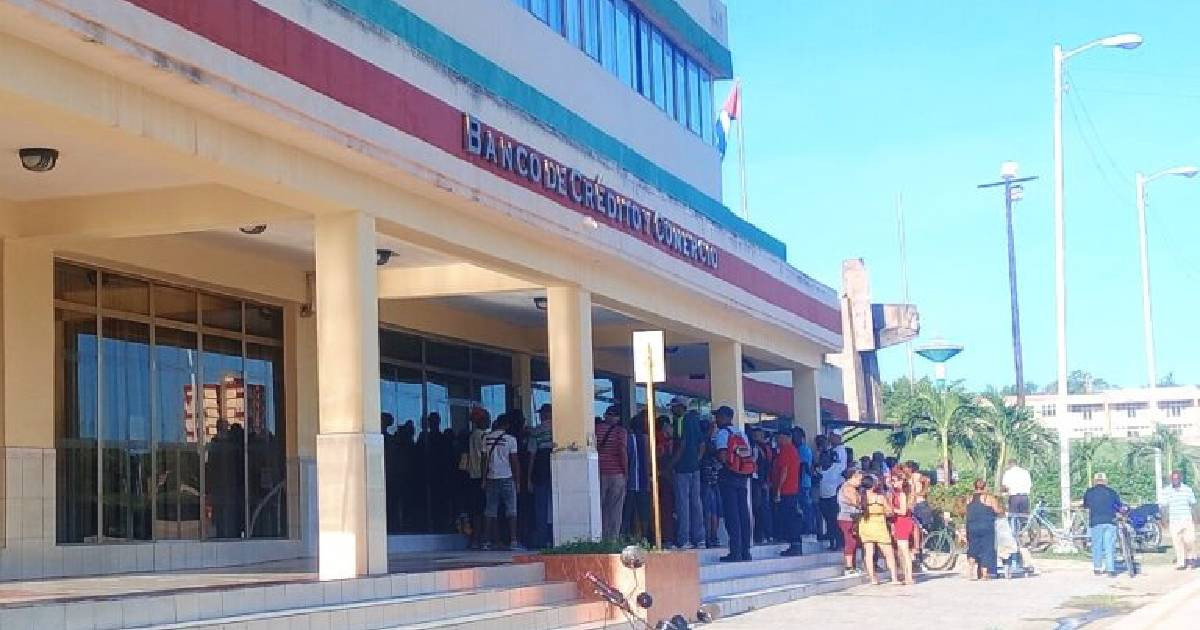
The persistent cash shortage in Guantánamo has led to an unusual solution where 113 private enterprises have stepped in to provide cash payments to retirees, a task traditionally managed by the banking system. Yaritza León Mustelier, the provincial director of the Banco Popular de Ahorro (BPA) in Guantánamo, disclosed this initiative, highlighting the severe limitations of the current banking infrastructure.
León Mustelier stated, "These 113 businesses have voluntarily adopted this role, driven by a humanitarian interest in supporting society and a demographic that we will all eventually join as employees." Her remarks, recorded by the official newspaper Venceremos, suggest a voluntary framework, but the reality may not be as straightforward.
Unveiling the Pressure Behind Voluntary Participation
Yuder Ortiz González, the accounting deputy director at the Banco de Crédito y Comercio (Bandec) in Guantánamo, clarified the ramifications for businesses opting out. "Being a financial agent aiding the bank is a different standing than doing nothing," he asserted, implying that these decisions will influence future economic interactions.
Businesses that engage with the bank become banking agents, gaining advantages such as prioritized service, expedited credit processes, and enhanced access to cash—a scarce resource in the region.
The Struggle of Guantánamo’s Elderly Population
Venceremos reports that Guantánamo is home to 68,000 retirees, with 18,000 receiving cash payments through postal services and 50,000 using cards. These cardholders face significant hurdles converting their funds into cash due to banking issues, ATM shortages, and unscrupulous middlemen exploiting older adults.
Oscar Mendoza Pérez, the provincial director of Labor and Social Security, emphasized that the current 113 participating businesses cover over 3,000 retirees, a number still insufficient compared to the goal of reaching 70% of retirees through this method.
A Nationwide Financial Crisis
This cash crisis, acknowledged by Guantánamo officials in July, sees Bandec capturing barely over 35% of the 15 million pesos needed daily for operations, while over half of the nation’s ATMs are either non-functional or empty. Venceremos admitted in early July that this issue has escalated from a banking difficulty to a societal problem.
The model being used in Guantánamo originated as a pilot program in four Havana municipalities in April, later expanding to Holguín in May, where 20 small businesses provided pensions to around 5,000 retirees. In July, the Central Bank made it a national measure as part of 176 economic and social transformations approved by the National Assembly.
The situation presents a paradox: businesses must accept electronic transfers under threat of fines and closure while simultaneously tasked with distributing the cash banks lack.
In Guantánamo, a municipal inspection director recently cautioned against non-compliance with digital payments, citing no middle ground, as reported by Radio Guantánamo.
Three years after the regime imposed mandatory banking, only 3.77% of Cuba's transactions are digital, despite over 15,240 fines and 269 business closures nationwide.
Economic Realities Facing Retirees
Cuba hosts over 1.7 million retirees, with a minimum pension of 4,000 pesos monthly—less than $10 on the informal market—while a basic basket of goods costs over 30,000 pesos.
Economist Elías Amor criticized the scheme as "madness," contending that pension payments are a state obligation that shouldn't be shifted to the private sector. "My immediate proposal is to end this madness. It's yet another ill-conceived initiative by the Castro regime, which fails and then blames the blockade and embargo for the failure," he stated.
FAQs on Guantánamo's Pension Payment Dilemma
Why are private businesses paying pensions in Guantánamo?
Due to a severe cash shortage and banking system limitations, 113 private businesses have taken on the role of distributing pension payments in cash to retirees.
What benefits do businesses receive for participating in the pension payment scheme?
Participating businesses are prioritized for banking services, receive faster credit processing, and have better access to cash, which is in short supply in the area.
How has the pension payment issue impacted Guantánamo's retirees?
Retirees face challenges in accessing cash due to ATM shortages and banking problems, with some falling prey to opportunists who exploit their need for cash.