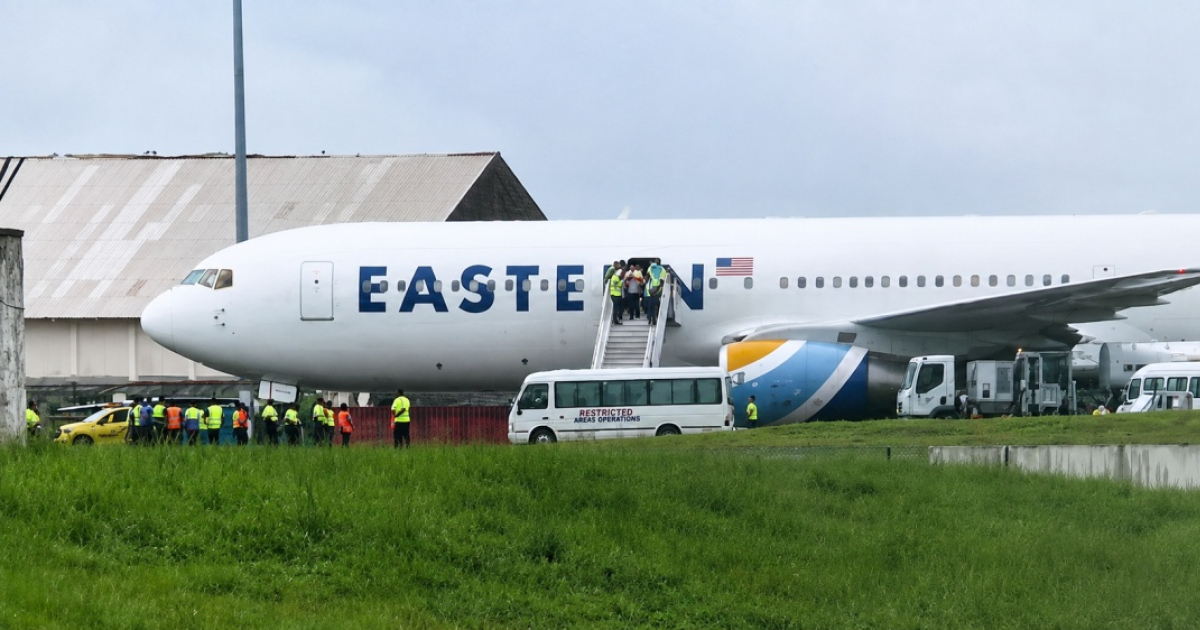
On Thursday, the inaugural flight carrying deportees under a new arrangement between the United States and Liberia landed at Roberts International Airport, located in Harbel, just outside Monrovia. This agreement allows the African nation to accept up to 1,200 migrants from various countries over the next year.
Among the 20 individuals deported on this flight, some were identified as Cuban nationals, as reported by Reuters and confirmed by Liberia's Information Minister.
Jerolinmek Piah, Liberia's Information Minister, specifically highlighted the presence of Cubans. "Most of the individuals are from Latin American countries, including Venezuela, Cuba, Colombia, and others," he stated to Reuters.
Despite this confirmation, Liberian authorities did not provide detailed information on the nationalities of the deportees or specify how many Cubans were on the initial flight.
Journalists from AFP, present at the airport, were kept at a distance and were unable to speak with any of the arriving passengers.
The flight originated in Louisiana, making a stopover in Dakar, Senegal, before reaching its final destination in Liberia.
Unclear Terms and Financial Involvement in the U.S.-Liberia Agreement
Liberia's Justice Minister, Natu Oswald Tweh, clarified that the government had reviewed the list of migrants before they arrived. He noted that most had committed immigration-related offenses and that the deported individuals could apply for asylum in Liberia or leave at their discretion.
The agreement between Washington and Monrovia was signed in September 2025 and publicized by the U.S. State Department in March 2026, though the Liberian government only announced it publicly earlier this week.
While the Liberian administration claims the deal is not a transactional quid pro quo and that it has not received compensation, Reuters reported that the U.S. provided $5 million to Liberia for "migration management activities" earlier in the year.
Robert Blair, a Brown University professor with expertise in Liberian politics, expressed skepticism about these claims to Semafor, suggesting that Monrovia likely expects "some kind of favorable treatment" from Washington in the future.
An anonymous immigration attorney summarized the situation, saying, "Everyone's speculating because very little is documented."
The State Department refused to elaborate, describing the implementation of Trump's immigration policies as a "top priority." Meanwhile, the Department of Homeland Security cited "operational security reasons" for not confirming the deportations.
Cuban Deportations to Africa: A Precedent
This is not the first instance of Cuban deportations to African countries. Since July 2025, the U.S. began sending Cubans to Eswatini under a similar deal that involved up to 160 deportees in exchange for $5.1 million in aid.
One of the most notable cases was that of Cuban Roberto Mosquera del Peral, who was detained in a maximum-security prison in Eswatini without formal charges. Additionally, Cubans have been sent to South Sudan, and in July of this year, the U.S. negotiated with Uruguay to accept deported Cubans.
Immigration attorneys have warned that these deportations to third countries exploit a legal loophole. The Trump administration argues it is only prohibited from directly returning migrants to the countries they fled, not to nations they have never been to, and where they may face security risks.
In February 2026, a federal judge in Massachusetts deemed this policy illegal for failing to allow prior notification or the opportunity to contest the transfer. However, enforcement of the ruling has been temporarily suspended.
A Global Network of Deportations
The agreement with Liberia is part of Trump’s broader immigration strategy. According to Third Country Deportation Watch, a coalition of Refugees International and Human Rights First, the U.S. has forged agreements with at least 35 countries, deporting over 23,000 people to 26 nations under these frameworks.
In Africa, Liberia joins a network that includes Eswatini, the Democratic Republic of the Congo, Rwanda, Ghana, Uganda, Equatorial Guinea, Sierra Leone, Cameroon, and South Sudan.
With the capacity to receive up to 1,200 deportees within a year, the agreement with Liberia is one of the largest in volume that the Trump administration has negotiated on the African continent.
Frequently Asked Questions About U.S. Deportations to Liberia
What is the agreement between the U.S. and Liberia about?
The agreement allows Liberia to accept up to 1,200 migrants deported by the U.S. over the next 12 months, as part of a broader immigration policy strategy.
Why are Cubans being deported to Liberia?
Cubans are among those deported to Liberia due to the U.S. agreements with third countries, which exploit a legal loophole allowing migrants to be sent to nations where they have never been, rather than their home countries.
How has the international community reacted to these deportations?
The deportations have drawn criticism for their lack of transparency and the potential risks migrants might face in the receiving countries. Legal challenges have also been made against these policies.
What financial involvement does the U.S. have in the agreement with Liberia?
The U.S. reportedly provided $5 million to Liberia for "migration management activities," raising questions about the true nature of the agreement.