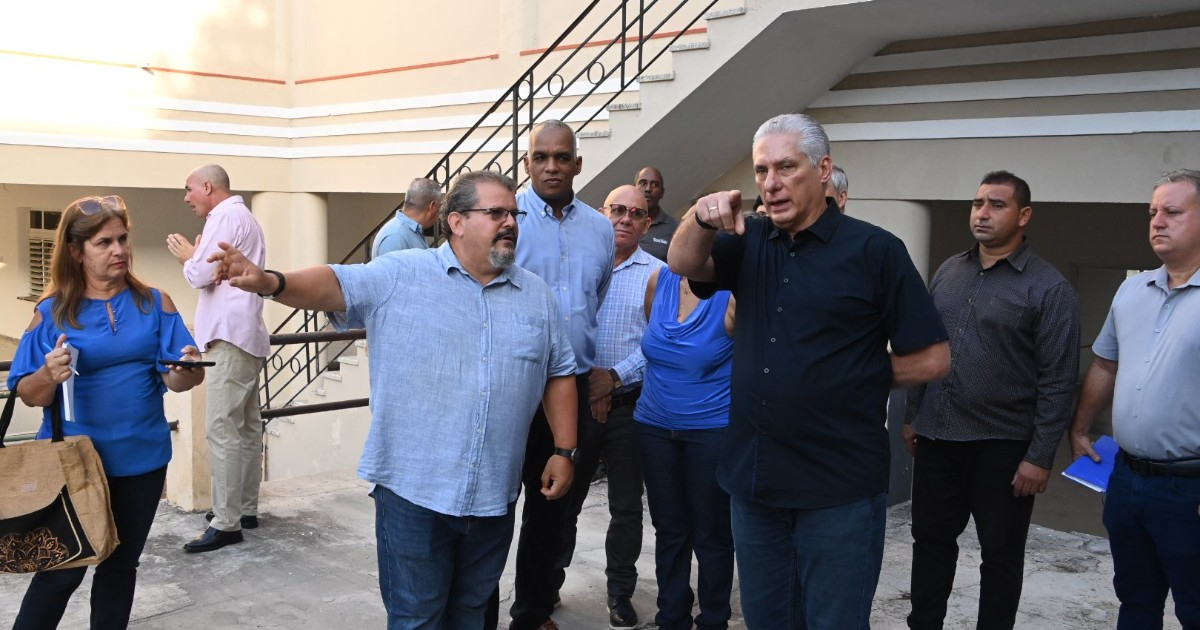
Amidst a severe crisis plaguing Cuba's educational system, characterized by a shortage of teachers, frequent power outages, and disruptions in teaching, government officials declared that "universities are our reason for being." This statement was made during a tour of Havana's Playa municipality, which the regime showcased as evidence of its support for higher education just days before the new school year was set to begin.
Cuban leader Miguel Díaz-Canel visited Playa on Thursday to inspect two institutions associated with higher learning: the upcoming headquarters of the Higher Institute of Design (ISDi) and the Science and Technology Interface Society at CUJAE, known as CETA S.A.
"Almost every province and university has their interface societies. Thus, this is our primary network of alliances. We have the Chamber of Commerce of the Republic of Cuba, which plays a crucial role for businesses. And we have our universities. The universities are our reason for being," stated CETA S.A. director, Danae Pigueiras Otero.
Meanwhile, Sergio Luis Peña Martínez, dean of ISDi, commented on the new premises established following the closure of the faculty's historic location: "The University of Design will have a new home, a completely rejuvenated and renovated space. During this challenging period, resources, efforts, and commitments have emerged to finally give the School of Design its space," he noted.
The necessity for a new facility stems from reasons the authorities prefer not to highlight. The historic ISDi building, located at Belascoaín and Carlos III in Centro Habana, was declared uninhabitable in 2022 due to severe structural damage.
The situation worsened over time: in July 2024, part of the building's interior facade collapsed, despite it being supported and closed off, and in January 2025, another partial collapse hospitalized a 78-year-old woman. The structure was ultimately demolished in March 2026 after years of neglect.
The construction, managed by crews from a Ministry of Construction enterprise, remains unfinished. However, the dean is optimistic that some classrooms may be operational by September.
Díaz-Canel's visit comes at a critical juncture for Cuban higher education.
In May 2026, the government suspended university entrance exams, replacing them with assignments based on high school academic indices. Additionally, the 2025-2026 academic year concluded prematurely between June 15 and 30, weeks ahead of schedule, due to the energy crisis crippling the nation.
The new university term for 2026-2027 is slated to commence on September 1, 2026, as confirmed by the Ministry of Higher Education.
Key Aspects of Cuba's Educational Challenges
What are the main issues facing Cuba's educational system?
Cuba's educational system is currently struggling with a severe shortage of teachers, frequent power outages, and disruptions in the teaching process.
Why was the historic ISDi building declared uninhabitable?
The historic ISDi building was declared uninhabitable in 2022 due to significant structural damage, which eventually led to its demolition in 2026 after years of deterioration.
How is the Cuban government addressing the higher education crisis?
The government has replaced university entrance exams with assignments based on high school academic performance, and is attempting to showcase support for higher education through visits and statements, despite the ongoing energy crisis.