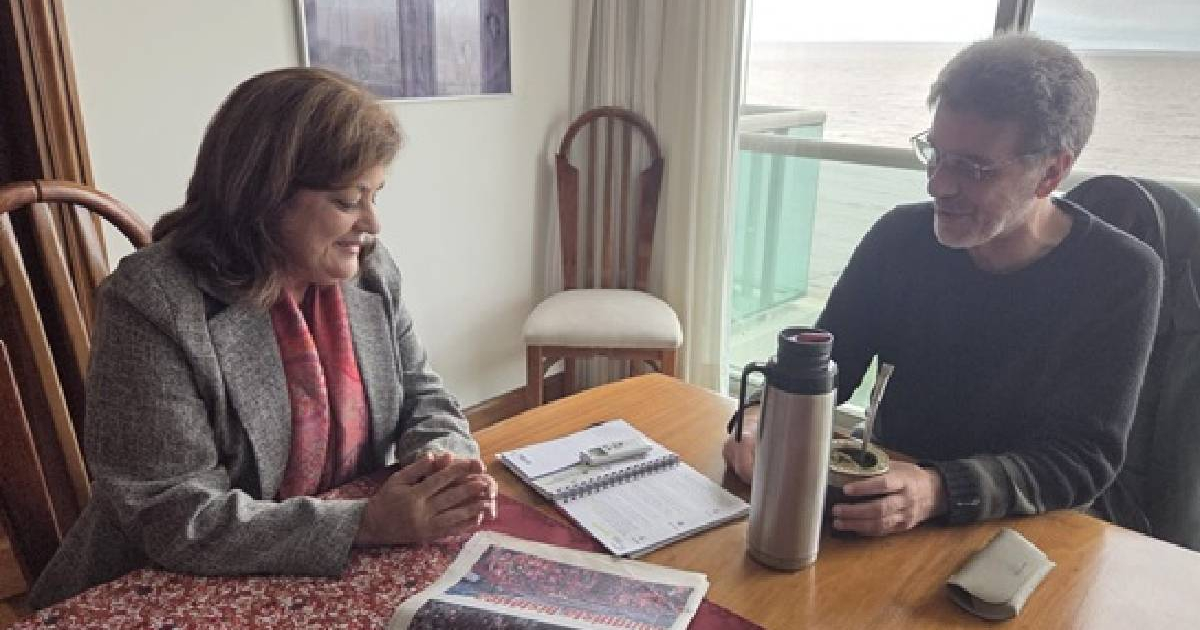
During an interview in Montevideo on Thursday, a Cuban deputy minister labeled the U.S. embargo as "genocide," but many Cubans have turned this argument around, pointing to the Cuban government itself as responsible for the humanitarian crisis plaguing the island.
Déborah Rivas Saavedra, the deputy minister of the Ministry of Foreign Trade and Foreign Investment (MINCEX), told the Uruguayan newspaper El Popular that "there is a genocide against Cuba, there's no other word for it," while attending an international meeting in the Uruguayan capital.
The official painted a grim picture of severe shortages, attributing them entirely to Washington's sanctions: "We can't perform surgeries on children, kids with cancer aren't receiving medication, and food is spoiling because it can't reach the country."
However, this narrative clashes with information that the Cuban government itself has acknowledged at other times.
The Reality Behind the Crisis
In May, the Minister of Energy and Mines, Vicente de la O Levy, conceded that Cuba had no reserves of fuel oil or diesel. Analysts and Secretary of State Marco Rubio have primarily linked this situation to the collapse of Venezuelan supplies and decades of structural failures under state management, not solely to the embargo.
Throughout 2026, the term "genocide" has been a central theme in Cuban official rhetoric. In July, Foreign Minister Bruno Rodríguez described the new U.S. sanctions package as "a clear demonstration of criminal and genocidal intent," and President Miguel Díaz-Canel stated that same month that Cuba is the target of "a coldly calculated genocide."
Contradictory Measures and Public Skepticism
While this narrative is repeated in international forums, at the UN, and in state media, the island faces its worst energy and supply crisis in decades, leading many citizens to point out that the true source of their suffering is in Havana, not Washington.
Simultaneously, in Montevideo, Rivas Saavedra defended the 176 economic and social transformation measures approved by the National Assembly in June. These measures include opening private banking, removing the cap of 100 workers for small and medium-sized enterprises, and increasing foreign capital involvement.
"We are not engaging in a rapid privatization of the economy," she stated, denying any return to capitalism.
The deputy minister framed these measures as the outcome of "years of analysis" with roots in the 2011 VI Communist Party Congress, aimed at "preserving the gains of the Revolution."
However, public skepticism towards these transformations is widespread: many Cubans remember that what is now being presented as a solution was prohibited for decades by the same system that now promotes it.
As the regime increases its international appearances to blame the embargo for every shortage, the question circulating within the island points in another direction: Who has been managing the economy for 67 years that today cannot ensure medication for children with cancer?
Examining Cuba's Economic and Humanitarian Crisis
What is Déborah Rivas Saavedra's stance on the U.S. embargo?
Déborah Rivas Saavedra, a Cuban deputy minister, has described the U.S. embargo as "genocide," blaming it for the severe shortages and humanitarian crisis in Cuba.
What are the key factors contributing to Cuba's current crisis?
Analysts point to the collapse of Venezuelan supplies and decades of structural failures under state management as major contributors to Cuba's crisis, alongside the U.S. embargo.
What are the new economic measures introduced in Cuba?
Cuba's National Assembly approved 176 economic and social transformation measures, including private banking access, lifting the worker cap for small enterprises, and increasing foreign investment.