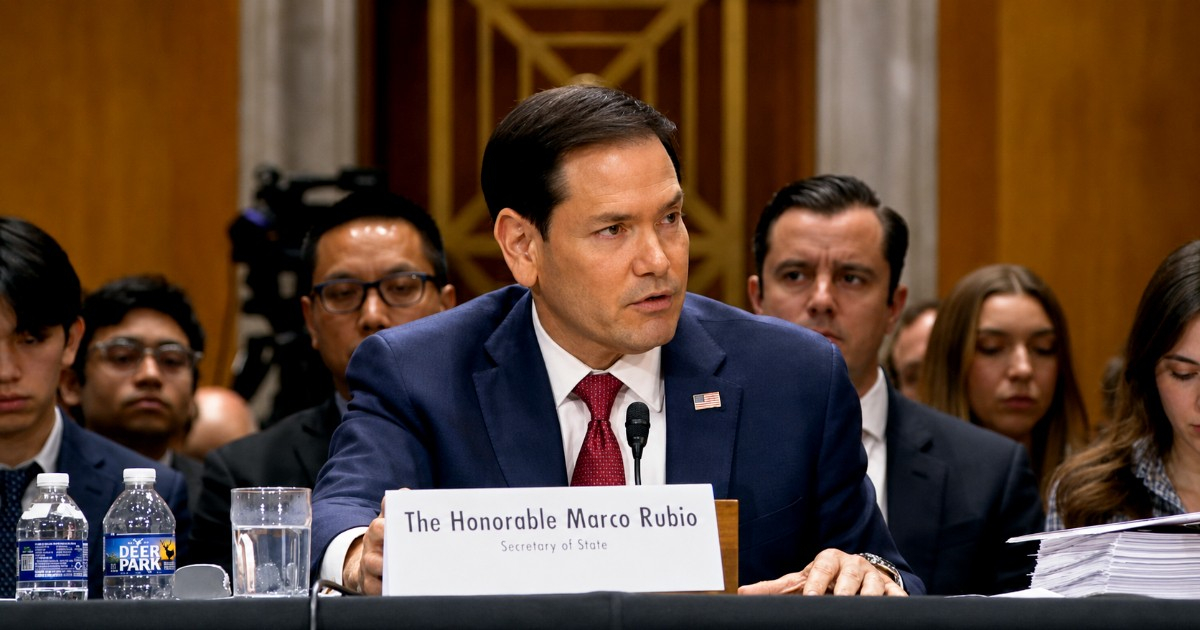
On Thursday, Secretary of State Marco Rubio accused the Cuban regime of employing a network of front organizations for decades to "infiltrate, corrupt, and radicalize" American citizens. This announcement came as he introduced a new round of sanctions targeting leaders of the Cuban Institute for Friendship with the Peoples (ICAP) and nine entities linked to Havana's repressive and economic machinery.
"The Cuban regime has spent decades using front groups to infiltrate, corrupt, and radicalize American citizens," Rubio declared while announcing Executive Order 14404, officially titled "Imposing Sanctions on Cuban Regime Actors Associated with Marxist Subversive Networks and Corrupt Economic Dealings."
The individuals identified in the sanctions include Fernando González Llort, president of ICAP; Noemí Ramona Rabaza Fernández, first vice-president; and Leima Martínez Freire, director for North America.
González Llort's case is particularly noteworthy: he was arrested in 1998 and sentenced in 2001 for his involvement in the Wasp Network, a Cuban intelligence network that infiltrated exile groups in Miami, operating under the alias "Rubén Campa."
After serving approximately 15 years in a U.S. prison, he returned to Cuba in 2014 and has been leading ICAP since 2017, an organization Washington considers a primary tool of the regime's foreign influence.
The timing was significant: a day before the sanctions, President Miguel Díaz-Canel publicly congratulated González Llort on his birthday.
The nine sanctioned entities include the Cuban Ministry of Construction, the Comandante Ernesto Che Guevara Nickel Company, the Geominero Salinero Business Group (GEOMINSAL), and the Commercial Representations Contracting Agency S.A. (ACOREC S.A.).
Rubio emphasized the international reach of the sanctions: "Foreign banks and other companies providing services or holding funds for these entities must take immediate steps to cease their support," he warned, making it clear that any actor supporting those sanctioned risks being designated as well.
This isn't the first instance of ICAP being at the center of U.S. sanctions. On June 4, 2026, the Treasury Department had already listed it on the Specially Designated Nationals (SDN) list by the Office of Foreign Assets Control, accusing it of supporting Cuban intelligence and counterintelligence activities.
The institute previously rejected these accusations and demanded removal from the list, arguing that in its 65 years of existence, it has focused on promoting international friendship and solidarity.
This recent action is the latest in an ongoing campaign initiated with the signing of Executive Order 14404 in May 2026, which has included rounds of sanctions in June, July, and August against the regime's military, financial, mining, and construction sectors.
In July, Washington also unveiled a plan linked to the Cuban regime to mobilize protests on U.S. soil, reinforcing the Trump administration's narrative of Cuban subversion within the United States.
Analyses cited by specialized media estimate that nearly 90% of ICAP personnel are affiliated with Cuban intelligence services, a claim the institute categorically denies.
Understanding U.S. Sanctions on Cuba
What are the main allegations against ICAP?
ICAP is accused of being a central instrument for foreign influence used by the Cuban regime, with allegations of involvement in intelligence and counterintelligence activities against the United States.
Who are the key figures targeted by the sanctions?
The sanctions target Fernando González Llort, Noemí Ramona Rabaza Fernández, and Leima Martínez Freire, all of whom hold significant roles within ICAP.
How do these sanctions impact international businesses?
International businesses, including foreign banks, are urged to cease support or services to the sanctioned Cuban entities to avoid penalties or being designated themselves.