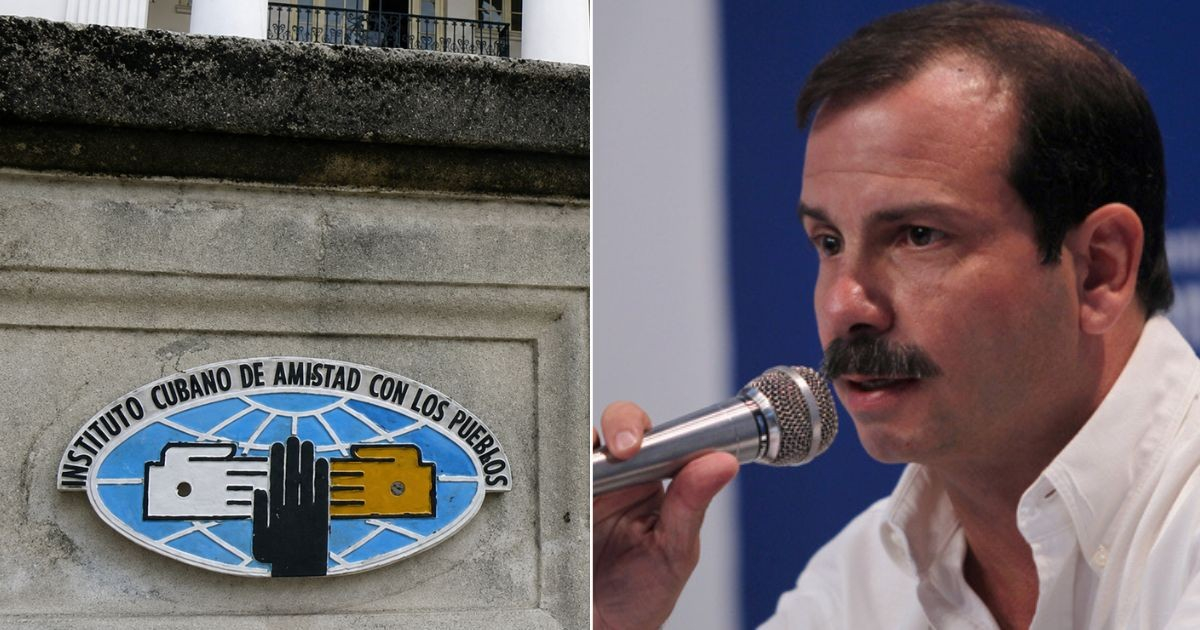
This Thursday, the United States imposed sanctions on Fernando González Llort, a former spy and current president of the Cuban Institute of Friendship with the Peoples (ICAP), alongside two other key figures of the organization: Noemí Rabaza Fernández and Leima Martínez Freire.
The action was taken by the Office of Foreign Assets Control (OFAC), a branch of the Treasury Department, which added these individuals to the list of Specially Designated Nationals and Blocked Persons (SDN) under Executive Order 14404. They were explicitly identified as being associated with ICAP.
González, who leads ICAP since 2017, was previously part of the Wasp Network, a group dismantled in Florida in the late 1990s. He was convicted in the United States for espionage activities.
The sanctions also target Noemí Rabaza Fernández, ICAP's first vice president, and Leima Martínez Freire, director for North America.
Interestingly, the sanctions against González Llort come just two days after Cuban leader Miguel Díaz-Canel publicly congratulated him on his 63rd birthday, calling him a "Hero of the Republic of Cuba" and praising his dedication to the Revolution and his leadership at ICAP.
The OFAC's recent actions have expanded to include additional locations linked to ICAP, such as the Friendship House, Salvador Allende Memorial House, and the Julio Antonio Mella International Camp in Artemisa.
The individual sanctions come after Washington previously targeted ICAP on June 4, adding it to the SDN list along with the Committees for the Defense of the Revolution (CDR), the travel agency Amistur Cuba S.A., Minera La Victoria S.A., and the Ministry of the Revolutionary Armed Forces (MINFAR).
At that time, Washington described ICAP as a component of the Cuban government's international outreach structure. Founded in December 1960, ICAP officially portrays itself as an entity promoting solidarity and friendly relations between Cuba and foreign organizations.
The measures against Fernando González Llort, Noemí Rabaza Fernández, and Leima Martínez Freire are part of a broader update to the SDN list that also included eight Cuban state enterprises and the Ministry of Construction, along with separate designations related to terrorism, drug trafficking, and Iran.
Understanding the Recent U.S. Sanctions on Cuban Figures
Who is Fernando González Llort?
Fernando González Llort is the president of the Cuban Institute of Friendship with the Peoples (ICAP) and was a former member of the Wasp Network, a group involved in espionage activities in the United States.
Why did the United States sanction ICAP?
The United States sanctioned ICAP as part of its efforts to counteract entities within the Cuban government's international outreach structure, which it views as problematic.
What is the significance of the SDN list?
The SDN list includes individuals and entities whose assets are blocked in the United States, and it prohibits U.S. persons from dealing with them. It is a tool used to combat terrorism, drug trafficking, and other threats.
What was Miguel Díaz-Canel's reaction to the sanctions?
Cuban leader Miguel Díaz-Canel had recently praised Fernando González Llort for his dedication to the Revolution, calling him a "Hero of the Republic of Cuba," just days before the sanctions were announced.