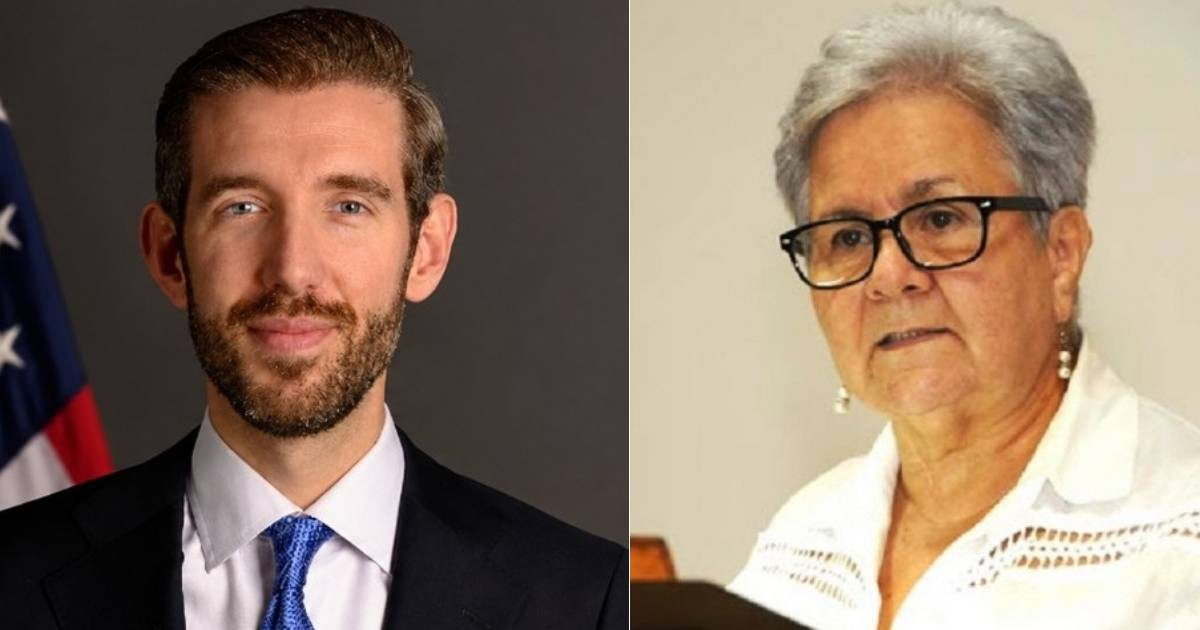
Recently appointed U.S. Assistant Secretary of State for Western Hemisphere Affairs, Juan Pablo Segura, has once again brought attention to the financial opacity of GAESA. He recalled the case of former Cuban Comptroller General Gladys Bejerano, who publicly admitted in 2024 that the state audit authority could not scrutinize the powerful military-run business conglomerate.
From his official account on X, @WHAAsstSecty, Segura linked Bejerano's departure from the Comptroller General's office to those statements. This interpretation starkly contrasts with the narrative provided by Cuban authorities at the time.
"The former Vice President of the Council of State and Cuba's Comptroller General for 14 years was ousted by the Cuban regime for publicly stating the truth—that the State had no jurisdiction to audit GAESA. This is just one example of how GAESA has looted $18 billion from the Cuban people's money," Segura wrote.
The post included a graphic displaying partially redacted financial documents and a phrase summarizing Washington's accusation: "GAESA: EVEN CUBA'S MAIN AUDIT BODY COULD NOT AUDIT THEM."
Revelations Exposing GAESA's Immunity
Bejerano led the Comptroller General's Office from its establishment in 2009 until July 2024, also serving as Vice President of the Council of State for part of that tenure. In May 2024, during an interview with EFE regarding a corruption case involving former Economy Minister Alejandro Gil, Bejerano admitted that GAESA was beyond the reach of the Comptroller's audits.
She justified this situation by claiming the military conglomerate had "superior discipline and organization." Her statement was especially significant, coming from the top official responsible for overseeing public resource management, confirming that one of Cuba's largest business entities was not subject to inspection.
Just two months later, the National Assembly replaced Bejerano with Mirian Marbán González. Cuban authorities portrayed the change as part of a "natural process of cadre renewal." Although no public evidence has been presented to directly link her statements to her replacement, the timing has reignited criticism over the secrecy surrounding the military conglomerate's finances.
GAESA's Billions Shielded from Public Scrutiny
The issue gained further attention following the leak of GAESA's internal financial documents, revealing the scale of resources managed by the conglomerate. The $18 billion figure mentioned by Segura references a Miami Herald investigation in August 2025 based on 22 leaked financial documents.
According to these records, by March 2024, companies within the conglomerate—including Gaviota, TRD Caribe, CIMEX, and Almacenes Universales—held approximately $17.8 billion in current assets, with about $14.467 billion in bank accounts. These documents provided a previously unknown glimpse into the magnitude of resources under GAESA's control while Cuba's economy faced a severe crisis marked by blackouts, food and medicine shortages, and deteriorating public services.
Legal Protections for GAESA's Operations
The lack of oversight over military enterprises is not solely due to internal practices. The 2022 General Comptroller's Office Law, published in the Official Gazette in February 2023, altered the framework for controlling institutions linked to military structures.
This law removed previous references to auditing these organizations, leaving their oversight subject to specific mechanisms under presidential supervision, heightening criticism about the absence of independent public audits of GAESA.
The conglomerate dominates strategic sectors of the Cuban economy, particularly tourism, retail, remittances, logistics, and real estate operations. However, its financial statements are not regularly published for public knowledge.
Washington Intensifies Pressure on GAESA
This publication marks one of Segura's first high-profile statements on Cuba since taking office on August 14, following Senate confirmation. His message aligns with Washington's offensive against GAESA, which the Trump administration identified as a key economic pillar of Cuban military power.
In May, Secretary of State Marco Rubio announced direct sanctions against the conglomerate and its CEO, Ania Guillermina Lastres Morera. Subsequently, Washington increased pressure on foreign companies maintaining commercial relations with entities linked to GAESA.
In early August, the State Department once again highlighted the funds managed by the conglomerate, questioning why GAESA does not utilize them to meet the basic needs of Cubans. This question carries particular weight amid a crisis where millions endure prolonged blackouts and struggle to access food, medicine, and other essential products.
Segura's message now revives a contradiction that Bejerano's 2024 statements exposed: for years, the top authority responsible for auditing state resources acknowledged an inability to scrutinize one of the conglomerates concentrating a substantial portion of the nation's economic activity.
Understanding GAESA's Influence and Impact
What is GAESA, and why is it significant?
GAESA, or Grupo de Administración Empresarial S.A., is a Cuban military-run business conglomerate. It is significant due to its control over key sectors of the Cuban economy, such as tourism, retail, and real estate, and its financial opacity, which has drawn international scrutiny.
How did Gladys Bejerano's statements impact perceptions of GAESA?
Gladys Bejerano's admission in 2024 that GAESA was beyond the reach of state audits highlighted the conglomerate's financial immunity and fueled criticism of its lack of transparency, challenging the Cuban government's narrative of accountability.
What actions has the U.S. taken against GAESA?
The U.S. has imposed sanctions on GAESA and its CEO and increased pressure on foreign businesses engaged with the conglomerate, as part of a strategy to weaken the economic foundation of Cuba's military power.