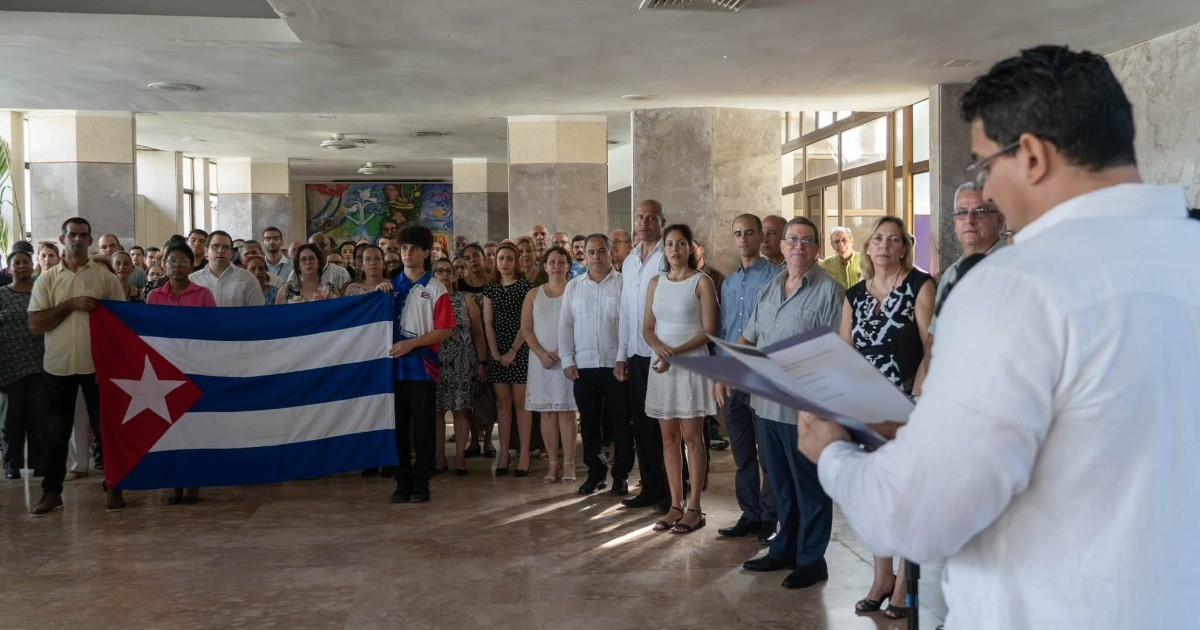
The return of Cuban diplomats expelled from the Dominican Republic has sparked a wave of satire and mockery on social media. On Wednesday, after Miguel Díaz-Canel welcomed them back on X as "honorable diplomats" who had fallen victim to an American conspiracy, the internet was quick to react.
In a message of welcome, President Díaz-Canel attributed the expulsion to "Washington's increasing efforts to isolate Cuba," assuring that ties between the two countries "will eventually be restored."
The images accompanying his post featured the group posing in front of the MINREX building in Havana, seemingly as part of an official reception. However, the regime's narrative failed to convince many Cubans, who took to commenting with sarcasm about the reality awaiting the exiled diplomats back home.
"You can see the joy on their faces for returning to their homeland. So many wonderful things await them," one user wrote. Another chimed in with similar irony: "They'll enjoy what they've been defending. Surely they're being welcomed with a solar panel and a bottle of oil."
Contradictions and Criticisms
The irony of labeling the diplomats as "honorable" despite their expulsion did not go unnoticed. "There's a bit of inconsistency in those three words. If they were so honorable, how could they have been expelled?" one commenter questioned.
Another was more blunt: "They weren't expelled from the Dominican Republic because of their honor; it was quite the opposite."
Many users openly dismissed the official explanation for the expulsion. "They weren't expelled due to any Washington escalation to isolate Cuba. You know very well they were expelled for conducting activities unrelated to their diplomatic roles during the Central American and Caribbean Games," one netizen argued. Others were more succinct: "Diplomats or spies?" and "They were spies and security agents."
Speculation on Future Plans
Some also speculated about what lies ahead for the expelled diplomats: "And now, where will they go? They'll probably find a way to reach the United States; they've gotten used to the good life." Another added, "Here they'll face hardships, alongside the people they represented abroad."
The background of the case suggests alleged intelligence activities during the 2026 Central American and Caribbean Games in Santo Domingo.
Dominican security reportedly identified Cuban agents infiltrating sports facilities, some disguised in other delegations' uniforms, with the alleged aim of monitoring athletes and preventing defections. At least five Cuban athletes defected during the games.
On August 13, the Dominican Foreign Ministry informed nine members of the Cuban diplomatic mission that they had seven days to leave the country, citing Article 9 of the Vienna Convention. Including family members, the decision affected around 21 individuals in total.
The Dominican government did not publicly explain the reasons, while the Cuban regime vehemently rejected the decision and accused Santo Domingo of succumbing to pressure from Washington.
The expulsion did not result in a formal severance of diplomatic ties; the Cuban embassy continued its operations with the remaining staff.
Insights on the Diplomatic Expulsion
Why were Cuban diplomats expelled from the Dominican Republic?
The expulsion was reportedly due to Cuban diplomats conducting activities outside their diplomatic roles during the Central American and Caribbean Games, possibly involving intelligence operations.
How did the Cuban government respond to the expulsion?
The Cuban government rejected the expulsion, describing it as a result of Washington's pressure on Santo Domingo and claimed it was part of efforts to isolate Cuba.
What was the public reaction in Cuba to the diplomats' return?
The return of the diplomats was met with sarcasm and skepticism on social media, with many Cubans questioning the official narrative and mocking the diplomats' situation.