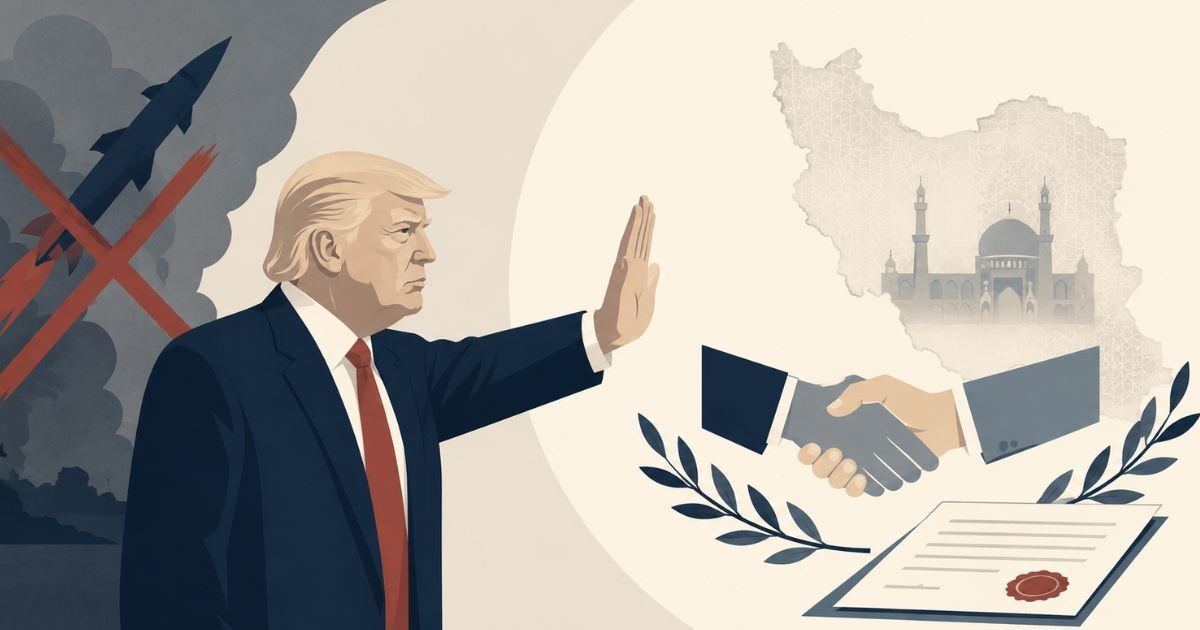
President Donald Trump declared on Wednesday what he termed as "the most crushing economic operation ever taken against any country," targeting the Islamic Republic of Iran. He described Iran as a nation "hanging by a thread."
The announcement, shared on his Truth Social account, was labeled an "Economic D-Day," drawing a parallel with the Allied landings of World War II.
"This will be economic warfare and isolation on an unprecedented scale," wrote Trump. He further claimed that Iran's navy "has vanished," its air force "is destroyed," its military factories "are rubble," and its currency "is worthless."
The declaration follows the collapse of a 60-day negotiation period between Washington and Tehran that ended last week without any agreement.
Escalation Beyond Diplomacy
On Tuesday, Trump confirmed that there are no ongoing or planned talks with Iran, leaving the conflict without a visible diplomatic resolution.
Trump warned that any country whose banks, businesses, airports, or government entities provide a "lifeline" to Iran will face "tremendous economic consequences."
He outlined specific mechanisms that must immediately cease: "Oil smuggling, currency exchange lines, cash transfers, currency exchanges, ship registrations, and shell companies. All must stop now. You know who you are."
Operation Economic Fury
The measure formalizes and publicly escalates the so-called Operation Economic Fury, which the Trump administration has been conducting since April 2026 alongside military pressure.
Treasury Secretary Scott Bessent had hinted on Monday that unprecedented measures would be implemented against Tehran, describing the plan as a "two-step punch": economic isolation combined with the naval blockade of the Strait of Hormuz.
Trump confirmed that this blockade "remains in full force and effect," impacting a route that previously channeled approximately 20% of the world's oil.
Senate Sanctions and Regional Tensions
The U.S. Senate approved new sanctions on August 7 against Iran's energy and arms sectors, effective until 2031.
The context is one of heightened tension. On Wednesday, the British newspaper Financial Times reported, citing two Iranian government sources, that Tehran is considering attacking U.S. military bases in Bulgaria and Cyprus if Trump intensifies the offensive.
General Ali Abdollahi, Chief of Staff of the Iranian Armed Forces, issued a direct warning to Gulf countries: "Any aid or facilitation given to the U.S. aggressor army will be considered as participation with the U.S. military forces."
On the same day, the United Arab Emirates suspended all commercial relations, trade exchanges, and financial transactions with Iran, accusing Tehran of launching two ballistic missiles against its territory. Iranian Foreign Ministry spokesperson Ismail Bagaei dismissed these accusations as "baseless."
Origins of the Conflict
The conflict stems from Operation Epic Fury, the coordinated attacks launched by the U.S. and Israel against Iran on February 28, 2026.
Following a ceasefire and a memorandum of understanding signed in Switzerland in June, Iran declared its commitments suspended on July 18, prompting Trump to resume the aerial offensive later that month.
Trump concluded his announcement with a stern warning: "These fanatics are on the ropes, and these historic measures will cripple them and their ability to project terror worldwide. Iran will never have a nuclear weapon."
Questions About Trump's Economic Measures Against Iran
What are the economic measures announced by Trump against Iran?
The economic measures include a comprehensive isolation tactic that ceases oil smuggling, currency exchanges, cash transfers, ship registrations, and the use of shell companies, among other actions.
What is the historical comparison Trump uses for these economic actions?
Trump refers to these economic actions as an "Economic D-Day," comparing it to the Allied landings during World War II.
How has the international community reacted to the measures against Iran?
The United Arab Emirates has suspended all trade and financial transactions with Iran, while Iran has dismissed accusations of missile attacks on UAE territory as baseless.