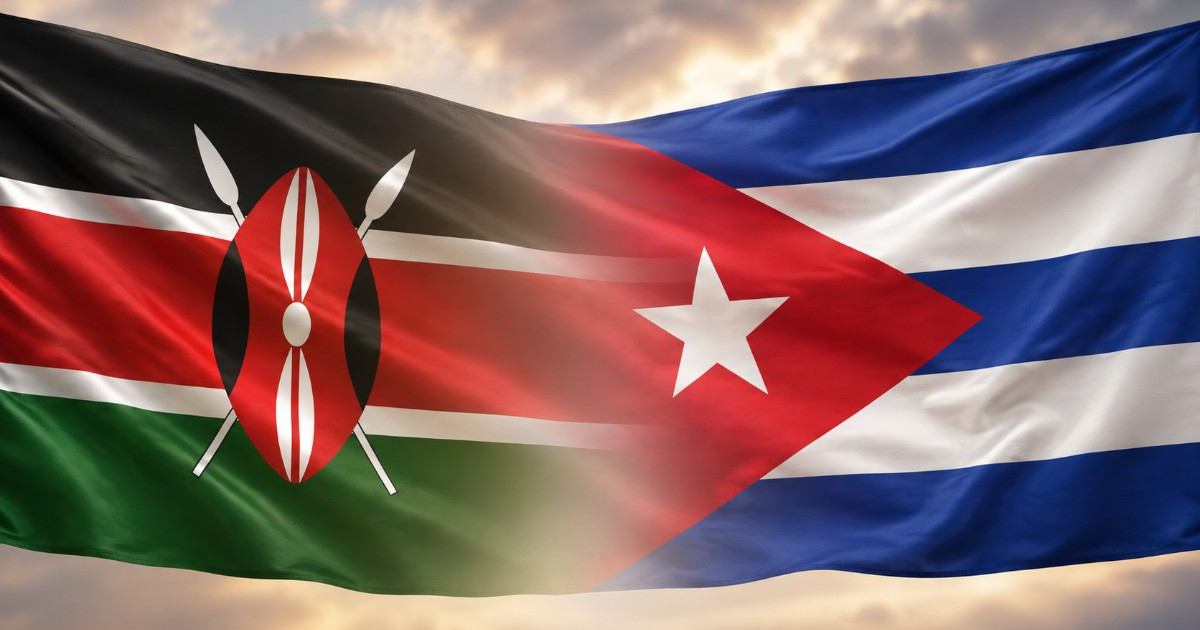
Kenya has officially shut down its embassy in Havana, relocating its Caribbean diplomatic operations to Kingston, Jamaica. This move marks the end of a decade where Cuba served as Nairobi's primary diplomatic base in the region. Despite the relocation, the diplomatic ties between the two nations remain intact.
This development was reported on Monday by Kenyan Foreign Policy, highlighting that the Havana office has been closed and its duties have been transferred to Jamaica.
Back in July, Kenya's Ministry of Foreign Affairs had already announced a "transition" of its diplomatic operations from Havana to Kingston.
The newly established Kenyan High Commission in Jamaica commenced its operations officially in July. Karisa Mwenda, who previously served as Kenya's representative in Havana, relocated to Kingston to become the first resident High Commissioner of the African nation in Jamaica.
The Kenyan government has framed the establishment of this mission as a strategic effort to deepen political and economic ties with Jamaica and expand its trade, investment, cultural, and consular activities in the Caribbean. Nairobi views Kingston as a strategic entry point to the Caribbean Community (CARICOM) market.
The Ministry of Foreign Affairs expressed gratitude to the diplomatic staff for ensuring what it termed a "smooth" transition of operations from Havana to Kingston, underscoring that the new Jamaican headquarters would practically replace the regional role once played by the Cuban mission.
Kenya's embassy in Cuba, which opened in 2016, was its first diplomatic mission in the Caribbean. From Havana, Kenya managed its relations with several Caribbean, Central American, and South American countries.
Nairobi's decision to close the embassy does not imply a severance of diplomatic relations with Havana. Cuba continues to maintain its embassy in Nairobi, and Kenya will still have diplomatic representation with the Cuban government through a non-resident ambassador based in Kingston, as per Kenyan Foreign Policy.
This reorientation concludes a chapter in the bilateral relations where healthcare cooperation was significant. In 2018, a contingent of 100 Cuban medical specialists was dispatched to Kenya under an agreement aimed at addressing staffing shortages in medical facilities across various counties. This program concluded in 2023.
The collaboration was also marked by one of the gravest incidents involving Cuban medical missions abroad. Doctors Landy Rodríguez Hernández and Assel Herrera Correa were abducted on April 12, 2019, in Mandera, northeastern Kenya, while en route to the hospital under escort. The attack, attributed to the Islamist group Al-Shabaab, resulted in the death of a Kenyan police officer.
In 2024, Al-Shabaab claimed that the two doctors had died during a U.S. airstrike in Somalia, but this claim was never independently verified. Seven years after the abduction, Cuban authorities have yet to provide a definitive confirmation regarding their fate.
Recently, both Kenya and Cuba have been connected, albeit separately, to another international issue: the recruitment of foreign nationals to fight alongside Russia in Ukraine. Kenyan authorities acknowledged instances among their nationals, repatriated dozens, and shut down over 600 recruitment agencies. Meanwhile, no updated official figures have been released in Cuba on how many of its citizens have joined Russian forces.
Kenya's Diplomatic Transition from Cuba to Jamaica
What prompted Kenya to move its diplomatic operations from Cuba to Jamaica?
The shift is part of Kenya's strategy to strengthen political and economic relations with Jamaica and to access the Caribbean Community (CARICOM) market more effectively.
Will Kenya maintain diplomatic relations with Cuba despite closing its embassy?
Yes, Kenya will continue its diplomatic relationship with Cuba through a non-resident ambassador based in Kingston, Jamaica.
What was the impact of Cuban medical collaboration in Kenya?
Cuban medical professionals were deployed to address staffing shortages in Kenyan healthcare facilities. However, the collaboration also saw significant challenges, including the abduction of two Cuban doctors by Al-Shabaab.