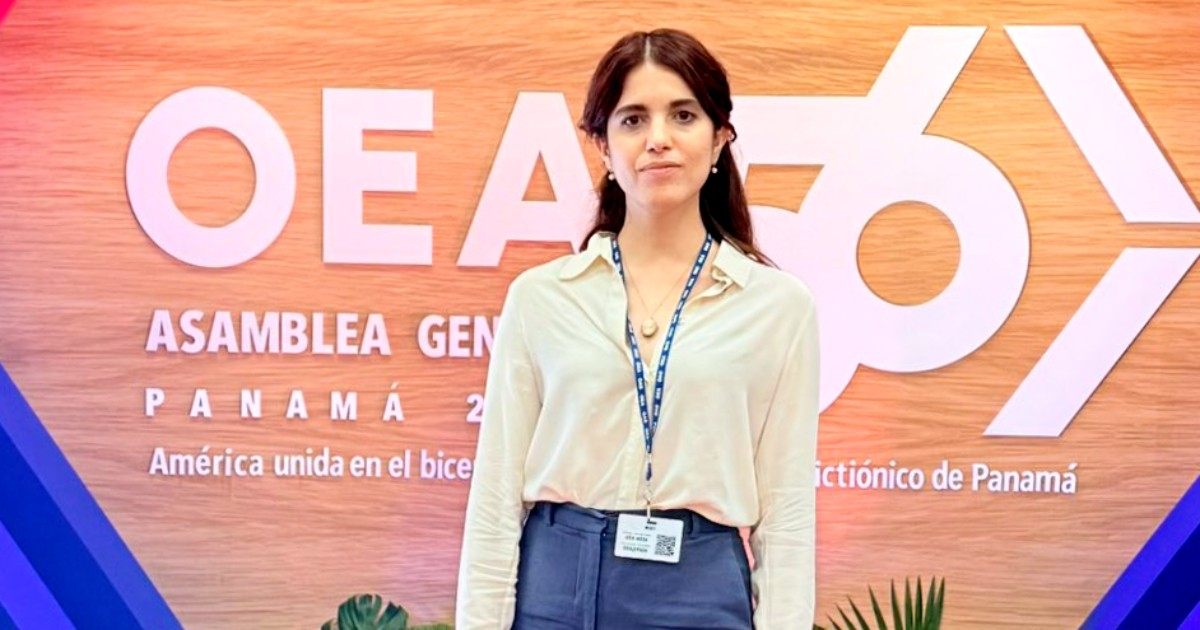
The renowned Cuban art historian and activist, Carolina Barrero, has arrived in Miami to embark on a new academic journey as she begins her doctoral studies at the University of Miami (UM). Her program, focused on literary studies, promises to intertwine with political discourse.
In a statement shared on her X account, Barrero described her move as "a return to the Americas, closer to the homeland," expressing her excitement to join a city she considers "sustained by the perseverance of Cuba's memory."
Barrero sees this academic chapter as a deep dive into "a distinctly Cuban tradition where the word has never been detached from the polis," thereby connecting historical narratives with the socio-political discourse of numerous Cuban leaders and intellectuals.
Despite her geographical transition, Barrero emphasized that her ties with Europe and Spain, as well as her advocacy work with European institutions, remain strong. She expressed gratitude to her team at Ciudadanía y Libertad for their continued growth on both sides of the Atlantic.
As a prominent figure in her generation of Cuban civic activism, Barrero has been intricately connected to the San Isidro Movement (MSI). She actively participated in the 27N protests, which marked a historic public demonstration in Havana on November 27, 2020, where artists, intellectuals, and journalists demanded an end to repression and censorship.
In February 2022, Barrero was compelled into exile in Spain under threat of imprisonment due to her activism in defending those detained during the July 11, 2021 protests. Upon leaving the island, she asserted, "leaving Cuba does not mean abandoning Cuba," pledging to continue her fight for civil and political rights.
During her four years in Madrid, she established a robust network of advocacy efforts with European institutions, the United Nations, and the Organization of American States (OAS). In March 2024, she was awarded the Sájarov Fellowship by the European Parliament, a recognition for human rights defenders. By July of that year, she publicly launched Ciudadanía y Libertad, a nonpartisan organization dedicated to promoting democratic culture and civil rights in Cuba.
Barrero's arrival in Miami follows closely behind the arrival of Luis Manuel Otero Alcántara, a leader of the MSI, who reached the city on July 18 after serving a five-year sentence in Cuba, released under the condition of permanent exile. Otero's arrival stirred significant anticipation within the Cuban exile community in Miami, which has since evolved over time.
Functioning as a bridge between the European exile community, where she engaged with parliaments and international organizations, and the Miami exile community, Barrero plays a crucial role.
In May 2026, Barrero cautioned that "the fall of the dictatorship does not automatically ensure a consolidated democracy," highlighting the need to strengthen democratic culture to prevent new authoritarian regimes.
In July, she insisted that Cuban civil society must be included in any negotiations concerning the island's future, alongside demands for the release of political prisoners, free elections, and assurances against recurrence.
"I look forward to getting to know the community more closely, listening to them, and participating in everything that is to come," Barrero wrote, announcing her new chapter and promising to share updates soon on events and spaces where she will be involved.
Understanding Carolina Barrero's Impact and Future Plans
What is Carolina Barrero's new academic pursuit in Miami?
Carolina Barrero is starting a doctoral program in literary studies at the University of Miami, which will explore the intersection of literature and politics.
How does Barrero plan to maintain her European connections?
Barrero intends to keep her connections with Europe and Spain intact, continuing her advocacy work with European institutions while expanding her efforts across the Atlantic.
What role does Barrero play in the Cuban exile community?
Barrero serves as a key connection between the European and Miami exile communities, leveraging her experience in international advocacy to support Cuban civil rights and democratic culture.