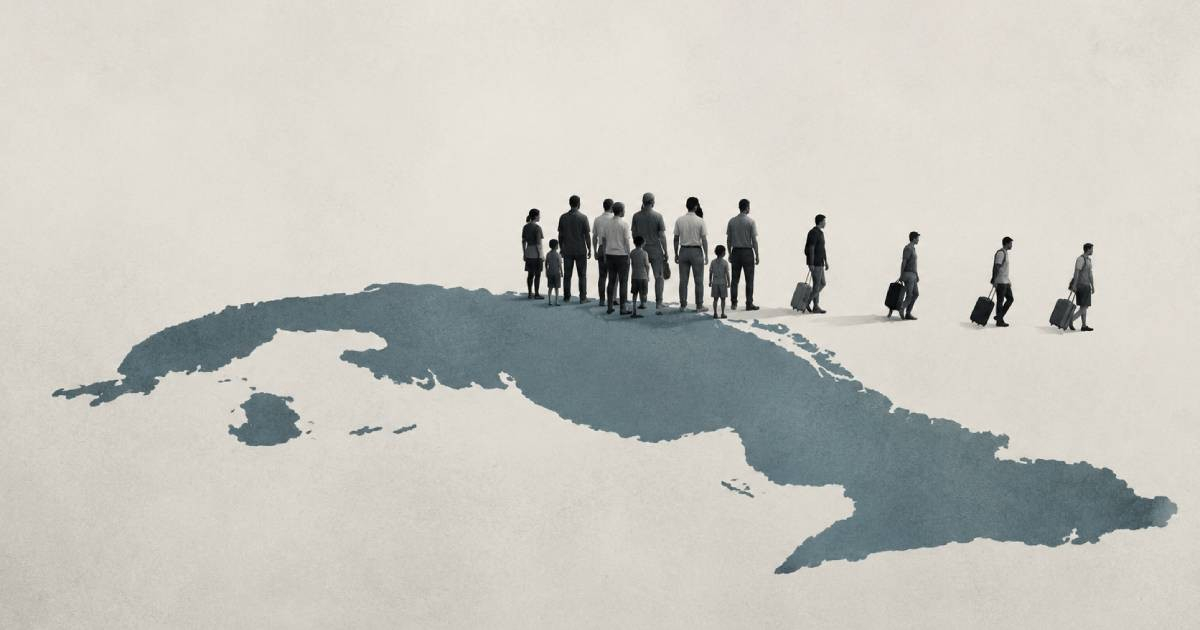
The population of Cuba may shrink to approximately 5.6 million if the current trends of low birth rates, high mortality, aging, and emigration persist, according to Cuban demographer Juan Carlos Albizu-Campos. He describes the situation as a rapid "demographic emptying" of the island.
In a conversation with Martí Noticias, Albizu-Campos outlined projections indicating a significant population decline in Cuba. He discussed scenarios where the population could drop to around 5.6 million if existing trends continue.
He further cautioned that such changes could become apparent much earlier than 2100, emphasizing that Cuba is experiencing a phenomenon far beyond a mere decrease in population numbers.
A Complex Demographic Crisis
The combination of sustained low fertility, rising mortality, the emigration of young people, and an aging population is exacerbated by economic, food, health, and social crises, which diminish future prospects, he stressed.
Albizu-Campos refers to this situation as a "polycrisis," arguing that demographic deterioration cannot be analyzed in isolation.
Women and Emigration
Many women, he explained, are reluctant to have children under the current conditions in the country, while others consider emigrating before starting a family. One concerning factor for the expert is the emigration of women of reproductive age. According to international data cited by Albizu-Campos, 57% of emigrants during the 2020 to 2024 migration wave were women.
This leads to not only an immediate reduction in population numbers but also a potential decline in future births if fewer women of childbearing age remain, even if individual fertility rates remain unchanged.
Discrepancies in Population Data
The demographer also questioned some official figures regarding the actual number of people residing in Cuba. According to his own estimates, the population was about 8.61 million by the end of 2023, significantly lower than the figures reported by authorities at the time.
Although recent official statistics are higher than independent estimates, they also confirm a sharp decline. Cuba ended 2025 with 9,434,593 inhabitants, down from 9,748,007 at the close of 2024, marking a loss of 313,414 people in just one year.
Challenges of an Aging Population
The natural population balance is particularly adverse. In 2025, there were 68,064 births compared to 136,214 deaths, meaning deaths nearly doubled births. The overall fertility rate stood at 1.29 children per woman, well below the generational replacement level of 2.1.
Emigration further deepened the decline. The official migration balance for 2025 was negative by 245,264 people. In just five years, the island's population fell from over 11 million to around 9.4 million, losing more than 1.25 million people of working age.
At the same time, Cuba is aging rapidly. Official data from 2025 shows that 26.7% of the population is 60 years or older, indicating that more than one in four Cubans falls into this age group.
Future Outlook and Potential Solutions
The trend has been accelerating over previous years. By the end of 2024, those over 60 represented 25.7% of the population. Villa Clara recorded 29.1%, Havana 28.1%, and the Plaza de la Revolución municipality reached 36.8%.
For Albizu-Campos, this process adds pressure to the pension system, social care, and health services, precisely as the economically active population supporting them decreases.
The largest generations from Cuba's so-called baby boom are now reaching retirement, a phenomenon the specialist describes as a "retirement boom."
The expert also sees little chance of a substantial recovery before 2030. He explains that reversing current trends would require profound transformations in political, legal, and economic spheres, along with policies to attract capital and revitalize essential sectors of the country.
He also considers it unrealistic to expect a mass return of emigrants to solve the issue. Those who settle in other countries build new lives there, and large-scale return migrations are not typically common.
The warning about a potential Cuba with only 5.6 million inhabitants aligns with a recurring projection by the United Nations Population Fund (UNFPA). If current trends persist, the island's population could end the 21st century around that number.
Albizu-Campos warns, however, that the reduction process is already underway, and its consequences could become evident much sooner.
He uses the term "demographic emptying" to describe the rapid loss of inhabitants caused by the combination of low fertility, mortality, and emigration.
The specialist argues that the solution does not simply lie in trying to raise birth rates. "There are no population problems, only populations with problems," he stated, linking decisions to emigrate, have fewer children, or delay motherhood to the conditions in which people live.
To halt the deterioration, he believes it's essential to rejuvenate the economy, restore basic services and healthcare infrastructure, create opportunities, and ensure rights.
His conclusion was straightforward: "The solution has to involve a change in the model in some way."
Until these changes occur, he warned, Cuba will continue to lose inhabitants and age, deepening a demographic crisis that is already altering the country's social and economic fabric.
Key Questions on Cuba's Demographic Trends
What are the main factors contributing to Cuba's population decline?
The primary factors include low fertility rates, high mortality, significant emigration, and an aging population, compounded by economic, food, health, and social crises.
How does the emigration of women affect Cuba's future population?
The emigration of women, especially those of reproductive age, leads to a reduced immediate population and a potential decline in future births, even if individual fertility rates remain unchanged.
What are the implications of an aging population in Cuba?
An aging population increases pressure on the pension system, social care, and healthcare services, while the economically active population that supports these systems decreases.