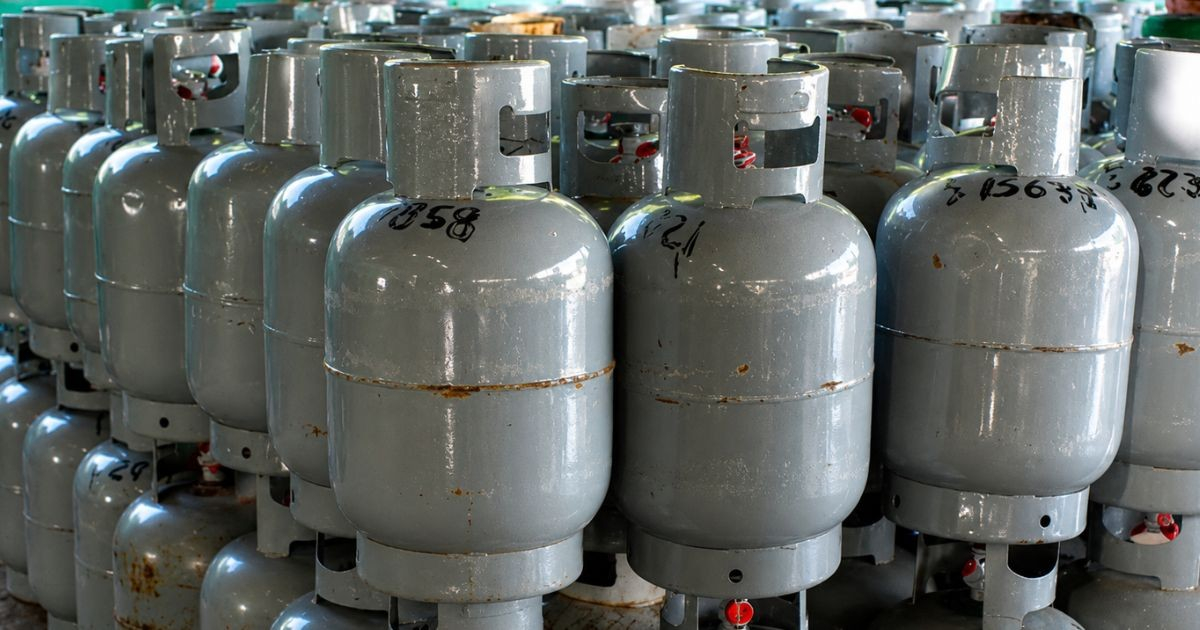
The ongoing shortage of liquefied gas in Santiago de Cuba has given rise to private offers at exorbitant prices that were unimaginable just a few years ago. A recent advertisement claims to deliver gas directly to homes for 65,000 pesos for a refill and 75,000 pesos if a cylinder is included, raising questions among users about the source and reliability of the service.
Adiel Ernesto Reyes Sánchez shared this offer in the Facebook group Compra y Venta Santiago de Cuba. He introduced himself as a self-employed worker and assured potential customers of the "guarantee" and "maximum security" of the product.
Unbelievable Prices and Skepticism
Reyes Sánchez explained that they collect the empty cylinder and deliver the gas to the customer's home without charging extra for transportation. When questioned about the price, he responded, "65,000 for the liquid and 75,000 for the cylinder with liquid." A skeptical user queried the authenticity of this offer, to which he firmly replied, "Yes, it is true."
However, the post quickly aroused suspicion. One promotional image showed dozens of green cylinders with the name Vidagas, a brand operating in Colombia under Inversiones GLP S.A.S. E.S.P., a subsidiary of Empresas Gasco. A user noted, "Those are photos from a Colombian company. The offer seems fishy."
Concerns Over Legitimacy
The seller countered that regardless of the image's origin, "the transaction is done in person and paid in national currency in cash." This explanation didn't erase all doubts, as another user remarked, "This seems odd."
Reyes Sánchez insisted he could provide contact numbers of regular clients to verify the service. Yet, another internet user questioned why, if the business was legal, it required private messaging to purchase such a high-demand product.
Tensions escalated when a user suggested that directing inquiries to private messages indicated "dubious origins," accusing such sellers of profiting from public need. The vendor denied any wrongdoing, stating, "There's nothing of dubious origin here," and claimed they also must pay to obtain the products they sell.
Context of Desperation
Another individual asked, "How long will you play with the people's needs?" to which the seller replied, "No one is playing with anyone; this is serious business."
Despite the vendor's reassurances, the post lacks documentation to independently verify the gas's origin, the business's supply chain, or specific sales conditions. The use of promotional material linked to a Colombian company does not alone prove a scam but has fueled doubts among potential buyers.
The context sheds light on why such offers appear and why they find interest even at exorbitant prices. In January, CUPET indefinitely halted liquefied gas distribution in Santiago de Cuba and other eastern provinces due to supply shortages. At that time, cylinders were selling for up to 50,000 pesos in eastern Cuban cities.
The prolonged absence of the product in state channels has created a vacuum filled by resellers, private businesses, and offers difficult to verify. A similar situation occurred in July in Sancti Spíritus, where 10-kilogram cylinders were offered for up to 70,000 pesos, while more than 37,000 customers had gone months without receiving gas through the usual distribution network.
The desperation for fuel has also opened the door to scams. In June, a family in Las Tunas paid 50,000 pesos for a cylinder that was mostly filled with water. The cylinder, purchased for home delivery, appeared to have the expected weight, but the deception was only discovered after several days of use.
Understanding Gas Supply Issues in Santiago de Cuba
Why is there a shortage of liquefied gas in Santiago de Cuba?
The shortage is due to CUPET indefinitely suspending the distribution of liquefied gas in Santiago de Cuba and other eastern provinces because of supply issues.
How are private vendors filling the gap left by state channels?
Private vendors and resellers are stepping in to provide gas at much higher prices, often with offers that are hard to verify independently.
Are there risks associated with buying gas from private vendors?
Yes, there are risks, including the potential for scams, as seen in cases where cylinders contained mostly water instead of gas.