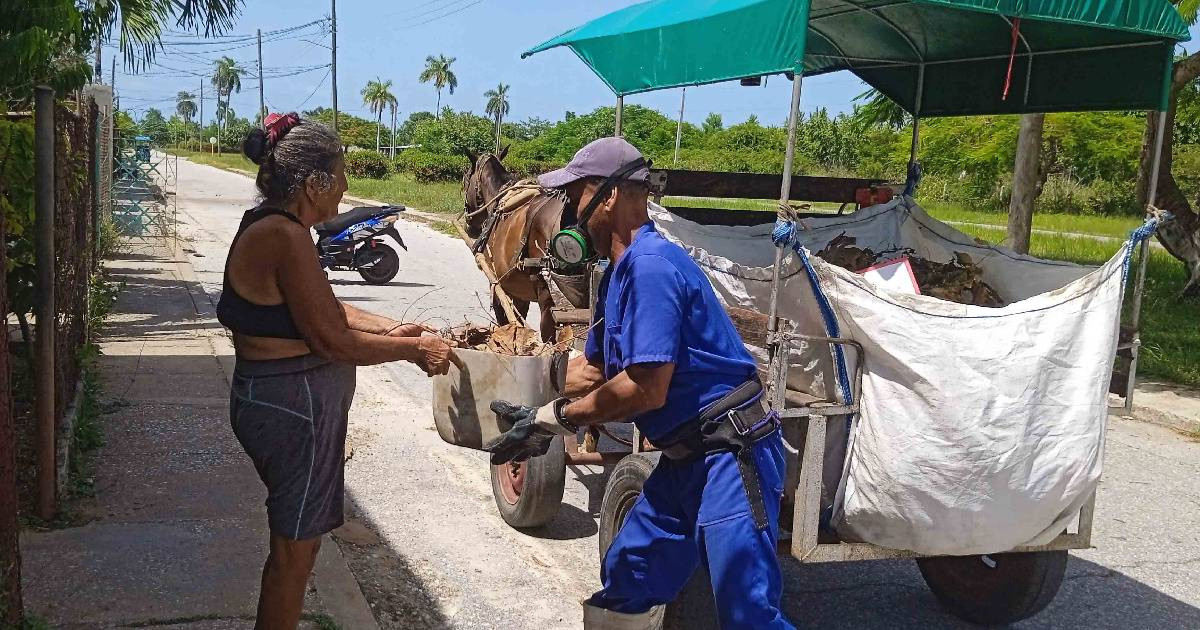
A private company has taken on the task of collecting household trash in the Juan Delio Chacón Aldana neighborhood and Sierra Caballos area on Isla de la Juventud, charging residents a monthly fee of 100 Cuban pesos (CUP) per household. This marks a significant shift toward the privatization of a service that was once freely provided in Cuba.
The company behind this initiative is the microenterprise Belmary, led by Florencio Maricy Alarcón. Originally focused on construction, Belmary is now expanding into waste management due to the high unmet demand in this special municipality, according to the official publication Victoria.
New Trash Collection Schedule and Workforce
The trash collection service operates on Mondays and Thursdays from 3:00 PM until after 7:00 PM. In the Chacón area, the team consists of four cart drivers and two payment collectors, while in the larger Sierra Caballos, there are four cart drivers and three collectors. Workers are equipped with gloves and masks for protection during their duties.
"We began by recruiting local labor and persuading them to join," Maricy explained to the Communist Party's newspaper in Isla de la Juventud.
Implementation and Future Plans
In August, Belmary is collecting trash from all residents, regardless of payment. Starting in September, those who do not pay the fee will be identified through a system involving inspectors from the communal services office.
Eduardo Abreu Saragoza, president of the local council, was clear on the matter. "We will establish a mechanism to identify those who don't pay and determine how they will dispose of their trash. Inspectors will be strict with anyone who dumps garbage indiscriminately," he emphasized.
Abreu described the project launch as an opportunity for their area. "We consider it fortunate that the trash collection experiment started in our district. It progresses in two ways: collection and household-level billing," he noted.
The plan aims to expand soon to El Mangal, the Carlos Fonseca Amador Community, and Abel Santamaría. Additionally, Belmary plans to supply recyclable waste to the Raw Materials Company, the source added.
Context of Broader Privatization Trend
The situation in Isla de la Juventud is part of a broader trend across Cuba. In July, Havana's Rampa neighborhood introduced the El Rampeño project, utilizing electric tricycles with the same residential fee of 100 CUP. Previously, in May, residents of the Casino Deportivo area organized their own community trash collection in response to the absence of state services.
The collapse of the public system is structural. In February, only 44 out of 106 garbage trucks in Havana were operational due to fuel shortages and equipment deterioration.
Prime Minister Manuel Marrero Cruz acknowledged the institutional failure to address the issue by the end of 2025. Despite a massive cleanup operation in Havana that removed almost 400,000 cubic meters of waste in 20 days, sustained improvement has not been achieved.
The health implications are severe. Cuba closed 2025 with over 81,000 official cases of dengue and chikungunya, diseases directly linked to waste accumulation.
In this context, the microenterprise Belmary exemplifies a model where a formerly free service now relies on citizens' financial contributions.
Key Questions on Cuba's Waste Management Privatization
How does the privatization of waste management affect residents in Isla de la Juventud?
Residents now need to pay a monthly fee of 100 CUP for trash collection, a shift from the previously free service, affecting household expenses.
What are the operational details of the new trash collection service?
The service operates on Mondays and Thursdays from 3:00 PM to 7:00 PM, employing local workers equipped with protective gear for collection tasks.
What is the broader trend of privatization in Cuba's waste management?
There is a growing trend towards privatization across Cuba, with similar initiatives being introduced in other areas like Havana, often in response to public system failures.