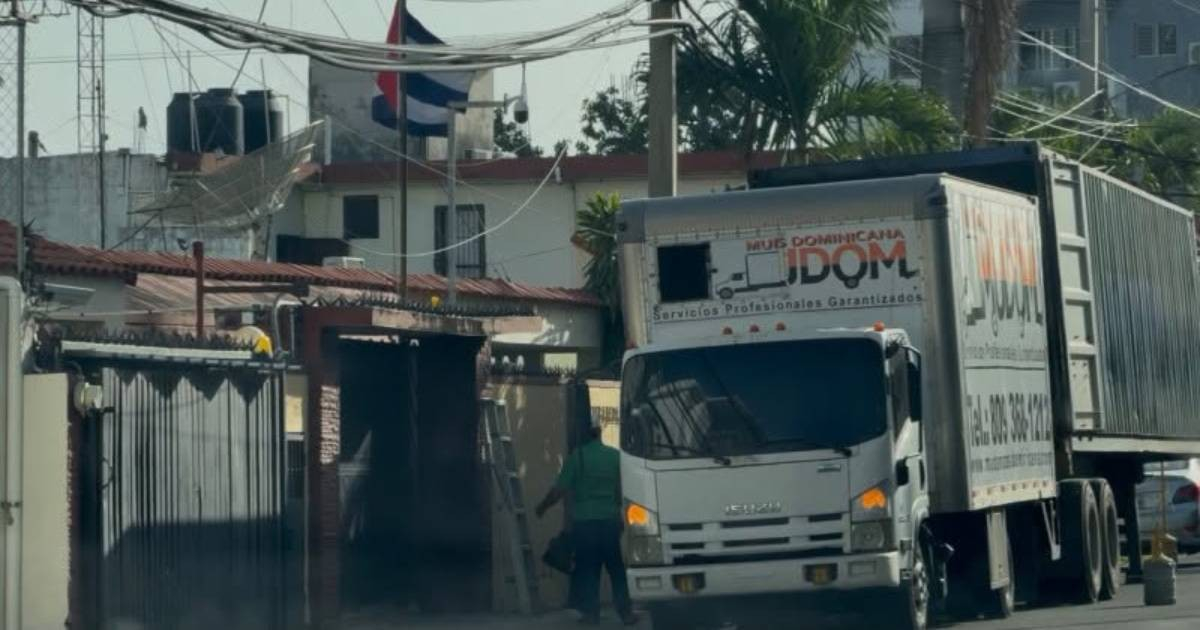
The staff at the Cuban Embassy in Santo Domingo spent much of Saturday amidst boxes, furniture, and appliances, as they hurriedly moved out before the Dominican government's deadline for the departure of nine Cuban officials from the country expired.
Trucks loaded with belongings were seen coming and going from the diplomatic premises located in the El Millón sector of the National District. The moving activity extended well past 8:30 p.m., according to a team from Diario Libre on the scene.
As the relocation continued, officers from the Dominican National Police were stationed around the embassy. The diplomats refrained from answering journalists' questions, retreating inside the building whenever approached by the press.
This scene underscored the tension surrounding one of the most sensitive diplomatic incidents between Havana and Santo Domingo in recent years.
The Diplomatic Deadline Looms
On August 13, the Dominican Foreign Ministry ordered the expulsion of the officials, invoking Article 9 of the Vienna Convention on Diplomatic Relations. This allows a state to declare members of a foreign mission persona non grata without having to publicly explain its reasons.
The deadline for the diplomats to leave is set for Sunday at 11:59 p.m. According to the Dominican Ministry of Foreign Affairs (MIREX), the measure affects nine Cuban officials and their families, totaling 21 people. However, the Cuban regime claims that ten officials were notified.
Cuban Ambassador Ángel Arzuaga Reyes did not confirm whether he is among those required to leave the Dominican Republic. When questioned by journalists, he deferred to the Dominican Foreign Ministry for that information.
Cuba Responds to the Expulsion
Independent Cuban media have identified Dimas Lima Orue, commercial counselor, and Luis Baró, minister counselor, among the affected officials. Havana reacted strongly to the decision, attributing it directly to pressure from Washington.
"There is no other explanation for this action than the Dominican government's submission to U.S. pressures, which seeks to isolate Cuba and harm our diplomatic relations with regional countries," stated the Cuban Ministry of Foreign Affairs in a release.
Santo Domingo has not publicly disclosed the reasons for demanding the officials' departure. However, diplomatic sources suggest that alleged Cuban intelligence activities under diplomatic cover were behind the decision.
Dominican Support for the Expulsion
Diplomat and former judge Ramón Horacio González Pérez supported the Dominican government's decision, asserting that the expulsion is fully grounded in International Law. He explained that Article 9 of the Vienna Convention allows the host state to demand the departure of diplomatic staff "at any time and without having to justify its decision," as he told the newspaper Hoy.
González Pérez also deemed the deadline given by Santo Domingo, which exceeds the typical 24 or 72 hours in such situations, as "very reasonable and prudent," dismissing Havana's claims of U.S. pressure as "speculative and lacking legal basis."
Broader Diplomatic Context
This crisis unfolds amid a growing political rift between the governments of Luis Abinader and Miguel Díaz-Canel. In May, Abinader publicly declared that Cuba "is not a democratic state." Two months later, the Dominican Republic abstained from voting on the United Nations General Assembly resolution against the U.S. embargo on Cuba, after supporting it the previous year.
The Dominican episode adds to a series of diplomatic setbacks for the Cuban regime in Latin America in recent months. In March, Ecuador ordered all Cuban diplomatic personnel to leave Quito within 48 hours. That same month, Costa Rica closed its embassy in Havana. In July, Colombia's new government announced it was severing diplomatic ties with Cuba and Nicaragua.
Despite the significant nature of Santo Domingo's action, Dominican sources specify that it does not signify a break in diplomatic relations between the Dominican Republic and Cuba. The Cuban embassy will continue to operate in the Dominican capital with the accredited staff remaining. However, images of officials removing furniture, appliances, clothing, and boxes from the embassy, under police watch and without engaging with the press, highlight the strained moment in a rapidly deteriorating bilateral relationship.
Key Questions on Dominican-Cuban Diplomatic Tensions
What led to the expulsion of Cuban diplomats from the Dominican Republic?
The expulsion was ordered due to alleged Cuban intelligence activities conducted under diplomatic cover, as per diplomatic sources. The Dominican government has not publicly shared specific reasons.
How has the Cuban government reacted to the expulsion?
The Cuban government has criticized the decision, attributing it to pressure from the United States aimed at isolating Cuba and damaging its regional relations.
Does the expulsion mean a break in diplomatic relations between the two countries?
No, the expulsion does not indicate a severing of diplomatic ties. The Cuban embassy in the Dominican Republic will continue to function with its remaining accredited staff.