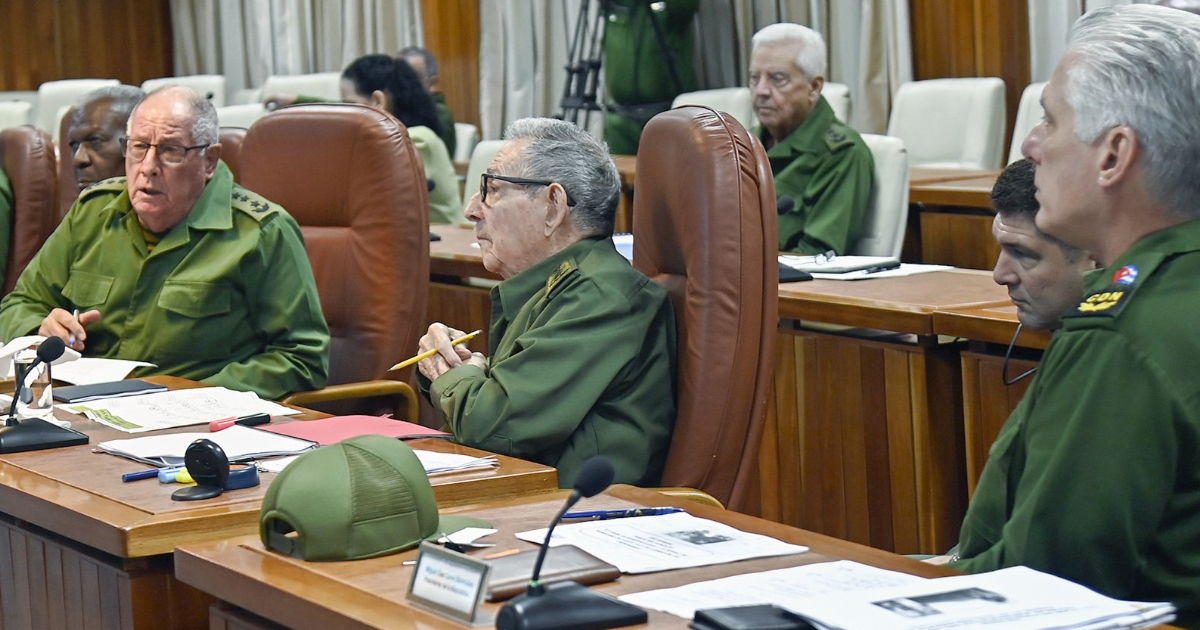
Who truly holds the reins of power in Cuba? According to the Trump administration, the answer extends beyond Miguel Díaz-Canel, pointing instead to a far more intricate web of influence. This network includes the Castro family, the military forces, and the bureaucracy of the Cuban Communist Party (PCC), all of which maintain significant control.
A Bloomberg report released on Saturday, drawing on sources familiar with Washington's strategy towards the island, suggests that U.S. officials believe Díaz-Canel's authority is heavily influenced by the Castro family. The real power, they argue, is distributed among this circle and high-ranking military officials.
This interpretation is vital to grasp the current strategy of the Trump administration, which is focusing on economic pressure to undermine the regime's financial resources and create internal rifts. Meanwhile, a potential military intervention remains a distant consideration.
The Complexity of Cuba's Power Structure
As per Bloomberg, U.S. officials are encountering challenges in managing the tensions among the various factions that make up Cuba's ruling elite. These factions include the Castro family, the Revolutionary Armed Forces (FAR), the PCC bureaucracy, and descendants of other revolutionary leaders.
The scenario in Cuba is considerably more complicated than what Washington faced in Venezuela following Nicolás Maduro's capture in January. In Cuba, the U.S. does not see a singular power center whose removal would quickly reorganize the political landscape.
This assessment also sheds light on why Washington has targeted economic structures tied to the military in its offensive. In May, the U.S. imposed sanctions on GAESA, a powerful business conglomerate controlled by the FAR, which plays a major role in sectors like tourism.
By July, the measures expanded to include the Ministry of Tourism and other state entities, as part of a strategy to cut off resources to the ruling elite and create opportunities for negotiations and internal fractures.
Rubio's Perspective on Time and Change
Secretary of State Marco Rubio, tasked by Trump to lead Cuba policy, has also hinted at Washington's view on the timeline for potential political change. In a podcast released this week, Rubio expressed confidence that Cuba is on an irreversible path to a different future before the end of the current administration in January 2029.
However, the U.S. diplomatic chief cautioned that dismantling a structure built over almost seven decades will not happen overnight.
The question facing Washington is not only how to increase pressure on Havana but also what the consequences might be if that pressure ends up fracturing the system.
Bloomberg notes that the U.S. does not have a unified opposition leadership ready to quickly take over and guide a political transition in Cuba.
Understanding Cuba's Complex Power Structure
How does the Trump administration view Cuba's power dynamics?
The Trump administration perceives Cuba's power structure as complex, involving not just Miguel Díaz-Canel, but also the Castro family, military forces, and the Communist Party bureaucracy, all of which hold significant sway.
What strategy is the U.S. employing against the Cuban regime?
The U.S. is focusing on economic pressure to weaken the regime's funding sources and foster internal divisions, while considering military intervention as a secondary option.
What challenges does the U.S. face in dealing with Cuba?
The U.S. faces difficulties in navigating the tensions between various factions of Cuba's ruling elite and lacks a unified opposition leadership ready to lead a political transition.