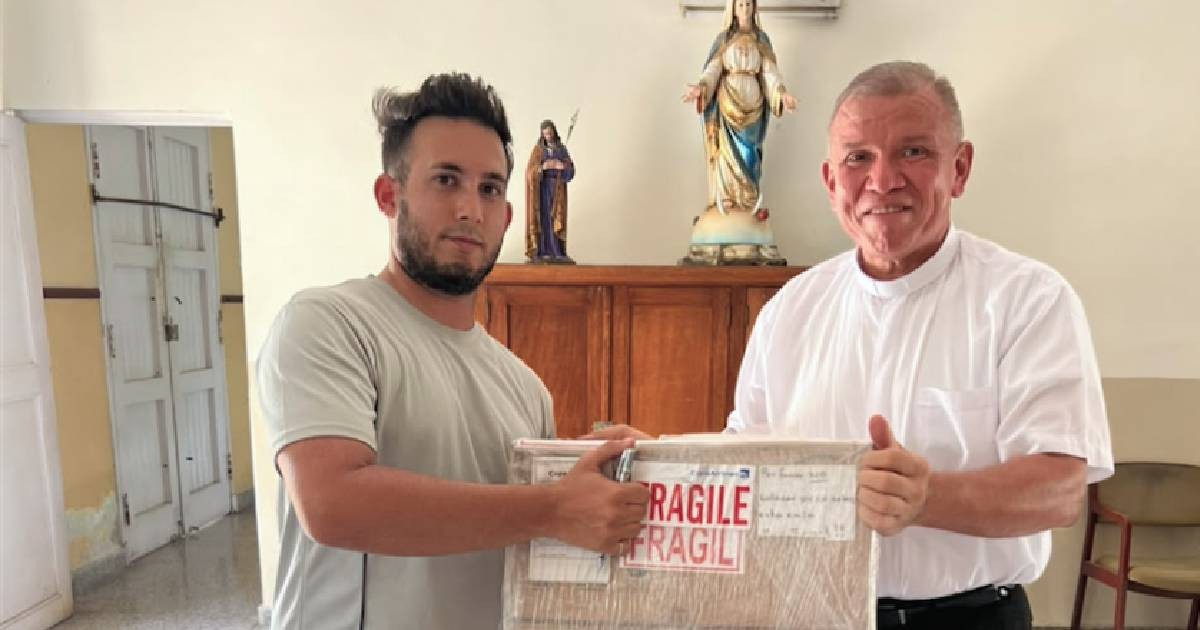
The Costa Rican Episcopal Conference recently dispatched 20,000 unconsecrated communion wafers to Cuba, joining a wave of regional support aimed at sustaining the Eucharistic celebrations on the island, which have been severely impacted by a crisis lasting several weeks. This humanitarian gesture was reported by the Eco Católico weekly.
The donation was verified by Father Ricardo Cerdas Guntanis, Deputy Secretary of the Costa Rican Episcopal Conference (CECOR), who highlighted that the dire situation in Cuba has inspired a wave of solidarity from neighboring church communities.
The wafers were manufactured at the Hostia Factory of the Costa Rican Episcopal Conference, which typically supplies Costa Rican dioceses and parishes through their La Sacristía stores.
Upon arrival in Cuba, the wafers were received by Father José Araya of the Congregation of the Most Holy Redeemer. Father Araya has a history of service in the Alajuela province, particularly at the Parish of La Agonía, over the past decade.
CECOR pointed to two key reasons for the crisis: "a shortage of raw materials like flour and the frequent power outages plaguing the island," which have significantly hampered the production of wafers for "several weeks."
The sole supplier for all Cuban parishes, the Monastery of Santa Teresa and San José in El Vedado, Havana, run by the Discalced Carmelites, has faced a nationwide crisis due to disruptions in their production processes.
Since early June, the nuns have reported that power outages—leaving Havana without electricity for up to 20 or 24 hours at times—have prevented them from operating the necessary machinery to produce the wafers.
Cuban priest Rolando Montes De Oca elaborated to ACI Prensa: "Even when there is power, it’s very unstable, and the time is limited. So the nuns can’t produce enough wafers; they’re making very few."
Faced with this emergency, the Carmelites announced they must ration their existing supply. "They will distribute what little they have so each priest gets a portion, but in practice, this means there won't be enough for everyone," Montes De Oca added.
The regional response began in June, with the Archdiocese of Panama sending 35,000 wafers, followed by the Archdiocese of San Juan, Puerto Rico, which sent an additional 300,000 to support Cuba’s Eucharistic celebrations.
This isn't Cuba's first encounter with such difficulties; in November 2022, wafer production was halted due to a lack of flour and was only resumed after donations from Miami, Puerto Rico, and Spain, along with some state-provided resources.
Cardinal Juan de la Caridad García Rodríguez, Archbishop of Havana, praised the efforts of the neighboring churches, stating, "These acts are a visible sign of communion among Churches and a tangible expression of the unity that stems from the Eucharist."
Understanding the Eucharistic Crisis in Cuba
What caused the wafer shortage in Cuba?
The wafer shortage in Cuba is primarily due to a lack of raw materials, such as flour, and frequent power outages that have disrupted production.
How have other countries helped Cuba during this crisis?
Countries like Panama and Puerto Rico have sent thousands of wafers to Cuba to help sustain the Eucharistic celebrations during the crisis.