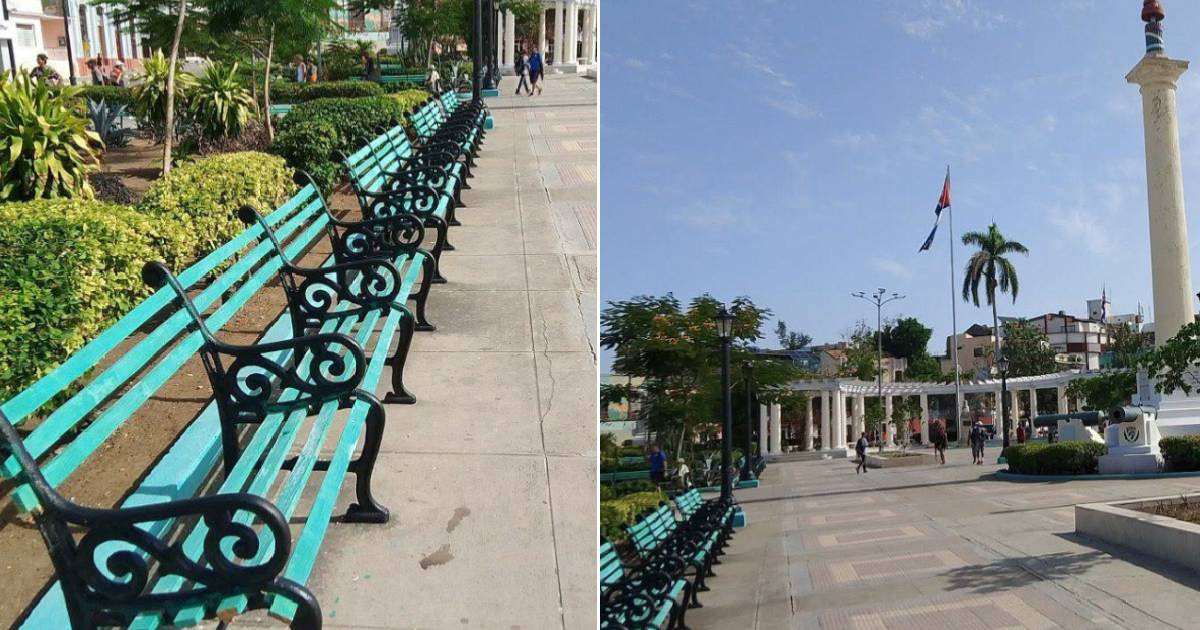
In a recent development, the benches at Plaza de Marte in Santiago de Cuba have been restored after vandals reportedly tore off their wooden planks, supposedly to use as firewood. This news was reported by the official newspaper Sierra Maestra, which also called for strict enforcement of laws against those who damage public places.
Images shared on the Facebook page of the Communist Party's official newspaper in the eastern province showcase the benches, now repainted in their signature turquoise and featuring black wrought iron frames, restoring the iconic Santiago landmark to its usual appearance.
The state-run media outlet stressed the importance of community involvement, stating, "Preservation efforts at this heritage site must be paired with public vigilance. Furthermore, legal measures should be enforced against acts of vandalism in this and other public areas."
The vandalism that led to this repair was initially reported earlier this month when Sierra Maestra published photos showing the metal frames intact but stripped of their wooden seats and backs, under the telling headline "The Wood for Firewood."
Public reaction to the restoration was largely positive but tinged with skepticism. Many commenters questioned whether there would now be someone to watch over the benches.
"Now everyone must protect them. Do the parks have caretakers yet? It's crucial to prevent vandalism," one person commented. Another was more straightforward: "This isn't about 'awareness'; it's about the law. If you break it, you pay for it."
Several residents of Santiago called for the reinstatement of park caretakers, a position that existed in the past but was eliminated. "I suggest reconsidering the reestablishment of park caretaker roles, as their presence was very effective in safeguarding our city's most iconic parks," one commenter noted.
Others suggested installing solar lighting and permanent guards, while some demanded the "maximum penalty" for offenders and insisted that the results of investigations be made public.
One comment encapsulated the mounting frustration: "They should have been made of metal and welded... end of story."
This incident is not an isolated one. Just this August, a section of metal railings disappeared from a historic bridge in Matanzas, a bronze star was stolen from the mausoleum of Major General Calixto García in Holguín, and an unknown individual toppled the bust of Antonio Maceo in a park in Las Tunas.
In May, vandalism led to the restoration of the letters spelling "CUBA" at La Alameda park along the Santiago waterfront.
The energy crisis and the scarcity of cooking fuel are cited as factors driving the theft of urban furniture wood for firewood, another symptom of Cuba's social deterioration under decades of authoritarian rule.
The Cuban Citizen Audit Observatory recorded 2,833 crimes in Cuba in 2025, marking a 115% increase compared to 2024, with 1,536 thefts, representing a 479% rise since 2023. These figures highlight the context in which Plaza de Marte, one of Santiago de Cuba's most cherished heritage sites, must endure following its latest restoration.
Understanding the Issues Surrounding Plaza de Marte's Restoration
Why were the benches at Plaza de Marte vandalized?
The benches were vandalized, with their wooden planks reportedly removed to be used as firewood, likely driven by the energy crisis and scarcity of cooking fuel.
What measures are being suggested to prevent future vandalism?
Suggestions include reinstating park caretakers, installing solar lighting, employing permanent guards, and enforcing stricter legal penalties for vandals.
How have the public reacted to the restoration efforts?
The public's response has been mostly positive but with skepticism, questioning whether proper care and protection will be ensured this time.