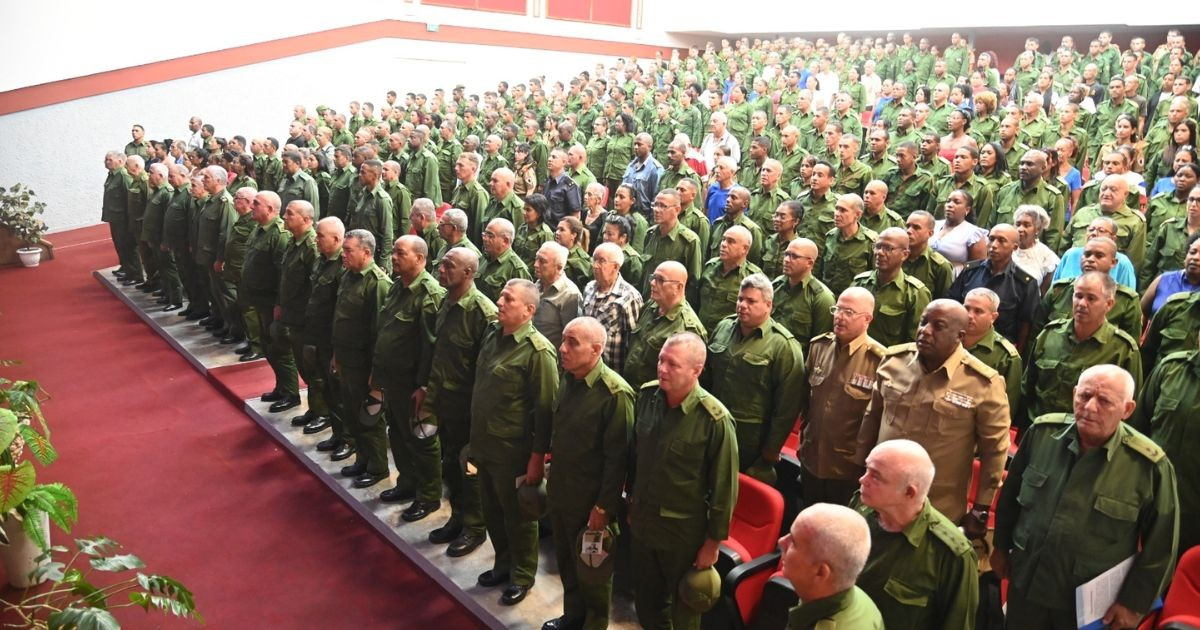
The Cuban Catholic priest, Alberto Reyes Pías, issued the 170th edition of his weekly column "I've Been Thinking" this Friday, delivering a poignant message to the military, police, State Security agents, paramilitaries, and informants who uphold the control system in Cuba. He warned them that "a nation cannot be chained forever."
The Nature of Power in Cuba
As the parish priest of Esmeralda in Camagüey, Reyes begins his reflection with an exploration of Cuba's power dynamics: "It's clear that control over a country isn’t maintained by a small elite, no matter how large, especially in Cuba, where actual power is concentrated within a single family."
He elaborates on the structure of control, stating, "For a nation to remain under control, an entire system of 'intermediate commands' is required, encompassing everyone from military officers to Party officials, and extending through a vast network of paramilitaries or 'civil agents,' vigilantes, spies, and informants..."
The Uncertainty of Control
Reyes acknowledges the limitations of what can be understood from outside: "We don't know how the central power manages to keep them under its service, whether through indoctrination or through fear, real or imagined." He admits ignorance about the orders they receive or the criteria that dictate what is allowed and what is suppressed.
A Shared Sense of Exhaustion
Despite this uncertainty, Reyes outlines shared certainties with those supporting the regime. He tells them they share the same fatigue with the people: "We know that both you and we are tired, tired of living amidst scarcity and misery, worn out from struggling to meet daily needs, and anxious over the lack of medicine, weary of seeing life wasted in mere survival."
He highlights the pain of emigration: "We know that both you and we suffer from the separation of children who have chosen to leave their homeland for good." This point bears weight, as according to the National Office of Statistics and Information, Cuba saw a loss of 245,264 people through emigration just in 2025.
The Universal Fear
Reyes points to fear as a common denominator: "We know that both you and we wish to live without fear: fear of speaking our minds, fear of being watched, fear of 'falling from grace' for saying or doing something not deemed 'politically correct'." He adds that families and friends secretly confide, "I don't want this for my children."
Breaking Free from the System
The priest acknowledges the difficulty of leaving the system: "We understand that it isn't easy to break free from the machinery once you're a part of it. Therefore, we pray for you, knowing that finding alternatives isn't simple, even if such a search might be personal and necessary today."
The column concludes with a historic warning: "Both you and we know that the future of Cuba does not belong to socialism, that a nation cannot be chained forever, and that it’s likely this system will leave no stone unturned."
This latest column continues a series of critical writings. In July, Reyes described Cuba as a country "at war" with its own people, arguing the regime is upheld more by fear of change than ideological conviction. In April, he accused the government of committing crimes against humanity, and in March, he warned that people rarely forgive abuses. Despite a summons from State Security in January, neither his voice nor his resolve has been silenced.
The column appears amidst a backdrop of documented and sustained repression. According to the Cuban Observatory for Human Rights, the regime executed 1,949 repressive actions in the first half of 2026. By the end of June, Prisoners Defenders recorded over 1,300 active political prisoners in the country.
Understanding the Cuban Regime's Control
How does the Cuban regime maintain control over the country?
The regime maintains control through a system of 'intermediate commands' that includes military officers, Party officials, and a network of paramilitaries and informants. The central power may use indoctrination or fear to keep these groups in service.
What common challenges do Cubans face under the current regime?
Cubans face challenges such as scarcity, economic hardship, and the emotional toll of family separation due to emigration. There is also a pervasive fear of expressing opinions or actions that might not align with the regime's expectations.