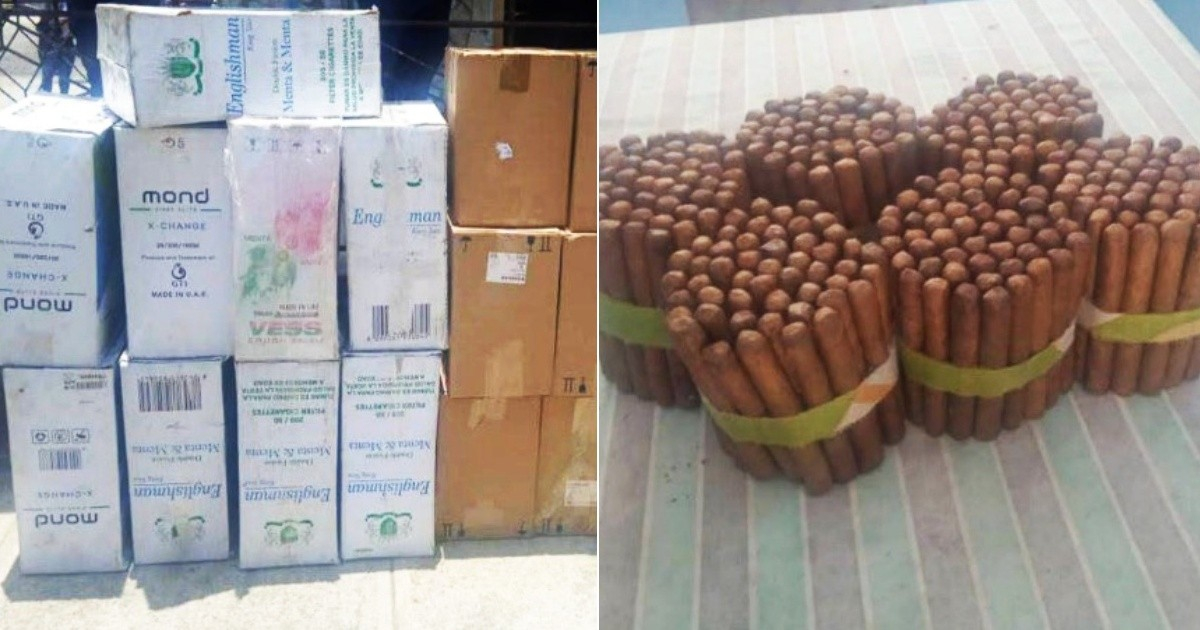
This week, officers from the Revolutionary National Police (PNR) apprehended several individuals at the Cristo Checkpoint, located at the entrance of Santiago de Cuba. These individuals were found transporting over 300 cigars and a significant number of boxes of Populares cigarettes in a private vehicle.
According to the official "Héroes del Moncada" Facebook page, the suspects did not have any documents to verify the legal origin of the goods. The seized items were reportedly intended for sale at inflated prices in the informal market.
The official source described how bystanders watched in amazement as police conducted a routine inspection of the vehicle, uncovering the illicit load.
Public Skepticism and Irony
While the operation was touted as a success by state media, it sparked a wave of public skepticism and irony in the comments section of the post. Instead of applause, the reaction was laced with distrust.
One commenter sarcastically remarked, "Great. Now I can buy them at the store!" capturing the widespread doubt among the public. The most persistent question was: Where did this merchandise originate?
Another comment read, "The million-dollar question: where did all of this come from?" with another urging, "A thorough investigation is needed to trace the supplier. It's baffling that there are no cigarettes in stores, yet the black market is flooded with them."
Economic Disparities and Market Realities
The contradictions in Cuba’s economic system are stark. The rationing system reduced the cigarette allowance to two packs per person in 2025, down from just four packs monthly in 2024. Officially, a box of Populares is priced at 30 Cuban pesos, but on the black market, it can sell for 450 to 600 pesos, marking a price increase of up to 20 times.
Several commentators expressed concerns over the fate of the confiscated goods. "In the end, those cigarettes just changed hands and will likely be sold at the same street price," one person suggested. Another added, "Only by organizing production and distribution can the situation be stabilized. The production seems to be working; the issue lies with distribution."
Recurring Issues and Past Incidents
This perception is supported by past incidents. In April 2026, a worker from the EMPA in Jiguaní was detained for stealing thousands of cigarette packs from a state warehouse, causing losses exceeding 10 million pesos. In July, authorities intercepted the illegal transportation of quintals of dry tobacco leaves from Pinar del Río to Havana. That same month, customs seized over 4,200 cigars at Havana's José Martí Airport on a flight bound for Panama.
The Cristo Checkpoint is no stranger to such operations. In January 2025, PNR intercepted a motorcyclist at the same checkpoint with more than 85 rolls of unregistered local cigarettes. The pattern is clear: goods that never reach official stores end up in the hands of individuals ready to sell them at black market rates.
Understanding the Cuban Cigar and Cigarette Black Market
What is the significance of the Cristo Checkpoint in Santiago de Cuba?
The Cristo Checkpoint is a strategic location for intercepting illegal goods entering Santiago de Cuba, playing a crucial role in operations against the black market trade.
Why do cigars and cigarettes often appear on the black market in Cuba?
Cigars and cigarettes appear on the black market due to distribution issues and rationing, resulting in shortages in official stores and creating opportunities for illegal sales.
How does the Cuban rationing system affect cigarette availability?
The rationing system limits cigarette availability, reducing monthly allowances and causing increased demand on the black market where prices are significantly higher.