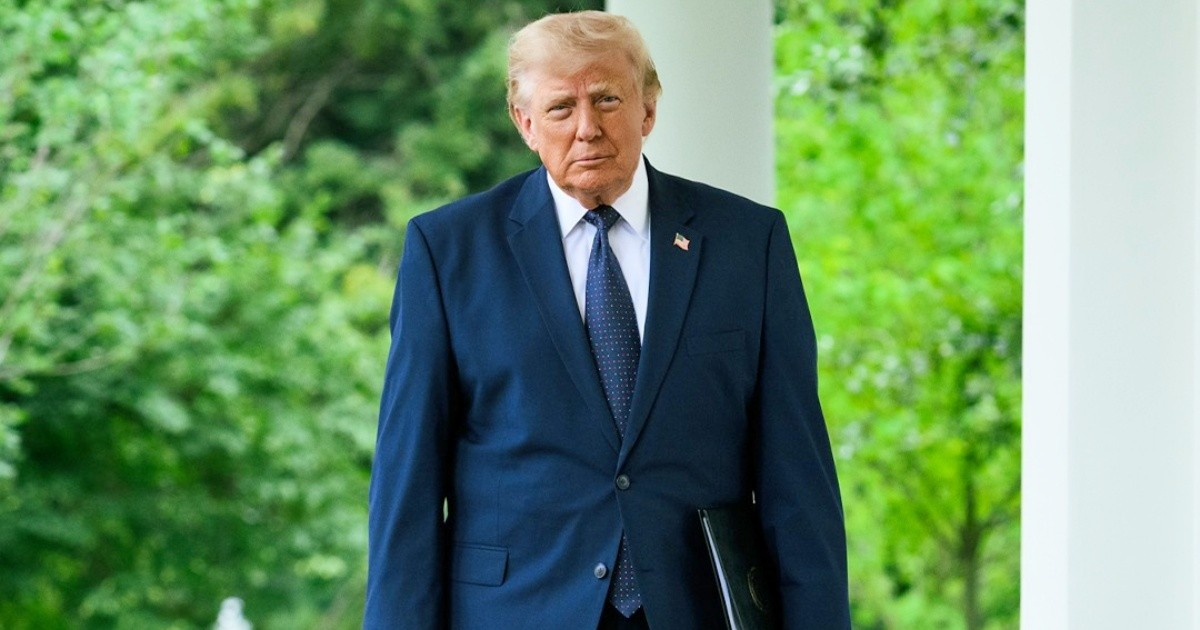
Donald Trump has put to rest ongoing rumors about a potential 2028 presidential candidacy by openly acknowledging to reporters at Joint Base Andrews in Maryland that the U.S. Constitution prevents him from seeking a third term.
Having just returned from the Patriot Games event in Ohio, Trump disembarked Air Force One to face the recurring question that has followed him throughout his second term.
"Everyone keeps asking me that, and you know the law is quite explicit. I'd love to run, but the law is very clear," Trump remarked in statements reported by the American press.
The former president highlighted the persistent pressure from his supporters, noting that even at the Ohio event that evening, the crowd chanted "2028!"
"No, everyone wants me to do it, but the law is very clear," he reiterated.
The Constitutional Barrier to a Third Term
The legal hurdle Trump refers to is the 22nd Amendment of the United States Constitution, ratified in February 1951, which explicitly states that "no person shall be elected to the office of the President more than twice."
This amendment was adopted following the death of Franklin D. Roosevelt, the only U.S. president to win four consecutive elections.
Amending this provision would require a two-thirds majority vote in both the House and Senate, plus ratification by 38 of the 50 states—a process deemed nearly impossible given the current legislative makeup.
Republican Congressman Andy Ogles has introduced a proposal to amend the 22nd Amendment, but it has not progressed in Congress.
Trump's Previous Ambiguity
Trump's recent statements contrast with the ambiguity he maintained for months.
In March 2025, during an interview with NBC News, Trump asserted that he wasn't joking about a third term and hinted at possible "methods" to achieve it.
"There are methods by which it could be done," he claimed, describing a scenario where Vice President JD Vance runs, wins the election, and then resigns to hand him the presidency.
"That's one," Trump replied when queried, adding that there were "other options" as well.
However, legal experts have pointed out that this scenario is also blocked by the 12th Amendment, which prevents anyone ineligible to be president from becoming vice president.
In late July, Trump jokingly revisited the idea at the White House Correspondents' Dinner, wearing a red cap with "Trump 2028" embroidered on it.
"Just like my presidency, the second time is always better. Always better. And the third time will be even better. It's just a joke," he said.
The 2028 Republican Race Heats Up
While Trump has—at least for now—closed the door on another run, the race for the 2028 Republican nomination is intensifying.
Vice President JD Vance and Secretary of State Marco Rubio are the leading contenders.
In May 2026, Trump called them a "dream team," although he clarified, "That doesn't mean they have my endorsement under any circumstances. But it sounds like a presidential and vice-presidential ticket."
At the Western Conservative Summit in Colorado this month, Rubio received backing from 57% of over 500 attendees, compared to 21% for Vance.
Understanding the 22nd Amendment and Trump's 2028 Speculation
What does the 22nd Amendment say?
The 22nd Amendment to the U.S. Constitution states that no person can be elected to the office of the President more than twice, effectively barring any individual from serving more than two terms as President.
Has Trump considered running for a third term?
While Trump has hinted at the possibility in the past, he recently confirmed that the U.S. Constitution prohibits a third presidential term, effectively putting an end to speculation.
What would it take to change the 22nd Amendment?
Amending the 22nd Amendment would require a two-thirds majority vote in both the House of Representatives and the Senate, followed by ratification by 38 of the 50 states, a daunting legislative process.