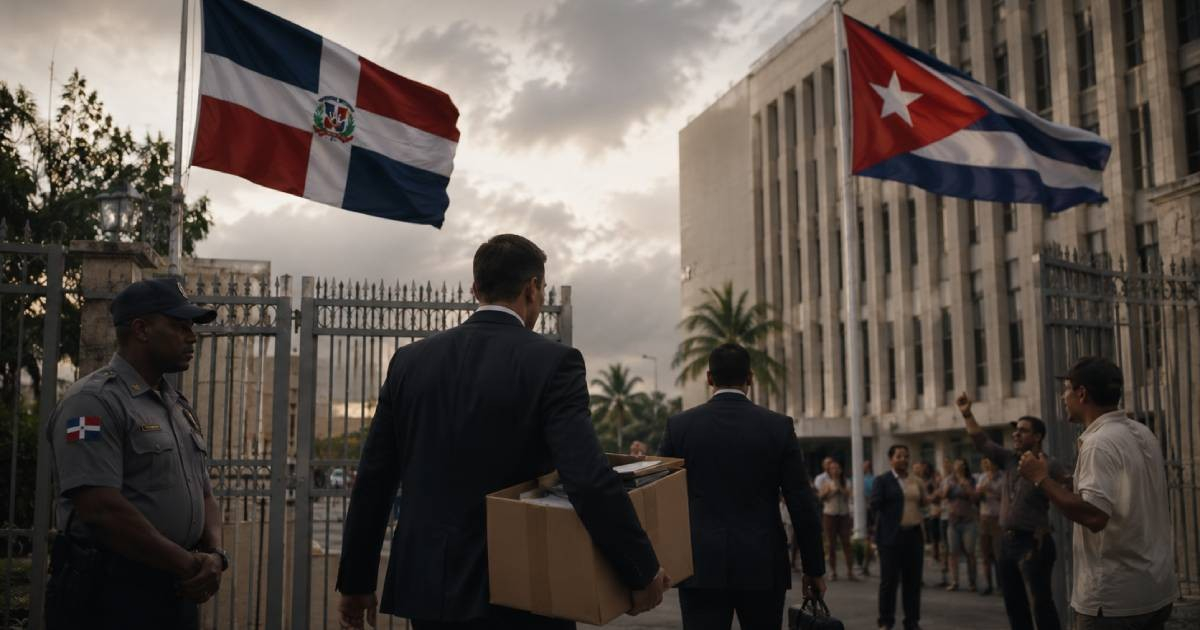
The Dominican Republic's recent decision to expel nine Cuban diplomats from its embassy in Santo Domingo has ignited a flurry of reactions across social media. Many Cubans have welcomed the move, viewing it as further evidence of the increasing diplomatic isolation of Havana's regime in the region.
"Great, the noose is tightening slowly," one user commented, capturing the sentiment of those who received the news with approval.
Diplomatic Turbulence in Santo Domingo
On Thursday, the Dominican Foreign Ministry confirmed the order for the Cuban officials to leave, citing Article 9 of the Vienna Convention on Diplomatic Relations. This article allows a host nation to declare diplomatic personnel persona non grata without publicly explaining the reasons.
The nine diplomats, along with their families—totaling around 21 people—must vacate Dominican territory by Sunday, August 16.
Cuban Government's Reaction and Accusations
While Santo Domingo has kept the precise reasons for its decision under wraps, Cuba's Ministry of Foreign Affairs (MINREX) issued a strong rebuttal, condemning the action in the "strongest terms" and directly accusing the United States of exerting pressure on the Dominican government.
"There's no explanation for this action other than the Dominican government's submission to U.S. pressure," stated the Cuban Foreign Ministry, which also denied any wrongdoing by its diplomats.
This explanation from Havana sparked further criticism online.
One commenter remarked, "I start to read 'Cuba rejects...' and that's where I stop. You reject, don't generalize; what the Cuban people reject, and a lot, doesn't end." Another user challenged the claim of American pressure: "Why not just state the reasons given to you? They have an absolute fixation on the U.S., convinced that the Cuban people are ignorant."
Mixed Reactions Among Cubans
Amid the uproar, a significant number of social media posts expressed a particularly critical view of the Cuban regime and its diplomatic missions.
One user wrote, "That's called getting rid of the trash, no one should have diplomatic relations with a dictatorship." Another echoed a common accusation from the Cuban exile community: "They weren't diplomats; they were spies."
These opinions are user-generated comments on social media and have not been substantiated by Dominican authorities, who have yet to disclose specific reasons for the expulsion.
A minority of commentators defended the Cuban government's stance, viewing the Dominican decision as an act of subordination to U.S. foreign policy, aligning with MINREX's narrative.
The Cuban Foreign Ministry cited past instances of such alignment, including Cuba's exclusion from the X Summit of the Americas and a shift in the Dominican stance at the United Nations regarding the U.S. embargo resolution.
Heightened Distance Between Santo Domingo and Havana
This diplomatic crisis unfolds after months of growing distance between the two governments under President Luis Abinader's administration.
In May, President Abinader publicly declared that Cuba "is not a democratic state," a rare statement in bilateral relations that highlighted the widening political rift with Havana.
The incident also occurs within a broader regional context that is increasingly unfavorable to Cuban diplomacy.
In March, Ecuador expelled the entire Cuban diplomatic mission from Quito, giving them just 48 hours to leave the country. Costa Rica followed suit that same month by closing its embassy in Havana and requesting the withdrawal of Cuban personnel from San José.
In July, Colombia's then-President-elect Abelardo de la Espriella announced the severance of diplomatic ties with Cuba and Nicaragua as part of a reorganization of Colombia's foreign presence.
Cuba's Assurances to the Dominican People
Despite blaming the Abinader government for yielding to Washington, MINREX sought to separate the governmental crisis from the historical ties between Cubans and Dominicans.
In its statement, Havana acknowledged the decision "sensitively injures the ties between the two governments," yet assured that it would maintain its "unwavering friendship" toward the Dominican people.
Nevertheless, on social media, many Cubans reacted in stark contrast to the Foreign Ministry's stance, viewing the diplomats' expulsion not as an affront to Cuba, but as another setback for a regime they hold accountable for decades of oppression, economic hardship, and mass exodus.
Understanding the Diplomatic Rift
Why did the Dominican Republic expel Cuban diplomats?
The Dominican Republic expelled the Cuban diplomats under Article 9 of the Vienna Convention on Diplomatic Relations, which allows a host nation to declare diplomatic personnel persona non grata without providing public explanations.
How has Cuba responded to the expulsion of its diplomats?
Cuba's Ministry of Foreign Affairs condemned the expulsion, attributing it to U.S. pressure on the Dominican government and denying any wrongdoing by its diplomats.
What is the broader regional context affecting Cuba's diplomacy?
The expulsion comes amid a regional shift against Cuban diplomacy, with Ecuador and Costa Rica having recently taken similar actions. Additionally, Colombia's announced severance of ties with Cuba adds to this trend.