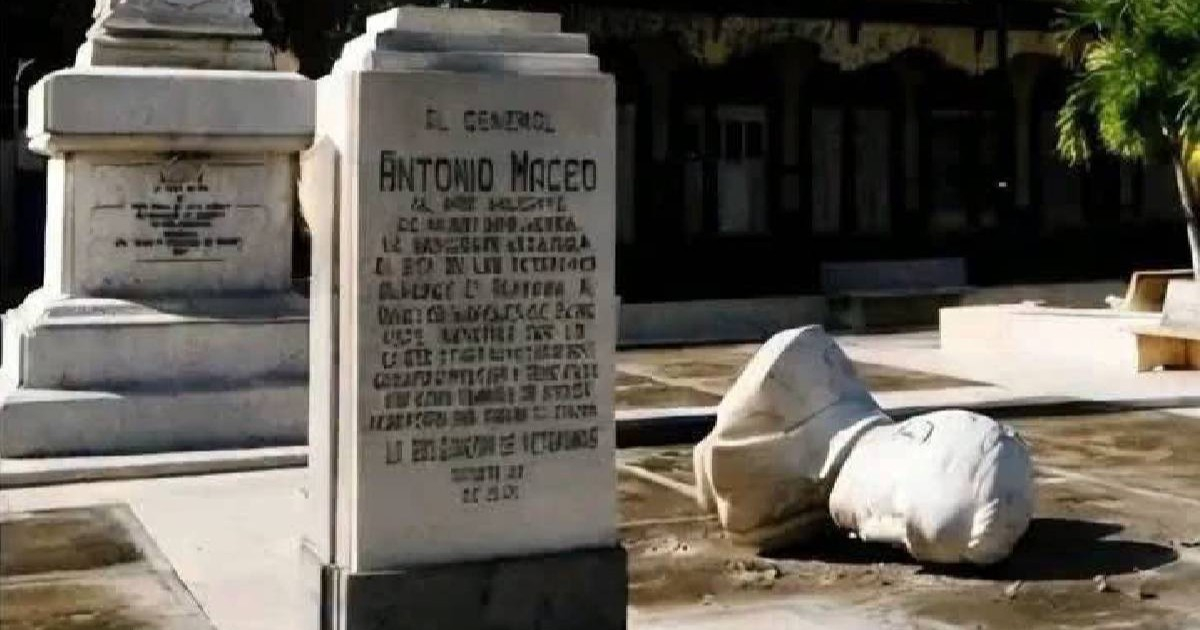
Cuban activist Lara Crofs, also known as Yamilka Lafita, responded to the recent toppling of General Antonio Maceo's bust in Las Tunas' namesake park with a powerful statement: "Maceo should not be torn down; he should be returned to Cuba."
The white marble bust was violently removed from its pedestal during the early hours of Sunday, August 10, by unidentified individuals, leaving visible damage on several parts of the sculpture's face.
This incident, which took place at the park dedicated to the Cuban hero, resulted in the piece being taken into police custody while technical and forensic investigations are underway to find those responsible.
In her response, Lara Crofs was unequivocal: "This is not a protest against the dictatorship; it's VANDALISM against our own history."
Historical Significance of Maceo's Bust
The core of the activist's argument rests on a historical fact: the bust was unveiled on August 28, 1947, twelve years before the Revolution, and was sculpted by Holguin native José Virelles at the behest of veterans of the independence wars.
"Maceo does not belong to the Communist Party, the misgovernment, or any institution of power; he belongs to Cuba," she asserted.
For Lara Crofs, the bust represents "a republican memory and a patriotic tradition that predates the current regime," situating it outside the symbolic inventory of the dictatorship and making it a heritage of all Cubans.
Condemning the Regime's Manipulation of National Heroes
The activist acknowledged the regime's manipulation of national heroes. However, she drew a clear distinction: "We must denounce the regime's propagandistic manipulation of our heroes while it oppresses, imprisons, and impoverishes the people. But this never legitimizes the destruction of our national symbols."
Her message ends with a crucial distinction for those who aspire to a free Cuba: "Rebellion does not require the destruction of Maceo; it requires preventing those in power from appropriating his legacy. Down with the dictatorship, yes. But also down with the vandalism and destruction of our historical memory."
Lara Crofs' statement carries additional weight considering her own detention by State Security in Havana on April 18, making her a voice with firsthand experience of the regime's repression.
The Las Tunas incident is not an isolated case. Just days earlier, on August 8, a bronze star was stolen from the mausoleum of Major General Calixto García in Holguín.
In July, a marble plaque dedicated to Pablo Neruda was vandalized in Loma de la Cruz, also in Holguín. And in May, the protective fence of the martyrs' mausoleum in Cárdenas, Matanzas, was looted, leaving it exposed.
The restoration of the bust in Las Tunas has been entrusted to artist Leonardo Fuentes Caballín, who will reintegrate the damaged parts and perform conservation treatment before returning the piece to its original pedestal, as reported by Periódico 26, the official media of Las Tunas, which described the act as an "assault on the province's heritage and cultural identity."
Understanding the Impact of Vandalism on Cuban Heritage
Why was the bust of General Antonio Maceo significant?
The bust of General Antonio Maceo is significant because it represents a republican memory and a patriotic tradition that predates the Cuban Revolution, making it a symbol of national heritage for all Cubans.
What actions are being taken to restore the vandalized bust?
Artist Leonardo Fuentes Caballín has been tasked with restoring the bust. He will reintegrate the damaged parts and perform conservation treatment before the piece is returned to its pedestal.
How does Lara Crofs view the regime's manipulation of national heroes?
Lara Crofs criticizes the regime's manipulation of national heroes for propagandistic purposes, stating that it oppresses, imprisons, and impoverishes the people. However, she emphasizes that this does not justify the destruction of national symbols.