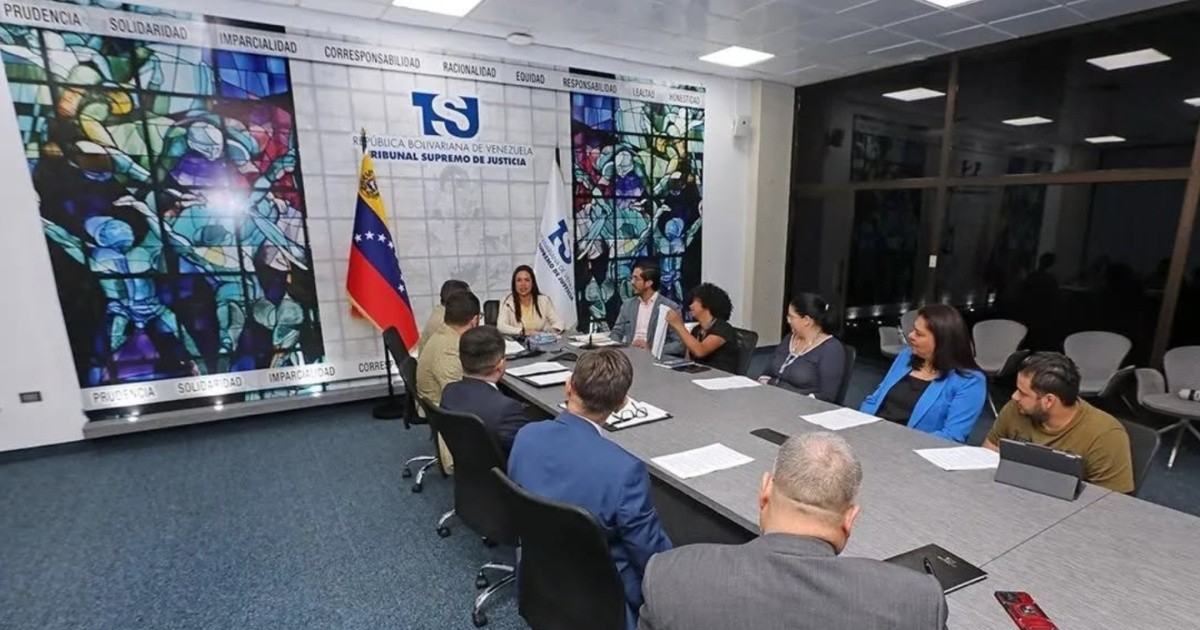
On Wednesday, in Caracas, representatives of the Venezuelan regime and the opposition, led by the 2015 National Assembly (AN), signed a joint statement signaling the conclusion of the First Cycle of Talks. This agreement includes specific measures to completely overhaul Venezuela's Supreme Court of Justice (TSJ).
The document was signed by Jorge Rodríguez, head of the Venezuelan government delegation, and Dinorah Figuera, president of the 2015 AN and leader of the opposition delegation. This is part of the transition dialogue formally launched on August 7 at the La Carlota airbase in Caracas.
The agreement outlines four major steps: amendments to the Supreme Court's Organic Law and other justice system laws; expansion and renewal of the judicial nominations committee; initiation of a new nomination process for all justices; and the establishment of a council to review the credentials and qualifications of candidates, guided by the Constitution and evaluation standards.
The statement specifies that the timeline for implementing these agreements will start this August with official announcements and concrete actions, supported by a continuous work mechanism to ensure strict adherence to each commitment.
Figuera previously mentioned that the schedule includes appointing the new TSJ in November and renewing the National Electoral Council in December, aiming to complete the process before the end of 2026.
This dialogue, prompted by the United States seven months after the capture of Nicolás Maduro, marks the ninth negotiation attempt between the chavismo and the opposition. However, it is the first with explicit and active backing from Washington.
The joint statement also agreed on efforts to recover Venezuela's international reserve assets held in the Bank of England to aid the victims of the twin earthquakes on June 24, which resulted in at least 6,125 deaths and left nearly 18,000 people homeless.
Both parties committed to establishing "mechanisms of transparency, traceability, and auditing for the efficient use of these assets."
Significant fractures challenge the process. The Democratic Unity Platform (PUD), which includes María Corina Machado and opposition member Edmundo González Urrutia, was excluded from the talks as they are not members of the 2015 AN.
The PUD demands "an end to political persecution and the restoration of civil rights as necessary conditions for moving towards genuine national reconstruction."
On the other hand, hardline chavismo factions protested in Caracas against the dialogue, decrying it as a Washington-imposed initiative.
The TSJ agreement has direct precedents: in April 2026, the AN formed a commission to renew justices; in May, a reform was approved to expand the court from 20 to 32 justices; and in June, there were 561 applications to fill the vacancies. Analysts noted at the time that these reforms did not alter chavismo's political control over the judiciary.
The August 12 agreement marks the first tangible and verifiable outcome of this cycle of talks, and it is the first time the opposition has formally participated in shaping the process of judicial renewal in Venezuela.
Insights into the Venezuelan Supreme Court Agreement
What are the key components of the Venezuelan Supreme Court overhaul?
The overhaul involves amending the Supreme Court's Organic Law, renewing the judicial nomination committee, initiating a new nomination process for justices, and establishing a council to review candidates' credentials.
Why was the Democratic Unity Platform excluded from the talks?
The Democratic Unity Platform was excluded because its members are not part of the 2015 National Assembly, which is leading the opposition delegation in the dialogue.
What role did the United States play in these negotiations?
The United States played a significant role by actively backing the negotiations, marking the first time Washington's support has been explicitly involved in discussions between the Venezuelan government and the opposition.