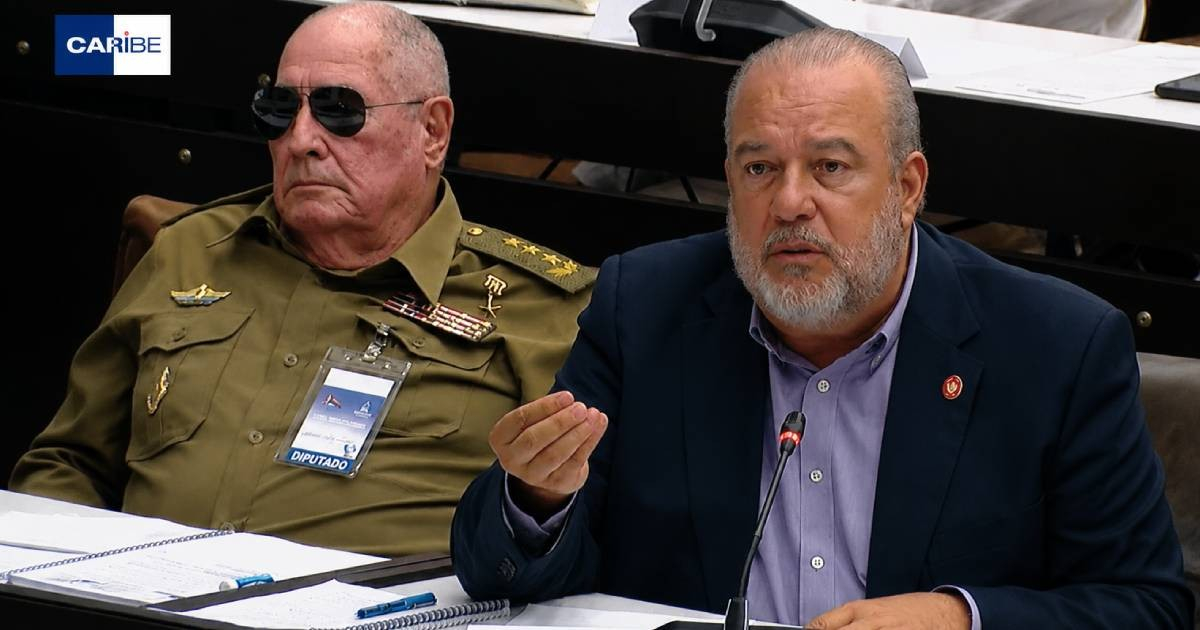
Cuban Prime Minister Manuel Marrero Cruz declared on Wednesday that the ongoing economic changes in Cuba are "entirely Cuban" and executed with "complete sovereignty," refuting claims that the regime is emulating the reform models of China or Vietnam.
He made these remarks during his participation in the panel "Fidel and the Global Economy," part of the first International Colloquium "Fidel: Legacy and Future," held at the Palace of Conventions in Havana.
With over 1,500 delegates from 63 countries in attendance from August 10 to 13, the forum was organized to commemorate the centennial of Fidel Castro's birth, which falls on Thursday, August 13. The regime uses this political event to frame its economic reforms within the ideological legacy of the deceased leader.
Emphasizing Cuban Sovereignty in Economic Reforms
According to reports from the state-run Juventud Rebelde, Marrero emphasized that Cuban socialism "cannot be a rigid theory" but rather a practice of adaptation. He asserted that the current measures reflect Castro's approach to modernizing the model without abandoning its core principles.
The phrase "Distinct from China and Vietnam" encapsulates the prime minister's stance against comparisons to the economic openings in those Asian nations.
Recent Legislative Approvals and Economic Measures
This announcement comes two months after the National Assembly approved, during an extraordinary session on June 18 and 19, a package of 176 economic and social transformations grouped into 23 key areas. Noteworthy measures include the authorization of private banking under the Central Bank's oversight, the establishment of private exchange houses, lifting the cap of 100 workers for small and medium-sized enterprises, allowing individuals to own multiple businesses, opening the market to foreign franchises, and converting state enterprises into joint-stock companies.
The government has previously denied alignment with Asian models. On July 6, Vice Prime Minister Óscar Pérez-Oliva Fraga also rejected claims that Cuba was replicating "any country's model," although he acknowledged that China's and Vietnam's experiences had been considered.
In March, President Miguel Díaz-Canel promised Mexico's La Jornada newspaper a "unique model" inspired by these experiences but with "Cuban peculiarities."
Challenges and Economic Realities
On July 30, Marrero addressed the National Assembly to report progress: 110 of the 121 measures planned for the June-July period had already been approved, representing 90.9% of the total. In the same session, he cautioned that "the most crucial and perhaps the most challenging phase" of implementing the transformations was beginning, reaffirming the government's commitment to socialism.
Economist Pedro Monreal noted in May that Cuba's adoption of Chinese-style reforms is delayed and that structural obstacles, political challenges, and U.S. sanctions make it extremely difficult to replicate that model.
The daily realities of Cubans—characterized by prolonged blackouts, food and medicine shortages, and an unprecedented exodus—stand in stark contrast to the official optimism surrounding the colloquium and its declarations on sovereignty and socialist adaptation.
The reform package also includes reducing the number of state ministries from 27 to 21 and increasing the minimum wage in the budgeted sector from 2,100 to 3,210 pesos starting this month, a figure still inadequate in the face of accumulated inflation in recent years.
Understanding Cuba's Economic Changes
What is the main goal of Cuba's recent economic transformations?
The primary aim of these transformations is to modernize the Cuban economic model while maintaining the core principles of socialism, as inspired by Fidel Castro's vision.
How does Cuba's approach differ from China's and Vietnam's economic models?
Cuba insists its reforms are uniquely Cuban, emphasizing sovereignty and adaptation, unlike the more market-oriented reforms seen in China and Vietnam.
What challenges does Cuba face in implementing these reforms?
Cuba encounters structural and political challenges, alongside U.S. sanctions, which complicate the implementation of economic reforms similar to those of China and Vietnam.