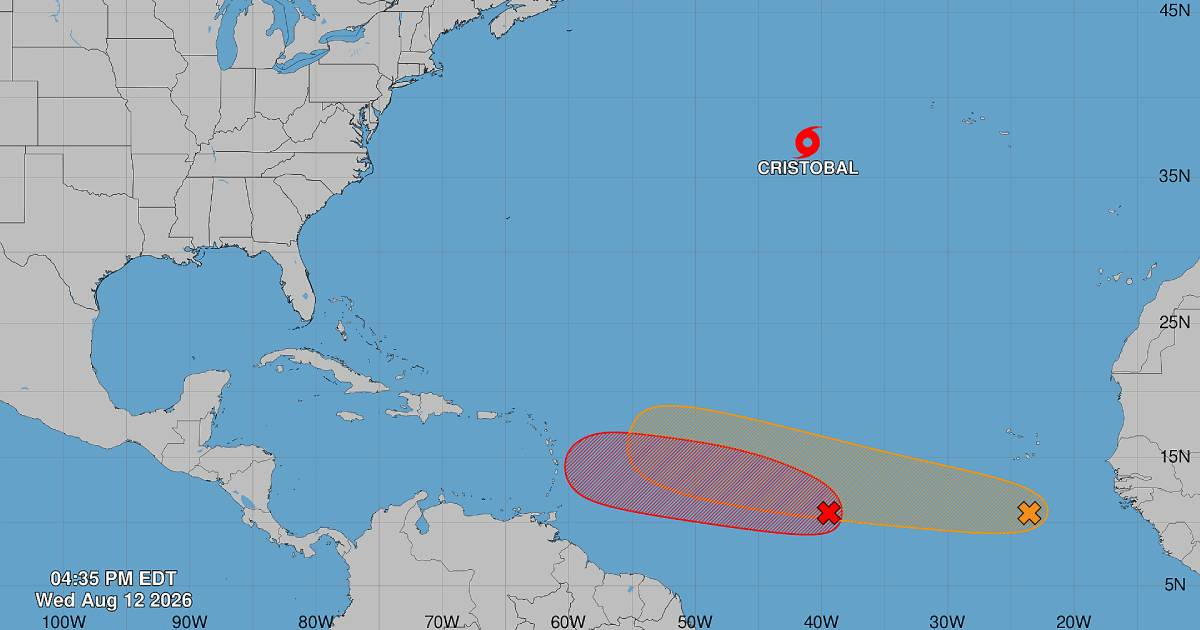
The Cuban Institute of Meteorology (INSMET) announced its first Tropical Cyclone Advisory on Wednesday following the emergence of Tropical Storm Cristóbal in the northern Atlantic, marking the third named system of the 2026 hurricane season.
Even though its formation coincides with the Atlantic's peak hurricane activity period, Cristóbal poses no threat to Cuba, with forecasts suggesting it will have a brief lifespan.
At 11:00 a.m., the storm's center was positioned at 36.7 degrees North latitude and 43.0 degrees West longitude, about 1,420 kilometers west of the Azores Islands, far from the Caribbean.
Cristóbal was sustaining maximum winds of 75 kilometers per hour, with stronger gusts, and a central pressure of 1,008 hectopascals. It was moving swiftly eastward at around 41 kilometers per hour.
INSMET reported, "In the next 12 to 24 hours, Tropical Storm Cristóbal will slow its movement towards the east-northeast, gradually weaken, and potentially dissipate by Thursday."
The Cuban agency emphasized that "this system poses no threat to Cuba and is only of interest for navigation purposes."
The United States National Hurricane Center (NHC) also confirmed there are no threats to land areas. Cristóbal is expected to encounter cooler waters, dry air, and unfavorable atmospheric conditions that will aid in its weakening.
El Niño's Impact on the 2026 Hurricane Season
Cristóbal's formation is particularly notable given the below-average activity observed in this year's Atlantic season.
The presence of El Niño has led to significant wind shear across vast areas of the Atlantic, a factor that can hinder cyclone formation, prevent their intensification, and even disrupt already developed systems.
Cristóbal is only the third named storm of 2026, following Arthur and Bertha, neither of which posed a direct threat to Cuba. However, meteorologists are watching another area in the tropical Atlantic with a high likelihood of cyclonic development in the coming days. If it reaches tropical storm status, it will be named Dolly.
This vigilance is crucial, as the period from mid-August to mid-October typically sees the most hurricane activity in the Atlantic.
The Return of the Name Cristóbal
The name Cristóbal might sound familiar. In June 2020, another tropical storm carried the same name. That system developed in the Bay of Campeche, impacted southeastern Mexico, and later moved across the Gulf of Mexico toward the United States. Official records from the NHC indicate it reached maximum winds of about 95 km/h.
The reuse of the name six years later is not an error. Atlantic tropical cyclone names are recycled every six years unless a hurricane is so devastating or deadly that the World Meteorological Organization decides to retire its name. Cristóbal was not retired after 2020, hence its reappearance in the 2026 list.
Continued Vigilance in Cuba
The 2026 season has so far been less active than usual. Arthur appeared in June and Bertha in July, while Cristóbal emerged after the typical climatological date for the first hurricane of a normal season.
INSMET's May forecast predicted the formation of 11 tropical cyclones in the Atlantic basin and estimated a 75% chance of at least one tropical storm affecting Cuba, with a 40% likelihood of a hurricane impact.
For now, Cristóbal can be ruled out as a threat to the island. However, as the historically most active period of the season begins and other systems are monitored in the Atlantic, meteorologists are already focusing on what might develop after this storm.
Frequently Asked Questions About Cristóbal and the 2026 Hurricane Season
What is the current status of Tropical Storm Cristóbal?
Cristóbal is currently moving eastward, with forecasts indicating it will weaken and possibly dissipate within the next 24 hours. It poses no threat to land.
Why is the name Cristóbal being reused?
The name Cristóbal is being reused because Atlantic tropical cyclone names are recycled every six years unless a storm is so destructive that the name is retired. Cristóbal was not retired after its appearance in 2020.
How has El Niño affected the 2026 hurricane season?
El Niño has contributed to increased wind shear in the Atlantic, which can hinder cyclone formation, prevent their strengthening, and disrupt developed systems, resulting in a quieter than usual hurricane season.