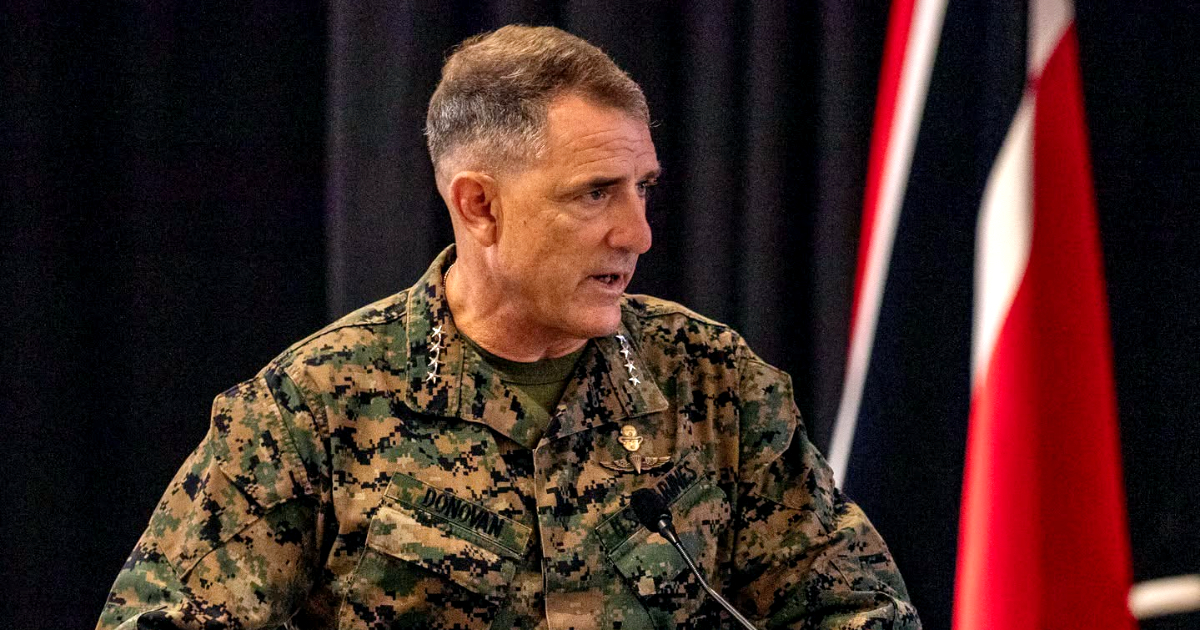
"The time has come to combat the foe." With these powerful words, General Francis L. Donovan, the head of the United States Southern Command (SOUTHCOM), addressed defense and security officials from 19 nations gathered in Panama at the Americas Counter Cartel Coalition (A3C) forum.
Donovan emphasized the opportunity at hand: "We have a chance to decide. Are we willing to bring the fight to the enemy? I believe we are." He further stressed the necessity of targeting these networks, stating, "We need to impose total systemic friction on them."
While SOUTHCOM's message did not explicitly name Cuba, the context in which it was delivered—amid a new U.S. strategy against narcoterrorism, the Venezuelan precedent, and the historical record of Cuban officials' ties to international drug trafficking—suggests it could also serve as a warning to the Cuban regime.
The Broader Implications of U.S. Strategy
During a speech in November 2025, former President Donald Trump publicly linked Cuba to his discourse on Maduro and narcoterrorists. He questioned on Truth Social, "Will Maduro and his narco-terrorists take another country, as they have with Cuba, Nicaragua, and Venezuela?" This rhetoric does not equate to a formal judicial accusation against Cuba, but it places the island within the same regional security context as Maduro’s operations.
Months later, this rhetoric took on a new dimension, as Donovan’s call for "total systemic friction" against drug cartels and terrorist organizations became a key priority. This involves denying adversaries undue influence in the hemisphere, going beyond traditional police cooperation and sanctions to include kinetic operations against vessels linked to narcoterrorists.
The Historical Context of Cuba's Involvement
The connection between high-ranking Cuban officials and drug trafficking didn’t start with the 1989 Causa 1 trial and the execution of General Arnaldo Ochoa. Declassified U.S. intelligence documents from the early 1980s reveal Cuban officials facilitating drug operations. In 1982, a U.S. federal grand jury indicted four senior Cuban officials for using Cuban territory to aid drug trafficking from Colombia.
Though the Cuban regime acknowledged in Causa 1 that high-level military and interior ministry officials had negotiated with Colombian traffickers, they claimed Fidel and Raúl Castro were unaware. This explanation has been contested for decades by defectors and former officials.
Recent Investigations and the Cartel of the Suns
Research from 2025 suggests a continuity between past Cuban operations and the development of criminal networks within the Venezuelan state. Reports indicate that Cuba's methods and capabilities may have influenced the Cartel of the Suns’ model, which involves using state structures for illicit activities.
These findings, though not officially endorsed by SOUTHCOM, echo previous U.S. investigations into Cuban involvement with drug traffickers and suggest that the island's significance lies in its intelligence and logistical capabilities rather than being a major cocaine transit route.
Cuba's Role in the Current Strategy
Recent evaluations do not depict Cuba as a primary cocaine hub. The 2025 Global Organized Crime Index does not list Cuba as a major international route, though it notes issues with illicit markets, drug trafficking, and corruption. However, Cuba's importance in the ongoing U.S. strategy may stem from its potential role in supporting narcoterrorist networks through intelligence and logistical support.
While there is no evidence of an imminent U.S. operation against Cuba, the historical and strategic context suggests Havana should heed the message, especially given the recent U.S. focus on dismantling entire networks rather than just intercepting shipments.
Understanding Cuba's Role in U.S. Anti-Drug Strategy
Why might Cuba be seen as a part of narcoterrorist networks?
Cuba's potential involvement stems from historical ties of its officials to drug trafficking and its capabilities in intelligence and logistics, which could support narcoterrorist networks.
What is the significance of "total systemic friction" in SOUTHCOM's strategy?
"Total systemic friction" refers to a comprehensive approach to disrupt and dismantle drug and terrorist networks by targeting their entire infrastructure, including intelligence, logistics, and financial operations.
How does the U.S. view Cuba in the context of regional security?
While not formally accused, Cuba is viewed within the same regional security context as other states like Venezuela, where narcoterrorist activities are of concern to U.S. interests.