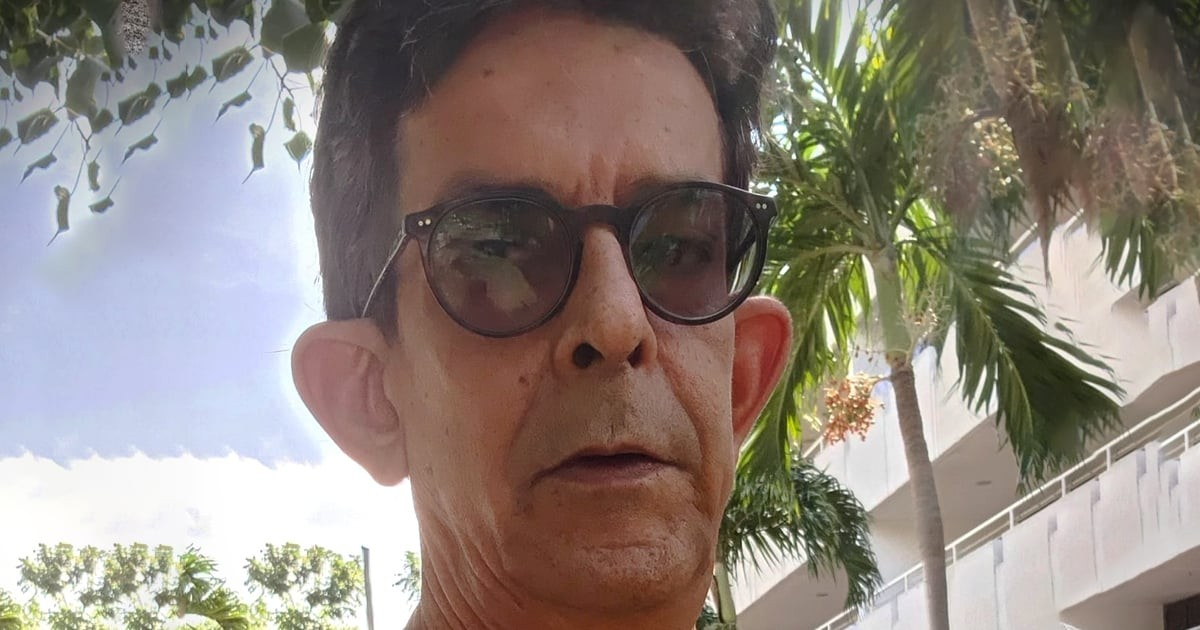
Cuban comedian and actor Ulises Toirac took to Facebook this Tuesday to deliver a scathing critique of the Cuban regime's pricing policies, the dual currency system involving the peso and the dollar, and the lack of economic transparency on the island.
In a lengthy post circulating on social media, Toirac depicts the Cuban peso (CUP) as a "parallel reality" with no real value beyond the state-controlled domestic market. He remarked, "The dollar and the CUP are worlds apart. The only place they claim it holds value is on the farm, but step into the financial market and you're met with puzzled looks: 'Cuban peso? What's that?'
The Currency Disparity
The gap highlighted by Toirac is backed by figures: the Central Bank of Cuba set the official rate at 624 CUP per dollar this Tuesday, while the informal market has been trading between 675 and 695 CUP in recent weeks, according to elTOQUE records.
Toirac also criticizes what he describes as a recurring government tactic: allowing or encouraging extreme price hikes, waiting for public backlash, and then imposing caps that, although lower than the peak, are significantly higher than the original prices.
Government's Ineffective Price Controls
He illustrates his point with an example involving the gas cylinder, writing, "I dress up as Superman and set prices lower than those of the astronaut in his rocket... But much higher than they were at the start of the game."
In July, the regime set the price of a 10 kg gas cylinder at 350 CUP through Resolution 155/2026, a 55% increase from the previous 225 CUP.
Regarding the price caps themselves, Toirac is blunt: "All they do is push the product into the black market and kick the can... on prices. And inflation enjoys the ride."
Inflation and Economic Transparency
This warning aligns with what President Miguel Díaz-Canel acknowledged in June: that the caps "caused shortages." Nevertheless, in August, provinces like Matanzas and Villa Clara reinstated local price ceilings, highlighting the inconsistency of official policy.
Toirac further points out the futility of controlling inputs when private actors can pass on costs: "As long as there are private entities like restaurants that need oil and can pass the costs onto the price of a dish, people will pay whatever it takes for a bottle of oil."
After the national caps on chicken, oil, and other essentials were lifted in June, chicken prices soared from 3,000 to over 7,000 CUP in some areas, and oil reached between 2,500 and 3,000 CUP per liter in Havana.
The Call for Transparency
Toirac concludes his analysis with a call for comprehensive audits: "EVERYTHING MUST BE AUDITABLE. Everything should allow for investigation and scrutiny. And that will never be allowed."
He warns that transparency is "the only way" for economic actors to "play fair," but that it will never happen because "it would be a brutal blow to good clients of Dior and Patek Philippe."
This isn't Toirac's first critique of the regime's economic management. In June, he demanded that Communist Party officials and military personnel be barred from new economic openings, calling for an "exclusion clause" and transparency. In February, he highlighted that the average salary of 3,888 CUP equated to less than 13 dollars at the informal exchange rate.
The post ends with a phrase summarizing the entire reflection's tone: "Things one ponders while throwing away some spoiled black beans."
Understanding Cuba's Economic Challenges
What is the dual currency system in Cuba?
Cuba operates a dual currency system involving the Cuban peso (CUP) and the convertible peso (CUC), although the CUC is being phased out. The disparity between the CUP and the US dollar creates economic challenges.
How do price caps affect the Cuban economy?
Price caps in Cuba often lead to product shortages as they push goods into the black market and fail to control inflation effectively, as noted by both Ulises Toirac and President Díaz-Canel.
Why is economic transparency important in Cuba?
Economic transparency is crucial for fair play among economic actors. It allows for accountability and proper auditing, which are necessary for a functioning and fair economy.