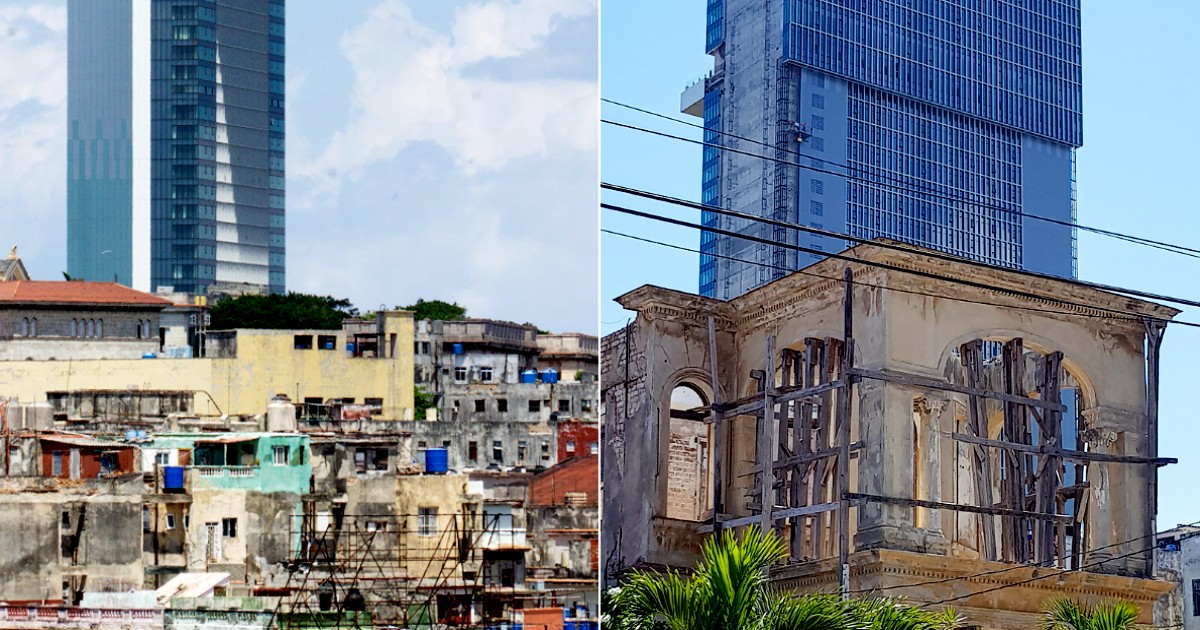
The U.S. State Department spotlighted Havana's 42-story K Tower hotel on Monday, emphasizing it as a stark symbol of the widening gap between the Cuban regime's wealth and the dire living conditions of its people.
In a post on X by the Western Hemisphere Affairs Office, the State Department characterized the skyscraper as "a constant reminder to the Cuban people that the illegitimate regime is focused solely on self-enrichment, neglecting to improve their living conditions."
This announcement is part of an ongoing campaign against GAESA, the military-controlled business conglomerate, highlighting that K Tower was "built for elites and foreign visitors" and remains closed while ordinary Cubans endure harsh living conditions.
Symbolic Skyscraper Amidst Struggles
Located at the corner of 23 and K in El Vedado, K Tower stands as Cuba's tallest building at approximately 154 meters. It was entirely funded by Almest, a GAESA subsidiary, in what the regime touted as a "100% Cuban investment."
While EFE estimated the cost at $200 million, journalistic sources suggest the figure could reach as high as $565 million. On social media, Cubans have questioned whether this sum might have sufficed to construct a 300 MW power plant, potentially easing the current energy crisis crippling the island.
Tourism Sector in Decline
The hotel, which officially opened in early 2025 with rates starting at 147 euros per night, closed in March 2026, citing "the country's situation." Shortly after, in June, the Spanish chain Iberostar announced its withdrawal from 12 of its 18 hotels in Cuba, including K Tower, due to the impact of sanctions on GAESA.
The collapse of Cuban tourism is widespread. Prime Minister Manuel Marrero Cruz admitted to the National Assembly that 73% of the country's hotel facilities were closed, with around 25,000 workers in the sector facing job uncertainty.
Blue Diamond Resorts shut down 62 hotels and over 12,900 rooms in May, while Meliá announced in July the closure of its 34 establishments on the island, ending 36 years of operations.
International Attention and Economic Disparity
This Monday's message is not isolated. On August 7, the State Department warned foreign companies operating with GAESA of becoming "complicit in the dictatorship's corruption scheme," and days earlier pointed out that the military conglomerate holds $18 billion in reserves while the Cuban people lack electricity, food, and medicine.
Simultaneously, as revealed by The New York Times, the CIA established a special group to trace the opaque financial flows of the Cuban elite both inside and outside the island.
K Tower, constructed with hundreds of millions from public funds, opened in 2025 only to close months later, stands as the most visible reminder of the regime's priorities, according to the State Department.
Key Insights into Cuba's Economic Challenges
What is the significance of K Tower in Havana?
K Tower is a 42-story hotel in Havana that symbolizes the contrast between the wealth of the Cuban regime and the hardships faced by the Cuban people. It highlights the regime's focus on self-enrichment rather than improving living conditions for its citizens.
Why did the U.S. State Department focus on K Tower?
The U.S. State Department highlighted K Tower to underscore the Cuban regime's neglect of its people's needs in favor of building luxurious accommodations for elites and foreign visitors. This serves as part of a broader effort to pressure GAESA, the conglomerate controlling much of Cuba's economy.
How has tourism been affected in Cuba recently?
Cuba's tourism sector is experiencing a significant decline, with many hotels closing due to economic instability and international sanctions. Major hotel chains like Iberostar and Meliá have reduced their presence on the island, contributing to widespread job losses in the industry.
What are the broader implications of the K Tower's construction and closure?
The construction and subsequent closure of K Tower highlight the Cuban regime's economic mismanagement and misplaced priorities, as significant funds were allocated to a project that ultimately failed to benefit the general population. This has drawn international criticism and raised questions about resource allocation in Cuba.