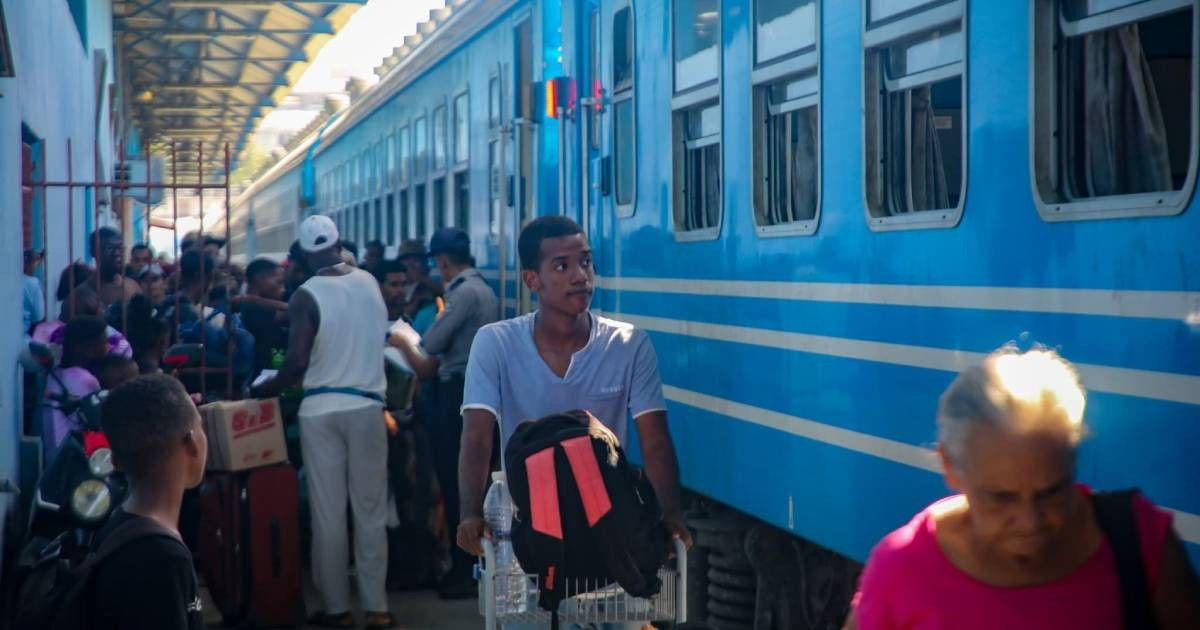
The fuel shortage in Cuba continues to severely impact interprovincial transportation, leading to delays in national train services and disruptions in other areas. This comes despite the government's significant reduction in service frequencies since June, aiming to cope with the limited availability of diesel.
On Monday, the Ministry of Transport acknowledged through a social media statement that it has been unable to maintain scheduled times in recent weeks, primarily due to the scarcity of fuel.
"In recent weeks, there have been disruptions in the train schedules and, to a lesser extent, in the departures of ferries and buses due to the unavailability of necessary fuel at crucial times," the ministry admitted.
This acknowledgment is particularly noteworthy as it comes during a period when national transportation has already been operating on an extremely reduced schedule since June 18. Trains now depart only once every 16 days to destinations like Santiago de Cuba, Guantánamo, Holguín, and Bayamo-Manzanillo, while National Buses offer just three weekly services from Havana to provincial capitals.
Even with this minimal schedule, the available fuel is insufficient to ensure services depart as planned. In July, data revealed that these cuts resulted in a 74% drop in monthly operations for national trains compared to peak periods of the Cuban railway.
The consequences of the fuel crisis have been felt directly by travelers. The ministry admitted that delays forced them to take "actions to guarantee the passengers' stay at stations," indicating that passengers had to wait at terminals for their transportation to depart.
However, the statement did not specify the number of trains, buses, or ferries affected, the duration of passenger waits, which routes experienced the most severe delays, or whether any services were ultimately canceled. It also did not provide any forecast for when fuel supplies might stabilize.
One measure announced on Monday highlights the uncertainty surrounding transportation planning: tickets can only be reserved three days in advance. The ministry linked this decision to "difficulties with the fuel supply needed to guarantee scheduled departures."
This reduction in advance booking time illustrates the authorities' challenges in ensuring that a train, bus, or ferry will have the required fuel available for a planned journey.
Fuel scarcity is not the only issue the ministry recognized. The same statement admitted that the distribution mechanism for the limited tickets since June created "opportunities for corruption and indiscipline in capacity allocation."
These irregularities, along with "poor management of reservations in some areas," led to a paradoxical situation in a country where securing an interprovincial ticket has become a daunting task: some services departed without filling all available seats.
This issue primarily affected trains and the maritime connection with the Isle of Youth. In response to these accumulated challenges, the ministry decided to revise the ticketing system once again, returning ticket sales to Viajero Company agencies in all municipalities where these offices exist.
Beginning Wednesday, August 12, agencies will start selling seats for trips scheduled from the 15th. Any unbooked seats will be available for purchase on the day of departure at the respective stations. Meanwhile, the Viajando app will remain offline for technical work, with no announced date for its reactivation.
Behind the delays, service cuts, and uncertainty surrounding departures lies a fuel crisis that has spread to nearly all aspects of daily life in Cuba. In May, the Minister of Energy and Mines, Vicente de la O Levy, acknowledged that Cuba lacked sufficient diesel and fuel oil amid a severe contraction in energy supplies.
A month earlier, the United Nations had warned about the repercussions of fuel shortages on essential services, affecting transportation, healthcare, water supply, and food distribution.
Understanding the Impact of Cuba's Fuel Crisis on Transportation
How has the fuel shortage affected train services in Cuba?
The fuel shortage has drastically reduced the frequency of train services, resulting in significant delays and disruptions. Trains now operate on a minimal schedule, departing only once every 16 days to several key destinations.
What measures has the Ministry of Transport taken to address transportation issues?
The Ministry of Transport has limited ticket reservations to three days in advance due to fuel supply challenges and has revised the ticketing system to mitigate corruption and inefficiencies in allocation.
Are there any predictions for when fuel supplies might improve in Cuba?
Currently, there is no official forecast for when fuel supplies might stabilize in Cuba. The ongoing crisis continues to affect various sectors, including transportation.