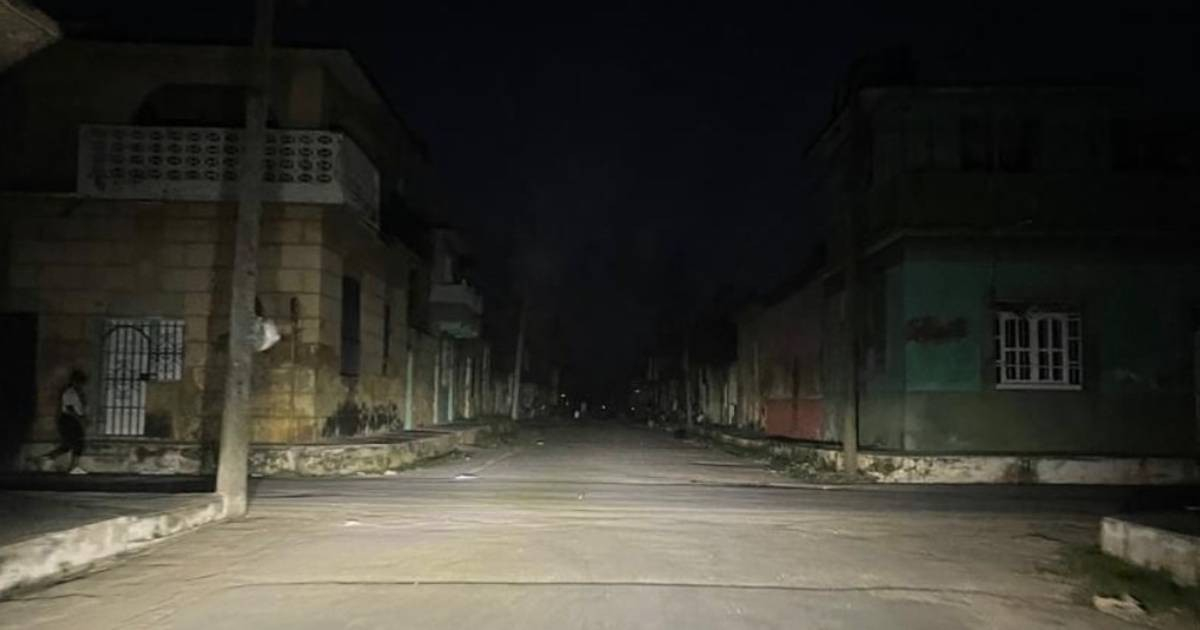
As another challenging week begins, the Cuban population is bracing for widespread power outages. According to a report from the Electric Union, this Monday, only 1,000 MW of electricity will be available to meet a peak demand of 3,250 MW, resulting in a deficit of 2,280 MW—nearly reaching the critical threshold of 2,300 MW.
On Sunday, the entire day was marked by a complete power outage, with no recovery even during the early hours. "The maximum capacity deficit recorded yesterday reached 2,272 MW at 10:50 PM," stated the state entity in its morning update.
Three major thermoelectric units remain out of service due to breakdowns: Unit 6 at the Máximo Gómez plant in the Mariel Special Development Zone, Unit 4 at Carlos Manuel de Céspedes, and Unit 2 at Lidio Ramón Pérez in Felton.
In addition, six other units are undergoing maintenance, including Unit 3 at the Ernesto Guevara de la Serna CTE in Santa Cruz del Norte, Units 5 and 6 at the Antonio Maceo CTE in Renté, and Unit 5 at the Diez de Octubre thermoelectric plant in Nuevitas.
The situation is exacerbated by the paralysis of distributed generation: 106 power plants are out of operation due to a lack of fuel, along with the Regla and Melones barges, and the Mariel and Moa Central Fuel plants.
On Sunday, 54 solar photovoltaic parks contributed 4,737 MW/hour, achieving a maximum power output of 737 MW. However, their contribution is limited to daylight hours, failing to mitigate the nighttime deficit that spikes between 6:00 PM and 11:00 PM.
Understanding Cuba's Power Crisis
What is causing the power outages in Cuba?
Cuba is experiencing power outages due to a significant deficit between energy supply and demand. This is caused by breakdowns in major thermoelectric units, maintenance issues, and a lack of fuel for distributed generation plants.
How are solar parks contributing to Cuba's energy supply?
Solar parks in Cuba provide additional energy during daylight hours, contributing a total of 4,737 MW/hour on Sunday. However, their impact is limited to daytime and does not alleviate the energy deficit during nighttime.