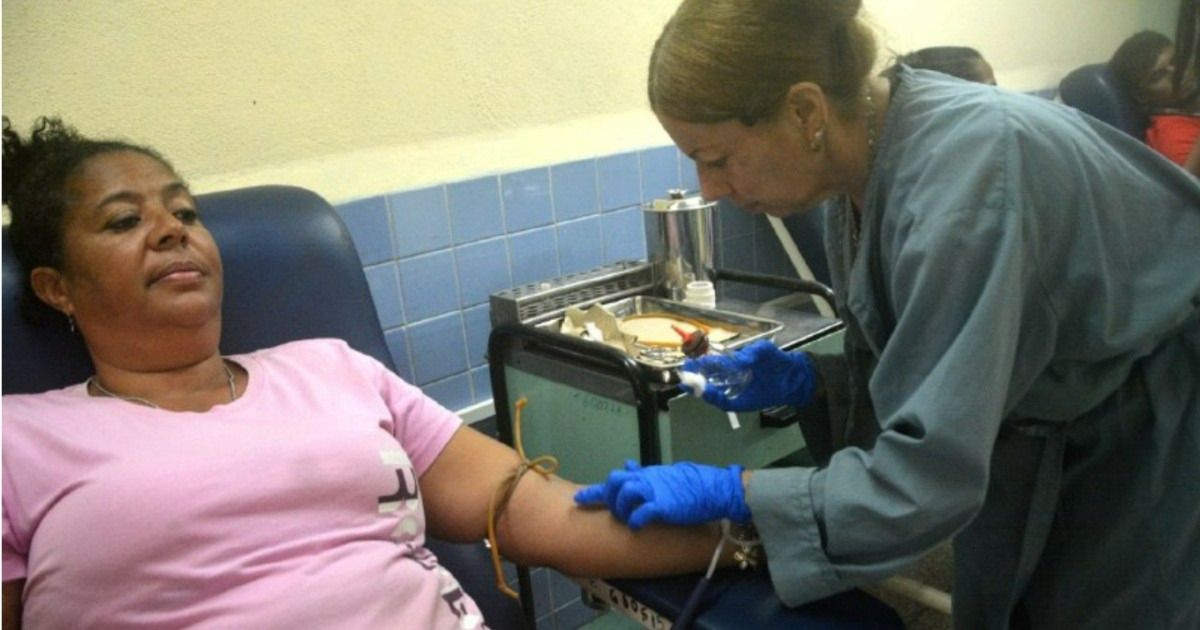
The Provincial Blood Bank in Villa Clara addressed on Sunday the circulating rumors of a blood shortage on Cuban social media, asserting that the province has a secured supply for emergency services. This statement, released by the state-run ACN agency, implicitly recognizes the very issue it seeks to dismiss.
Dr. Idamis Fernández Jure, the director of the entity, emphasized that "despite the emergence of donor requests on social media, the province effectively manages the blood demand to provide immediate assistance to those requiring emergency services."
According to the official statement, the bank conducts daily monitoring of blood inventories across all hospitals in the area to ensure availability and check the expiration dates of blood components. "We verify whether the blood within health institutions has expired, as its shelf life poses a significant risk to patients if not identified," Fernández Jure highlighted.
María Elena Infante Pacho, the deputy director, noted that the province has blood collection centers in each of its 13 municipalities, eliminating the need for donors to travel to Santa Clara.
When a patient's family is unable to donate, the bank utilizes community mechanisms: the Committees for the Defense of the Revolution, family doctors, or workplaces are used to mobilize donors.
The institution also produces plasma for medications such as albumin and immunoglobulins and has assisted other provinces in emergencies, like after the Saratoga hotel explosion and the Matanzas Supertanker Base fire in 2022.
This official statement contrasts with a nationally documented trend. Voluntary blood donations in Cuba dropped by 29% between 2020 and 2023, decreasing from 357,665 to 254,845 annually, according to the National Office of Statistics and Information. The mass exodus of young people—the primary donor group—has been identified as a key factor.
In provinces such as Sancti Spíritus, the situation reached critical levels: by April 2025, the provincial bank recorded zero voluntary donations, and transfusions at the Camilo Cienfuegos Provincial General Hospital relied entirely on blood from relatives. That same year, an informal blood market emerged on social media, with offers reaching up to 6,000 pesos for a donation of O-negative blood.
The social media pleas mentioned by the Villa Clara director have very real faces. In July, Ramona Gutiérrez Pita’s family in Ciego de Ávila had to resort to Facebook to find three A+ blood donors for the 80-year-old woman with a hip fracture. "She fell, fractured her hip, and is too weak to be operated on without A+ blood donations," wrote Guillermo Rodríguez Sánchez, a family member, on Facebook.
This contradiction is deepened by another: in April 2025, the regime officially acknowledged that BioCubaFarma would export blood plasma to the international market through AICA Laboratories, having signed an agreement with Brazil, while Cuban donors receive only a snack and a drink as compensation.
According to the Pan American Health Organization, Cuba recorded 23 donations per 1,000 inhabitants in 2023, compared to 31 in 2020.
Key Questions about Blood Supply in Cuba
What is the current state of blood donations in Cuba?
Blood donations in Cuba have significantly decreased, with a 29% drop in voluntary donations between 2020 and 2023.
How is Villa Clara addressing blood supply challenges?
Villa Clara has implemented daily monitoring of blood inventories and utilizes community mechanisms to mobilize donors when families cannot contribute.
What role do social media platforms play in blood donation in Cuba?
Social media has become a tool for families to seek donors when the official system falls short, highlighting the gap in the current supply.