Miguel Díaz-Canel, the Cuban leader, concluded the 24th International Meeting of Communist and Workers' Parties on Saturday at Havana's Convention Palace. In his address, he advocated for ongoing economic reforms, asserting that both state-run and private enterprises must aim for a singular objective: creating the "prosperous and sustainable socialism deserved by the heroic Cuban people."
The speech came just days before the 100th anniversary of Fidel Castro's birth on August 13, around which the Cuban regime has organized numerous commemorative events.
Addressing the economic reforms, Díaz-Canel emphasized to the communist and workers' party representatives that these measures do not signify a shift away from the socialist model. "This is a process to invigorate the economy, not to establish capitalism. There will be no indiscriminate privatization; the key means of production will remain in the hands of the people, preserving national sovereignty and independence," he stated.
A significant portion of his speech blamed the U.S. embargo and what he termed an "energy blockade" for the island's current crisis.
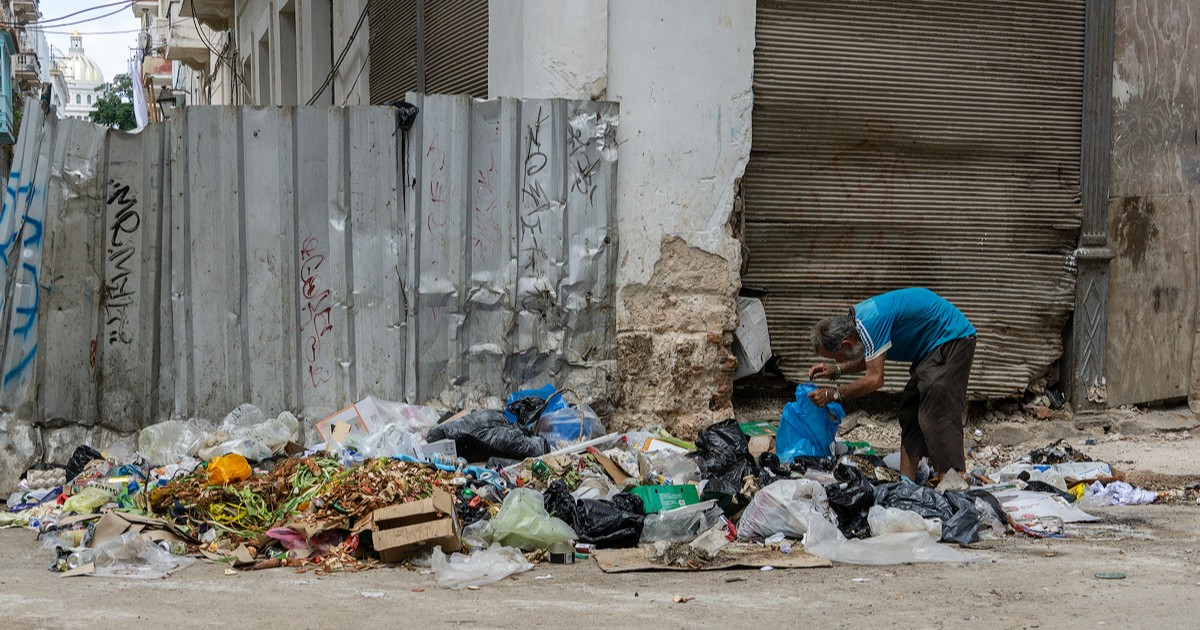
Díaz-Canel spoke of a "humanitarian toll of alarming proportions" and provided extensive statistics on the deterioration of essential services like healthcare and energy, yet he accepted no responsibility himself.
According to the figures he presented—attributed to the impact of U.S. sanctions—98,500 patients are awaiting surgery, including 12,000 children. He also claimed that 34,000 pregnant women lack sufficient prenatal ultrasounds, 67,000 infants are not up-to-date with immunizations, and 117,000 adults and 1,200 children with cancer are without adequate treatments, forced to rely on secondary or tertiary alternatives.
These figures starkly illustrate the collapse and failure of the Cuban socialist model.
In the energy sector, Díaz-Canel noted that over 1,400 megawatts of power, vital for distributed generation, are offline due to shortages of diesel and fuel oil.
He calculated that if this capacity were available daily, blackouts could be reduced to about three hours instead of the "twenty or more hours" currently affecting parts of the population. The National Electroenergetic System had experienced its seventh total collapse of 2026 just before the meeting's conclusion.
The leader also acknowledged the severe decline in several health indicators. He mentioned that the infant mortality rate, which had been between four and five deaths per thousand live births for years, has more than doubled to over 9.8 per thousand.
He added that only 30% of essential medications are available, and the technical availability of ambulances is just 22%. "The healthcare transport system is in a state of collapse," he admitted.
These statistics serve as an official acknowledgment of the extent of deterioration in essential services, though Díaz-Canel primarily attributed it to Washington's policies.
However, Díaz-Canel himself admitted in June that certain issues are not externally driven or due to the embargo: "There are obstacles that do not originate from outside or from blockades. There is slowness, bureaucracy, regulations that hinder those who want to produce, and decisions that we've postponed."
On the political front, Díaz-Canel referenced recent comments by U.S. Secretary of State Marco Rubio, who told Axios that Washington aims to show the Cuban regime that "there are no escape valves" against its pressure strategy.
He also noted reports from U.S. media about increased intelligence activities around Cuba. Recent revelations indicate the creation of a CIA team specifically focused on Cuba and an increase in U.S. intelligence-gathering resources concerning the island.
Díaz-Canel also highlighted international support for Cuba through a vote held on July 7 at the United Nations General Assembly. Specifically, 136 countries voted in favor of the Cuban proposal to hold an additional debate on the embargo, while nine voted against it and 30 abstained. The vote was not on a new resolution to demand the lifting of the embargo but rather on holding this exceptional debate.
The economic changes mentioned by Díaz-Canel are part of an emergency agenda introduced in June. Announced measures include eliminating general price caps, opening up to direct foreign investment in the private sector—including small and medium-sized enterprises—removing mandatory intermediation in foreign trade, and allowing private and foreign financial institutions to operate.
The regime insists on framing this package as a transformation within socialism rather than a shift towards a capitalist economy.
During the extraordinary session of the National Assembly held in June, Díaz-Canel also admitted that for decades, Cuban economic and social policies were sustained by resources from the former socialist bloc and subsequently from "friendly countries."
"Life showed us, and we learned, that this was not sustainable," he acknowledged, before pointing out that the challenge is to continue building socialism without that external dependency.
The renewed call to construct a "prosperous and sustainable socialism" comes amid severe economic contraction. The Economic Commission for Latin America and the Caribbean (ECLAC) projects a 6.5% decline in Cuba's GDP in 2026, following an estimated 3.8% contraction in 2025, according to its economic outlook update published in April.
Key Questions About Cuba's Economic and Political Challenges
What are the recent economic reforms in Cuba?
Recent reforms include the removal of general price caps, opening the private sector to foreign investment, eliminating mandatory intermediaries in foreign trade, and allowing private and foreign financial institutions to operate.
How does Díaz-Canel justify the current economic crisis in Cuba?
Díaz-Canel attributes the crisis mainly to the U.S. embargo and an "energy blockade," though he acknowledges that some issues stem from internal inefficiencies and bureaucracy.
What are the healthcare challenges currently faced by Cuba?
Cuba faces a significant shortage of essential medications and inadequate healthcare services, with only 30% of essential medications available and a severely under-resourced ambulance system.
What international support does Cuba have regarding the U.S. embargo?
In a recent United Nations General Assembly vote, 136 countries supported Cuba's proposal for an additional debate on the embargo, highlighting some level of international backing against the U.S. policy.