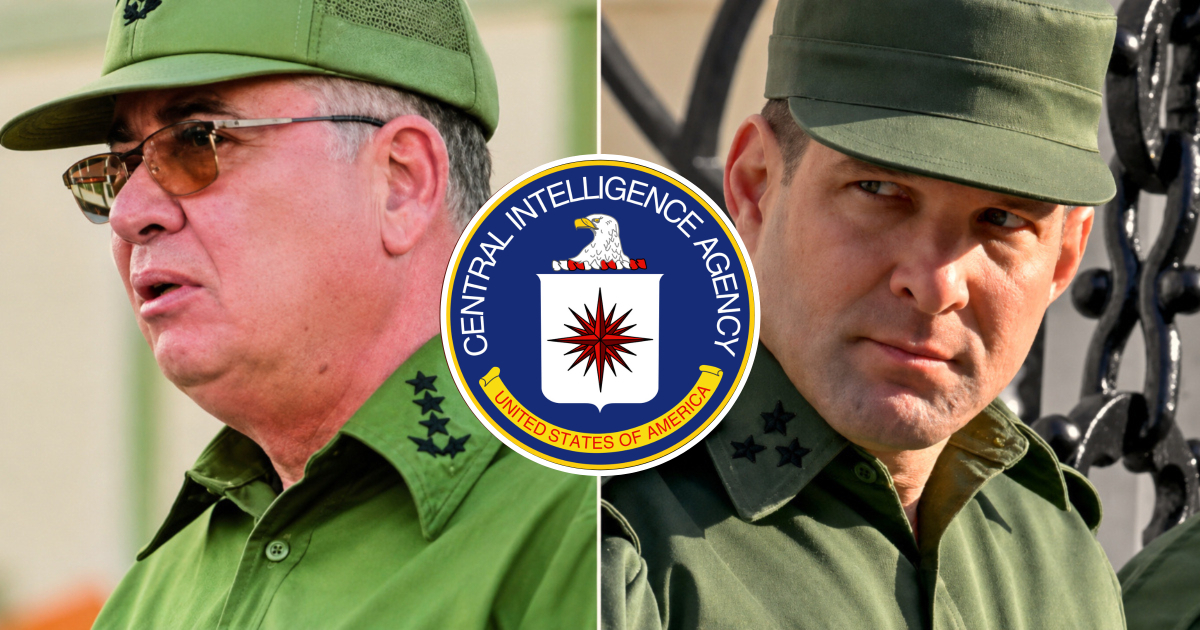
The recent disclosure by The New York Times suggesting that Raúl Guillermo Rodríguez Castro, known as "El Cangrejo," and the Interior Minister, Lázaro Alberto Álvarez Casas, may be acceptable to U.S. officials in a potential Cuban transition, presents an intriguing contradiction.
Both figures, based on their public records, do not fit the typical profile of leaders expected to usher in democratic reforms. "El Cangrejo," a grandson of Raúl Castro, has served as his bodyguard and remains deeply entwined with Cuba's political, military, and economic elite.
Álvarez Casas is an even more puzzling case, as he heads the MININT, overseeing the State Security, the National Revolutionary Police, and large parts of the repressive apparatus.
Cuban-American journalist Nora Gámez Torres, from the Miami Herald, publicly expressed her astonishment at the Times' report. She highlighted Washington's past denunciations of Cuban intelligence activities and the sanctions against Álvarez Casas for human rights abuses, asking, "Is he also an acceptable counterpart?" Her speculation suggests the possibility of a strategy to sow distrust.
In January 2021, Álvarez Casas and MININT were sanctioned by the U.S. under Executive Order 13818, linked to the Global Magnitsky Act, for severe human rights abuses, including harassment and surveillance of journalists, dissidents, and activists, notably from the San Isidro Movement.
The repression of the July 11, 2021 protests, involving MININT's subordinate National Revolutionary Police and the Black Berets special forces, led to further U.S. sanctions on these entities and several officials.
In July 2025, Marco Rubio highlighted on social media the ongoing U.S. visa restrictions on Cuban regime leaders, including Díaz-Canel, López Miera, and Álvarez Casas, due to their roles in the regime's brutality against its people.
Thus, envisioning the head of such an apparatus as a potential figure for democratic transition—one that would necessitate political freedoms and the release of political prisoners—is indeed striking.
Potential U.S. Strategy: Seeking a "Cuban Delcy Rodríguez"
The Times suggests that the Trump administration might be looking for a "Cuban Delcy Rodríguez"—a figure from within the regime with enough clout to ensure state functionality while being open to collaboration with Washington.
From this viewpoint, both Álvarez Casas and "El Cangrejo" have notable assets: one oversees internal security, while the other has direct ties to Raúl Castro's family.
However, having the power to lead a transition doesn't necessarily mean a willingness to dismantle the very system that grants such power. Public evidence of either figure prioritizing Washington's demands over regime interests is lacking.
Recent High-Level Meetings and Their Implications
Adding to the intrigue, both Álvarez Casas and "El Cangrejo" met with CIA Director John Ratcliffe during his visit to Havana on May 14, as reported by Axios. Ratcliffe reportedly conveyed that Washington viewed them as formidable adversaries but also as potential future partners.
He warned that the regime was running out of time to implement the "fundamental changes" demanded by Trump, indicating that both figures at least have direct communication channels with Washington, though this doesn't confirm them as real candidates to lead Cuba.
Nora Gámez Torres' question becomes particularly pertinent here.
Internal Dynamics and the Role of the CIA
The New York Times also disclosed that the CIA has established a special unit for Cuba, aiming to create rifts within the political elite, displace hostile factions, and promote more pragmatic figures. This unit includes experts in source recruitment, cyber operations, and covert influence operations.
In this setting, the public portrayal of one of the most powerful men in MININT and Raúl Castro's grandson as potential U.S. interlocutors could impact a political structure where loyalty is paramount.
While this doesn't prove the Times' information to be an influence operation, it could certainly be true. Yet, circulating specific names to fuel suspicions within the leadership aligns with exploiting internal divisions.
Furthermore, caution is warranted regarding leaks about U.S. strategy toward Cuba. Marco Rubio recently refuted another Times report based on sources claiming insight into U.S.-Cuba talks. He clarified that those speaking to the press were not part of the process and lacked real knowledge of events.
The White House backed this, emphasizing that Trump and Rubio were the ones fully aware of the strategy details.
This instance doesn't prove the new revelations false, but it highlights the gap between what anonymous officials tell the press and the White House's actual decisions.
Washington may indeed be seeking a "Cuban Delcy" and requires powerful regime interlocutors. However, viewing an interlocutor as useful doesn't equate to selecting them as a future leader.
And if the CIA's parallel objective is to create fractures within the leadership, merely speculating that Álvarez Casas or "El Cangrejo" could be among those Washington is willing to engage with already holds significant political value.
Perhaps this is a key to understanding such a startling revelation.
FAQs on U.S. Strategy Towards Cuba's Leadership
Why are Álvarez Casas and "El Cangrejo" considered by the U.S.?
They are seen as having significant influence within Cuba's current regime, making them potential partners for ensuring stability during a transition.
What role does the CIA play in this scenario?
The CIA has reportedly established a unit to foster divisions within Cuba's elite, aiming to promote more pragmatic figures that may align with U.S. interests.
What are the implications of their potential involvement with the U.S.?
Their involvement could lead to significant political shifts within Cuba, challenging existing power structures and potentially fostering reforms.