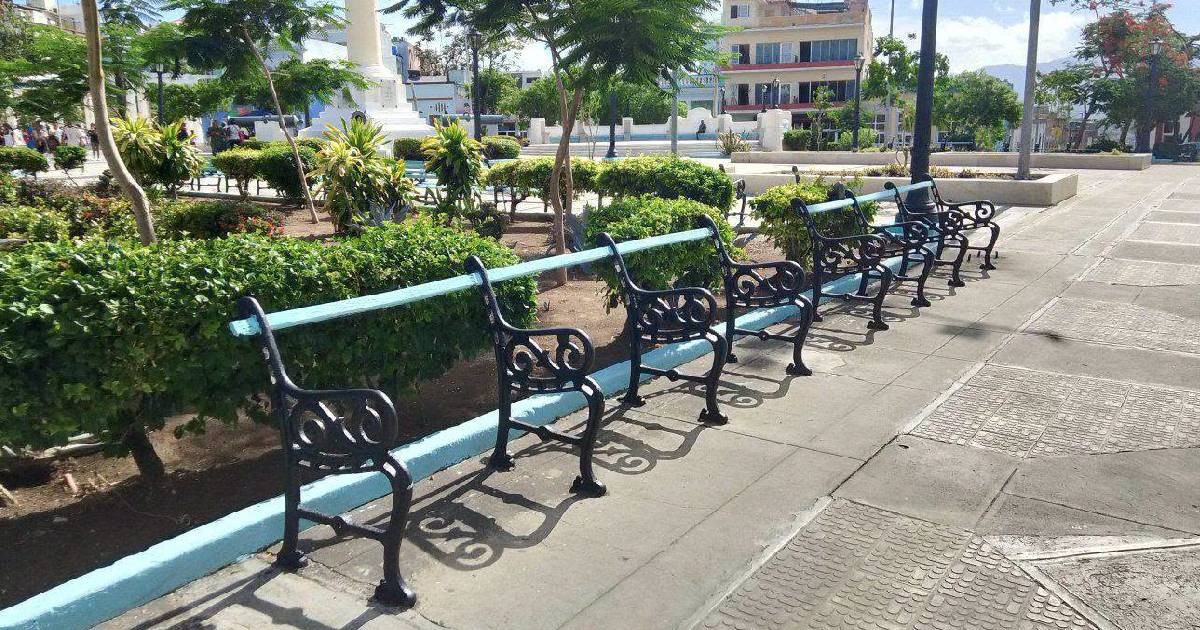
Wooden planks from the benches in Santiago de Cuba's renowned Plaza de Marte have reportedly been stripped away, presumably to be used as firewood. This unsettling revelation comes from images shared by the official newspaper Sierra Maestra on its Facebook page this August.
The most striking aspect of this incident is the source of the report: the official Communist Party organ in the province. Their post, titled "Wooden Planks for Firewood," prompted followers to ponder whether this was a case of "social indiscipline or negligence."
Images reveal the benches with their ornate black wrought-iron frameworks intact, yet the turquoise-painted seating and backrest planks are either completely missing or have been damaged beyond repair.
The plaza underwent a restoration in 2018, which included the refurbishment of urban furniture. By December 2023, the pro-government Granma reported additional conservation efforts encompassing material replacement, electrical system repairs, and upgrades to street lamps and lighting fixtures.
Only two years later, in December 2025, the same source highlighted a "revitalization" of the area as part of a project aimed at beautifying Santiago's historic center.
This decay occurs amidst an ongoing energy crisis, forcing many Cubans to resort to firewood as an alternative due to power outages that last over 20 hours a day in some provinces.
Santiago de Cuba has been one of the hardest-hit areas. In March and July of 2026, the city witnessed protests and pot-banging demonstrations in response to the power cuts. The provincial Communist Party headquarters, located in Plaza de Marte, was even militarized to prevent the spread of unrest.
The destruction of public furniture isn't confined to Santiago. In July 2026, destroyed benches and dilapidated pools in Havana's public spaces highlighted the same issue with no official acknowledgment or response.
Just this past Saturday, a historic bridge in Matanzas reported the theft of a section of metal railings. In 2022, over 40 benches and trash bins were stolen from a park in Matanzas as well.
Over the past two years, there have also been documented thefts of telecommunications towers, solar panels, and steel bars from public infrastructure across the island. Experts and activists describe this as a survival mechanism in response to the state's collapse.
Plaza de Marte is home to a 20-meter monument tower dedicated to the Liberation Army, along with busts of José Martí, Montes de Oca, and Camilo Cienfuegos. It remains one of the city's most revered sites.
The fact that a state-run outlet is documenting its decline—without offering solutions or announcing actions—captures the paradox of a regime that renovates its facades while the crisis it has created takes them apart.
Understanding the Crisis in Santiago de Cuba
Why were the wooden planks removed from the benches in Plaza de Marte?
The wooden planks were likely removed to be used as firewood, driven by the severe energy crisis in Cuba that has left residents searching for alternative fuel sources.
How has Santiago de Cuba been affected by the energy crisis?
Santiago de Cuba has experienced significant hardships due to the energy crisis, including power outages lasting over 20 hours daily. This situation has sparked protests and public unrest in the area.
What measures have been taken to address public space deterioration in Cuba?
While there have been restoration projects in the past, recent incidents of vandalism and theft in public spaces across Cuba have not been met with official responses or solutions, highlighting the ongoing challenges facing the country.