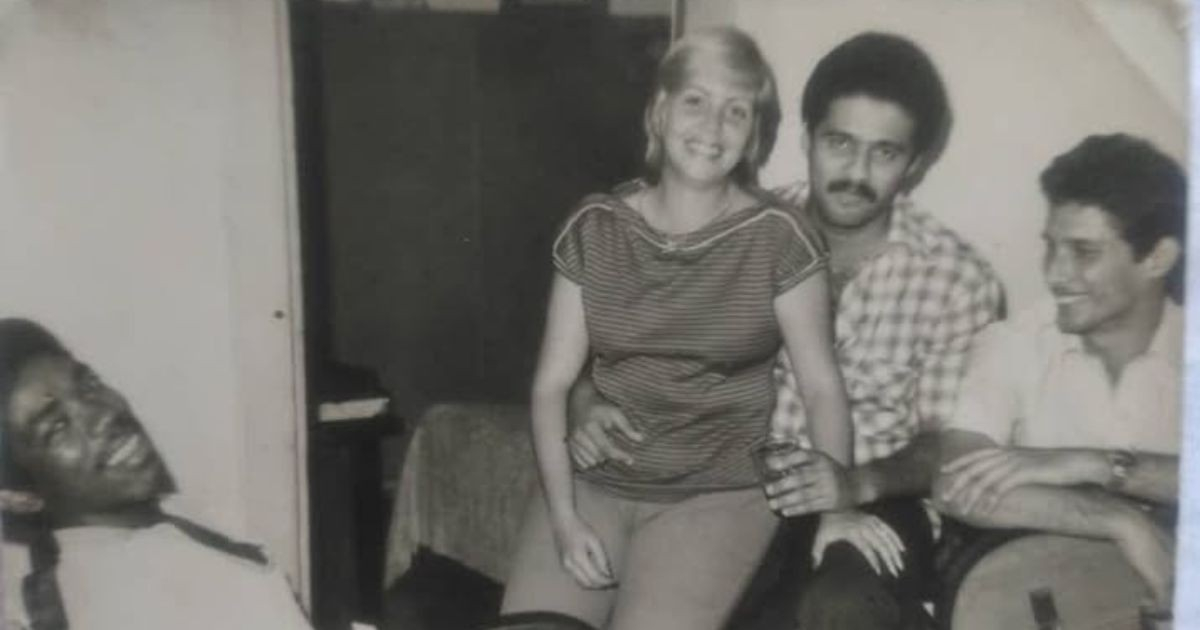
Violeta Pérez, a Cuban woman, recently shared a compelling personal account on Facebook, directed at Miguel Díaz-Canel. She paints a vivid picture of a humble young man she once knew in Santa Clara transforming into the leader she accuses of driving Cuba into poverty.
Her narrative, crafted with the intimacy of addressing a long-lost friend, spans decades, detailing moments from their college days at the Central University "Marta Abreu" of Las Villas (UCLV) to governmental decisions that, in her view, shattered the dreams of millions on the island.
"What a shame, Díaz-Canel... instead of fostering progress, you came with the slogan of continuity, which we soon realized was a regression to the darkest days of Fidelism," Pérez asserts in one of her most striking remarks.
Pérez recalls a younger Díaz-Canel, admired for his modesty, who biked around as the provincial secretary of the Communist Party of Cuba (PCC) in Villa Clara, conducting early morning inspections. "The people loved you," she directly addresses him.
The Shift from Hope to Disillusionment
The stark contrast between past and present forms the backbone of Pérez's account. She describes the 2012-2018 era under Raúl Castro as a period of relative openness—private enterprise, property sales, internet access, and travel—which led to hopes that Díaz-Canel would further these changes upon becoming president in 2018.
Instead, the opposite occurred. That same year, the government began restricting self-employed workers, allowing only one license per person. Pérez disdainfully cites a phrase from the then Minister of Labor and Social Security: "The self-employed are meant to resolve unemployment issues; they must work with their hands. Cuba is not ready for wealth."
The Economic and Political Collapse
Meanwhile, Pérez points out, Luis Alberto Rodríguez López-Calleja, Raúl Castro's son-in-law, controlled over 70% of Cuba's economy through the military-run conglomerate GAESA, which barred self-employed workers from its facilities.
The breaking point came with the "Ordering Task" on January 1, 2021, which eliminated the convertible peso and triggered historic triple-digit inflation, with prices skyrocketing five to 13 times. "Your ordering task was the stupidest move you could make, and the outcome was predictable," Pérez bluntly states.
Subsequent protests on July 11, 2021, spanning over forty cities, were met with violent repression, resulting in numerous arrests. Independent organizations report over 300 political prisoners remain detained from that date.
The Call for Freedom and Change
Pérez intensely describes Cuba's deterioration, confronting her former friend: "It's too late, Díaz-Canel! People no longer want reforms or dialogue or patches; they want freedom. And as things worsen, they will come for you—tomorrow, next month, or in December... because, for the first time, emigrants are united against misgovernment, and you are isolated internationally."
"You could have been the leader who opened Cuba, unleashed its productive forces, and made the country great... but you chose to revert to Fidelism," she concludes, noting the personal toll: "From friends, we've become enemies because I've lost loved ones and seen many tears because of you... and I never turn the other cheek."
The post sparked numerous reactions, with users sharing their own memories of a younger Díaz-Canel. "Power reveals true character. That's where the transformation lies," one commented. Another noted, "Between the lines, you read a heart betrayed by the life expectations any Cuban had since their youth."
Another commenter highlighted the disdain and mockery aimed at the president, stating, "Between the 'lemon base and the utopian walk,' he's the king of memes." A further remark concluded, "His legacy is that of one of the world's worst presidents."
This testimony emerges amid a backdrop of unprecedented disapproval of the president: an April 2026 national survey rated him 1.11 out of 5, with 93.7% of participants giving him the lowest possible score.
Understanding Cuba's Political Climate
What is the "Ordering Task" in Cuba?
The "Ordering Task" was a set of economic reforms implemented in Cuba on January 1, 2021, which included removing the convertible peso and resulted in significant inflation, with prices increasing dramatically.
How did Cubans react to the government's policies under Díaz-Canel?
Cubans have expressed significant discontent with the policies of Díaz-Canel's government, culminating in widespread protests on July 11, 2021, and ongoing dissatisfaction with economic and political conditions.
What were the main criticisms Violeta Pérez had of Díaz-Canel?
Violeta Pérez criticized Díaz-Canel for failing to continue the liberalization initiated by Raúl Castro, reverting to Fidelist policies, and contributing to Cuba's economic and political decline.