The recent hike in the cost of manufactured gas, commonly referred to as "street gas," has sparked criticism among Havana residents. This change, implemented this month, has been met with discontent as users grapple with increased expenses and the challenges of accurately measuring consumption.
Cupet, the state-run Enterprise of Manufactured Gas, announced on Facebook that the billing for August would reflect the new rates, to be collected in September. Customers are advised to review their accounts and ensure their payments are up to date.
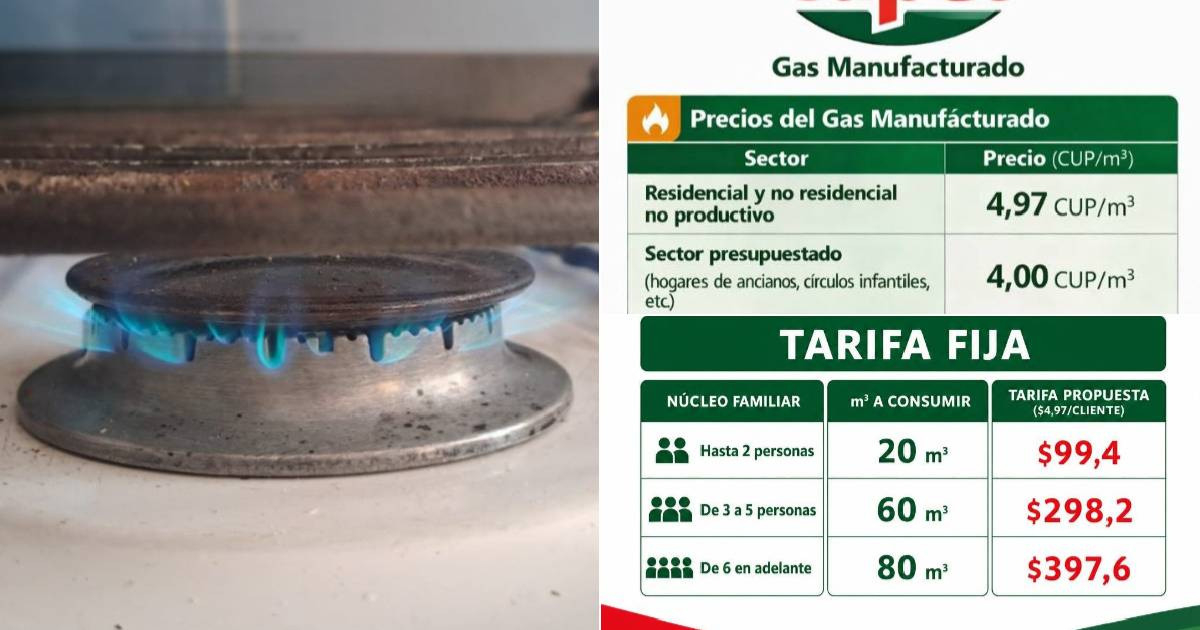
The price per cubic meter has nearly doubled, rising from 2.50 Cuban pesos (CUP) since January 2021 to 4.97 CUP. This adjustment, dictated by the Ministry of Finance and Prices' Resolution 156/2026, impacts over 280,000 residential customers in the capital.
New pricing tiers are now in effect based on household size. For homes with up to two residents, the charge is 99.40 CUP for 20 cubic meters. Households with three to five people will pay 298.20 CUP for 60 cubic meters, while those with six or more members face a fee of 397.60 CUP for 80 cubic meters.
The official announcement has not been well received. One user criticized the timing of the increase, citing the current economic struggle where wages fall short and even basic food items are scarce.
Another resident expressed frustration, claiming the service may be cut due to inaccurate billing. She reported that her latest bill reflected higher consumption than her meter indicated, demanding that meter readings be verified before payments are enforced.
This surge in manufactured gas prices coincides with a rise in liquefied gas costs. The price for a 10-kilogram tank has jumped to 350 CUP under Resolution 155/2026, a 55% increase from the previous 225 CUP since March 2024.
The availability of liquefied gas has deteriorated as well. Last April, 834,000 out of the 1.7 million customers nationwide were unable to purchase the product through state distributions.
In response to a halt in Venezuelan shipments, the government ceased distributions in Santiago de Cuba and other eastern provinces indefinitely starting January.
This scarcity has driven consumers to the informal market. In Sancti Spíritus, tanks have been resold for as much as 70,000 pesos, while online platforms have listed them for prices ranging from 24 to 29 USD.
The rising cost of gas adds to the ongoing food crisis, making even basic cooking alternatives more expensive.
A study by Cuban economist Javier Pérez Capdevila, published on May 10 in Columbia University's Horizonte Cubano, suggests that an individual in Cuba requires at least 96,060 CUP monthly to meet basic needs—a figure that is at least 14 times the island's average salary.
Charcoal, increasingly used as a cooking fuel alternative, can cost between 3,200 and 5,000 pesos per sack, compared to the official average salary of 6,930 pesos.
"The rise in gas prices adds another link to a chain of costs that makes it increasingly difficult to put a hot meal on the table," warned the Food Monitor Program.
Understanding the Impact of Rising Gas Prices in Cuba
Why have gas prices increased in Havana?
The increase in gas prices in Havana is due to a new tariff set by the Ministry of Finance and Prices, reflecting a significant rise in the cost per cubic meter of manufactured gas.
How are Cuban households affected by the gas price hike?
Cuban households are facing higher bills, with charges adjusted based on household size. This is compounded by economic hardships, making it difficult for families to afford basic utilities.
What alternatives are available for Cuban citizens struggling with gas shortages?
Many Cubans have turned to the informal market or alternative fuels like charcoal, despite its high cost, to cope with the shortage and high prices of both manufactured and liquefied gas.