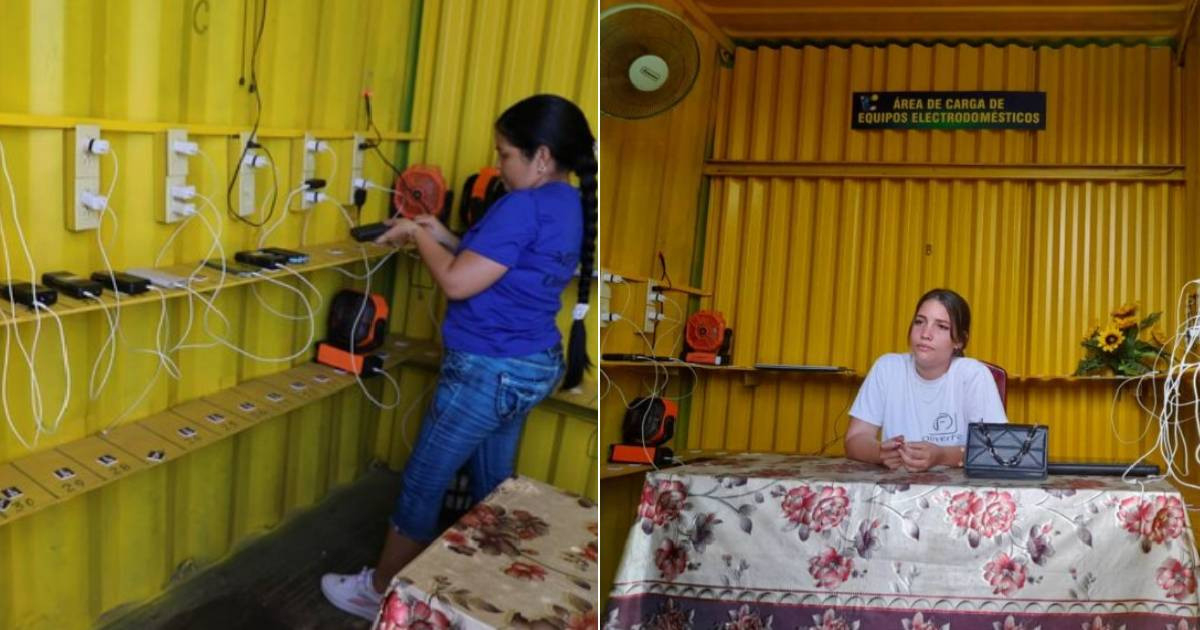
In response to the ongoing collapse of the National Electric System that has left residents without power for extended periods, the municipality of Guantánamo is setting up over 15 community charging and service stations across eight of the 10 Popular Councils in the provincial capital.
This initiative, outlined on Thursday by Yanney Cordero Martínez, vice president of the provincial Administration Council, was detailed on Radio Guantánamo. Cordero explained that each station would feature a power capacity of 30 kW and battery storage of 60 kW, operating continuously around the clock.
Beyond Simple Charging Points
These centers are not just charging hubs; they aim to fulfill essential needs that have become unattainable at home due to frequent blackouts.
"Designed with a power of 30 kW and a battery capacity of 60 kW, these charging and service stations will be equipped with rice cookers and pressure cookers for beans, allowing people to cook rice and beans and enjoy a pleasant time at the facility," Cordero elaborated.
Residents can also charge phones, tablets, electric bicycles, and scooters, and watch television while they wait. The stations will be illuminated by solar lamps, lighting up the surrounding area, including nearby streets, according to the source.
Uncertain Service Costs
The cost for using these services is still under consideration. The official mentioned, "The pricing is being evaluated to ensure it remains affordable for the people of Guantánamo."
Jointly executed by state companies and private microenterprises, the total investment is around 25 million pesos. The municipality of Imías has already opened the first of these facilities outside the provincial capital, with plans to gradually expand the model to other provincial municipalities.
A Reflection of Deepening Crisis
The significant investment highlights the severity of the crisis. Guantánamo relies on a single 110-kilovolt line from Santiago de Cuba for its connection to the national grid, making it one of the most vulnerable provinces in the nation.
In June, a fault in this line plunged the entire province into darkness, affecting eight transformers with no available replacements, leading to outages lasting up to 33 hours.
The dire situation prompted the provincial Communist Party leadership in July to urge a reduction in public complaints, which had exceeded 150 daily. Additionally, the government set up over 60 public audiovisual centers in public squares to allow people to watch television during blackouts.
The Rise of "Solineras"
The concept of solar charging stations, colloquially known as "solineras," has spread across the island as the regime struggles to address the underlying issues. The inaugural solinera in Holguín, "El Girasol," opened in June, stirred controversy with hourly rates ranging from 50 to 500 pesos, while provinces like Matanzas plan to establish nine collective solar charging points.
The National Electric System has suffered at least seven total collapses this year alone.
Understanding Guantánamo's Energy Initiative
What is the purpose of the community stations in Guantánamo?
The community stations are designed to provide essential services like cooking and charging electronic devices during power outages.
How are these stations powered?
Each station is equipped with 30 kW of power and 60 kW of battery storage, operating continuously with solar lamps for lighting.
What is the cost of using these services?
The pricing for these services is still being determined but is expected to be affordable for the local population.